
This article's table of contents introduction:
- Why a Centrifugal Fan for High Pressure & Dust?
- Key Features of a High-Pressure Dust Extraction Fan
- "Higher Gas Pressure" vs. "High Volume"
- Common Applications for This Specific Fan Type
- Critical Sizing & Selection Questions
- Summary Table: High-Pressure Dust Fan vs. Standard HVAC Fan
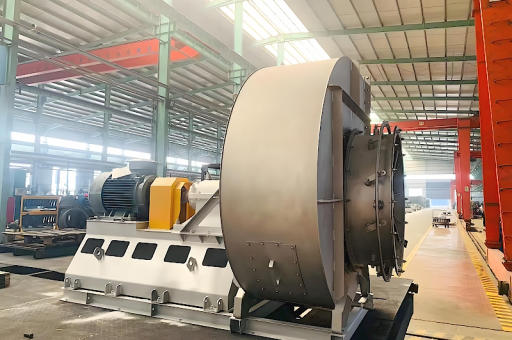
It sounds like you are describing a high-pressure centrifugal fan specifically designed for dust extraction (also known as a material handling fan or industrial exhaust fan).
Here is a breakdown of what that typically means, the key engineering considerations, and why a "large centrifugal blower" is the correct choice for generating "higher gas pressure" in a dusty environment.
Why a Centrifugal Fan for High Pressure & Dust?
- Centrifugal vs. Axial: Axial fans (like a desk fan) move large volumes of air at low pressure. Centrifugal fans (squirrel cage design) draw air into the center and throw it outward at 90 degrees. This design inherently generates higher static pressure, which is necessary to overcome the resistance of ductwork, filters, and cyclones in a dust system.
- Material Handling (Dust): Standard fans with backward-curved blades are efficient but can clog. For dust extraction, you need a fan that can handle particulate without the blades getting caked or damaged.
Key Features of a High-Pressure Dust Extraction Fan
For "higher gas pressure" and "dust," the fan will have specific design characteristics:
-
Impeller Design:
- Radial or Paddle Wheel Blades: These are flat or slightly forward-curved blades. They are the most robust for handling sticky, abrasive, or heavy dust. They generate the highest pressure but are slightly less efficient than airfoil blades.
- Heavy-Duty Construction: The impeller is typically made of thicker steel (or abrasion-resistant steel) to withstand particle impact.
- Open or Semi-Open Inlet: Prevents clogging at the eye of the impeller.
-
Housing:
- Scroll Design: The volute shape converts velocity pressure into static pressure.
- Abrasion Liners: High-end dust fans have replaceable wear plates on the "cutoff" (the tongue of the volute) and the backplate where erosion is worst.
- Shaft Seal: A simple labyrinth or lip seal prevents dust from traveling along the shaft into the motor bearings.
-
Performance Curve:
- A high-pressure centrifugal fan has a steep pressure curve.
- Pressure Range: For a "large" industrial unit, you are likely looking at Static Pressures from 20” w.g. (5 kPa) up to 60”+ w.g. (15 kPa+), depending on the system resistance.
"Higher Gas Pressure" vs. "High Volume"
There is a trade-off.
- High Volume, Low Pressure: A typical baghouse fan (airfoil blades).
- High Pressure, Moderate Volume: A Radial Blade Fan used for pneumatic conveying or dense phase dust extraction.
If you need really high pressure (e.g., for pushing dust through a long pipe or deep filter):
- You might need a Multistage Centrifugal Fan (two impellers in series).
- Or a Positive Displacement (PD) Blower (like a Roots blower) for pure pressure, but PD blowers cannot tolerate heavy dust unless a separator is placed upstream.
Common Applications for This Specific Fan Type
- Woodworking: Chip collection from saws, planers, and sanders.
- Mining / Aggregate: Dust control at crushers, screens, and conveyor transfer points.
- Welding Fume Extraction: High static pressure needed for small-diameter ducts and capture hoods.
- Cement / Chemical Plants: Conveying abrasive powders.
- Textile: Lint and fiber collection.
Critical Sizing & Selection Questions
If you are selecting or designing this fan, you must know:
- Airflow (CFM / m³/hr): How much air needs to be moved?
- Static Pressure (in.WG / Pa): What is the total resistance of the ductwork, hoods, cyclones, and filters?
- Dust Type: Is it fibrous (clogs), heavy (abrasive), explosive (requires explosion-proof motor + non-sparking impeller)?
- Temperature: Is the air hot (e.g., from a dryer) or ambient?
- Location: Indoor vs. outdoor? Corrosive environment?
Summary Table: High-Pressure Dust Fan vs. Standard HVAC Fan
| Feature | Standard HVAC Centrifugal Fan | High-Pressure Dust Extraction Fan |
|---|---|---|
| Primary Goal | Ventilation, Comfort | Material Conveying, Filtration |
| Blade Type | Backward Curved, Airfoil | Radial, Paddle Wheel, Backward Inclined (heavy) |
| Pressure Capability | 1” - 10” w.g. (250 - 2500 Pa) | 10” - 60”+ w.g. (2500 - 15000+ Pa) |
| Construction | Light gauge, galvanized | Heavy gauge steel, welded, liners |
| Dust Handling | Poor (blades clog) | Excellent (self-cleaning blade profile) |
| Motor | Standard TEFC | High HP, often with VFD, sometimes explosion-proof |
Final Recommendation: If you are building a system for "higher gas pressure" to move "dust," look for a Radial Paddle Wheel Fan from a manufacturer like Chicago Blower, New York Blower, Cincinnati Fan, or Aerovent. Ensure the motor is appropriately sized for the brake horsepower at the intended operating point (dust fans often have a "non-overloading" power curve design).





