
This article's table of contents introduction:
- Breakdown of the Specification
- Typical Applications
- Critical Design & Operational Considerations
- Summary Table of Key Factors
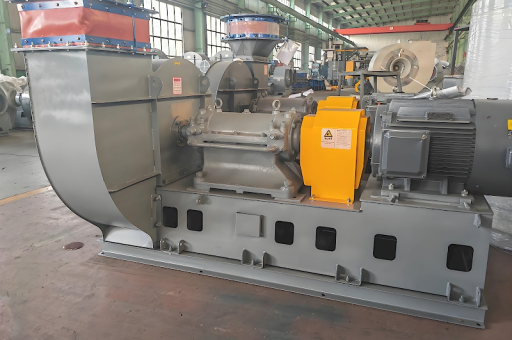
This is a technical specification for an industrial centrifugal fan designed for dust removal or material handling systems. Here is a breakdown of what each term means, typical applications, and key considerations for this type of equipment.
Breakdown of the Specification
- Dust Removal Air Blower: This indicates the fan is designed to handle air that contains particulate matter (dust, chips, fibers). It is not a standard HVAC fan. It typically requires a robust, wear-resistant design (e.g., thicker steel, possibly lined or with replaceable wear plates) to prevent erosion from abrasive particles.
- 125kW (approx. 168 HP): This is the motor power. This is a very high-power industrial fan. It will move a very large volume of air against significant static pressure. Expect a motor current draw of roughly 170-200 Amps at 400V AC.
- Direct Drive: The fan impeller is mounted directly on the motor shaft. There is no belt or coupling.
- Pros: Zero power loss from belt friction, lower maintenance (no belts to replace, no bearing alignment issues), more compact footprint, and better for high-speed operation.
- Cons: The fan speed is fixed to the motor speed (e.g., 1500 or 3000 RPM depending on motor poles). To change airflow, you must use a Variable Frequency Drive (VFD). Without a VFD, you have no speed control.
- Centrifugal Fan: The most common type of fan for high-pressure dust collection. Air enters axially (along the shaft) and is expelled radially (outward) via centrifugal force.
- Impeller Type: For dust removal, you will likely have a radial bladed (paddlewheel) or backward inclined impeller. Radial blades are ideal for sticky or heavy dusts as they are less likely to clog. Backward inclined are more efficient for cleaner applications but are more prone to clogging.
Typical Applications
A fan of this power (125kW) is used for central extraction systems in heavy industry:
- Woodworking: Large-scale MDF, particleboard, or sawmill extraction.
- Cement & Quarry: Conveying dust from crushing, grinding, and bagging operations.
- Metalworking: Fume extraction from plasma/laser cutting tables or grinding booths.
- Pharmaceutical / Food Processing: Pneumatic conveying of powders and pellets.
- Welding Fume: Central high-vacuum extraction for large factories.
Critical Design & Operational Considerations
If you are specifying, purchasing, or installing this fan, pay close attention to the following:
-
Drive Configuration (Direct Drive):
- A high-inertia starter (Soft Starter or VFD) is mandatory. A 125kW motor direct-on-line (DOL) start would cause a massive electrical inrush current (potentially up to 8x the FLA) and severe mechanical shock to the impeller, shaft, and bearings.
- Bearing Life: Direct drive puts full motor bearing load on a heavy impeller. Ensure the motor has heavy-duty (e.g., 6317 or larger) bearings designed for radial loads.
- Critical Speed: The shaft assembly (motor + impeller) must be dynamically balanced to G2.5 or better to avoid vibration at full speed.
-
Static Pressure & Air Volume:
- You need to know the operating point (e.g., 50,000 m³/hr @ 4,000 Pa). A 125kW fan is likely producing high pressure (>3000 Pa). Do not run this fan against a closed damper; the blockage will cause the motor to over-amp and trip, potentially damaging the shaft.
-
Dust Characteristics (Crucial):
- Is the dust explosive? (e.g., wood dust, aluminum powder, sugar). If yes: ATEX certification is required. The fan must have spark-resistant construction (aluminum or bronze impeller, steel casing) and a certified design to prevent ignition.
- Abrasiveness: (e.g., sand, glass fiber). Requires wear-resistant liners in the casing and a heavy-duty impeller (e.g., 10mm or thicker steel).
- Stickness: (e.g., resin, paint powder). Requires a purged impeller (holes in the backplate) or a radial blade design to prevent material buildup causing imbalance.
-
Mounting:
- A fan of this size needs a heavy steel baseplate or inertia base (concrete or steel frame). It must be isolated from the building structure using high-quality spring vibration isolators.
-
VFD (Variable Frequency Drive) Recommendation:
- For a dust removal application, a VFD is highly recommended. It allows:
- Soft starting (reducing electrical stress).
- Speed control to adjust airflow to demand (energy savings).
- Remote start/stop.
- Condition monitoring (running hours, current, torque).
- For a dust removal application, a VFD is highly recommended. It allows:
Summary Table of Key Factors
| Feature | Implication for 125kW Direct Drive Fan |
|---|---|
| Power | Very high operating cost (~€500-1000/month at 0.15€/kWh if running full time). |
| Speed Control | Requires VFD for DC motors or AC induction motor with VFD. Belt drive allows pulley change; direct drive requires VFD. |
| Startup | Must use Soft Starter or VFD. Never DOL start. |
| Maintenance | Lower than belt drive (no belts). But motor bearings are critical. |
| Dust Risk | High risk of impeller imbalance if dust sticks. |
Bottom Line: This is a heavy-duty, high-power fan for demanding industrial extraction. You must verify the static pressure and air volume requirements for your system (duct length, number of pickups) to ensure the fan's operating curve matches. Never run it without a VFD unless the system design guarantees constant pressure and volume.





