
This article's table of contents introduction:
- Parameter Breakdown
- Performance Estimate (at 1.2 kg/m³ air density)
- Applications in a Boiler System
- Key Design Considerations for this Spec
- Summary Table
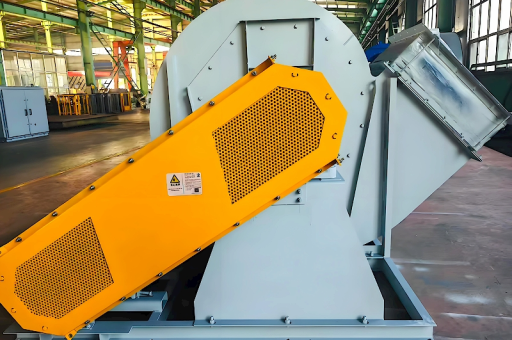
This appears to be a specification for a centrifugal fan used in a boiler application. Here is the breakdown of the parameters and what they likely mean, along with a technical assessment.
Parameter Breakdown
- 16156 m³/h : Airflow (Capacity) This is the volume of air the fan moves per hour. At 25°C, this is roughly 269 m³/min or 9,500 CFM (Cubic Feet per Minute).
- Backward PA: Blade Type
- Backward (Curved/Inclined) : This is the most efficient type of centrifugal fan blade. It is non-overloading, meaning the motor won't burn out if the ductwork is fully open.
- PA: This stands for Primary Air. This fan is supplying air to the coal mill (pulverizer) or directly to the boiler burners for the initial combustion air (to dry and transport coal in coal-fired power plants, or as combustion air in other boilers).
- Centrifugal: Fan Type Air enters axially (straight in) and exits radially (perpendicular to the inlet) due to centrifugal force generated by the impeller.
- 55 kW: Power Requirement
This is the power the motor must provide (motor shaft power) or the power consumed at the rated operating point.
- Expected Motor Size: Usually a 18.5 kW or 20 kW (25 HP) motor, depending on safety margins.
- Boiler Fan: Application Designed to handle high temperatures (often up to 150°C - 250°C for PA fans), slight to moderate dust loading, and vibration resistance necessary for boiler operation.
Performance Estimate (at 1.2 kg/m³ air density)
We can use the fan law to estimate the Static Pressure the fan is generating at that power.
Formula: $P = \frac{Q \times \Delta p}{\eta \times 3600}$
- $P$ = Power (18.55 kW)
- $Q$ = Flow (16156 m³/h)
- $\eta$ = Efficiency (Assume 75-82% for a good backward curved fan)
- $\Delta p$ = Pressure (Pascals)
Rearranged: $\Delta p = \frac{P \times \eta \times 3600}{Q}$
- If $\eta$ = 75%: $\Delta p \approx 3,104 \text{ Pa} \approx 310 \text{ mmWg}$ (mm Water Gauge)
- If $\eta$ = 80%: $\Delta p \approx 3,310 \text{ Pa} \approx 330 \text{ mmWg}$
Conclusion: This fan is likely rated for approximately 300 - 330 mmWg (3,000 - 3,300 Pa) static pressure.
Applications in a Boiler System
This specific fan is likely a Forward Curved or Backward Inclined design serving one of these roles:
- Primary Air Fan (Coal Boilers):
- Provides hot air to the coal mill to dry the coal.
- Transports the powdered coal from the mill to the burners.
- Must handle high temperatures (often from an Air Preheater [APH]).
- Overfire/Secondary Air Fan (Biomass/Coal):
Provides air for complete combustion above the fuel bed.
- Combustion Air Fan (Industrial Boilers):
General supply of air for burning gas, oil, or biomass.
Key Design Considerations for this Spec
- Motor: An 18.55 kW load suggests an IE3 (Premium Efficiency) or IE4 motor. Due to the Backward curve design, the motor is non-overloading, meaning the maximum power draw is at a specific point (peak power) and drops off if the system resistance decreases.
- Drive: Usually driven by a V-belt or a coupling.
- Belt: Allows for speed changes (RPM) to adjust flow.
- Direct Drive: More efficient, but requires a Variable Frequency Drive (VFD) to change speed.
- Inlet Box: A PA fan often has an Inlet Box (a 90-degree elbow) with or without Inlet Guide Vanes (IGVs) for flow control.
- Temp Rating: For a PA fan, the casings and bearings are specified for a higher temperature (often 150°C continuous, 200°C max).
Summary Table
| Parameter | Value | Unit | Notes |
|---|---|---|---|
| Flow Rate | 16,156 | m³/h | ~269 m³/min |
| Total Pressure | ~3,000 - 3,300 | Pa | Estimated (310-330 mmWg) |
| Power | 55 | kW | Shaft power at duty point |
| Blade Type | Backward Curved | - | High efficiency, Non-overloading |
| Application | Primary Air (PA) | - | For Boiler / Mill System |
In short: You have a Mid-Size, High-Efficiency Boiler Fan designed to move a moderate volume of air (16k m³/h) at a medium-high pressure (3kPa) using 18.55 kW of power.





