
This article's table of contents introduction:
- Why might the fan be "driving backward" for Oven Wall Cooling?
- Troubleshooting Steps for "Coupling Driving Backward" Issue
- Summary of your scenario:
It appears you are describing a specific configuration or troubleshooting scenario for an industrial centrifugal fan application. Let me break down the key components and terms you mentioned to provide a clear explanation.
Here is a technical interpretation of your query:
"Coupling Driving Backward" This likely refers to the arrangement of the motor and the fan impeller.
- Coupling: The mechanical component connecting the motor shaft to the fan shaft.
- Driving Backward: This could mean one of two things:
- Rotation Direction: The motor is spinning the fan in the "backward" or counter-clockwise (CCW) direction (when viewed from the motor end). In centrifugal fans, the impeller must rotate in the direction of the scroll housing design (wheel rotation direction) to move air efficiently. If the rotation is backwards, the fan will draw low current, produce very little airflow, or move air in the wrong direction.
- Inlet/Outlet Orientation: The fan housing is positioned so that air is discharged opposite to the standard forward-curved (Sirocco) blade design. "Backward inclined" or "backward curved" blades (like in a Q345 fan) are highly efficient and non-overloading.
"Q345 Industrial Centrifugal Fan"
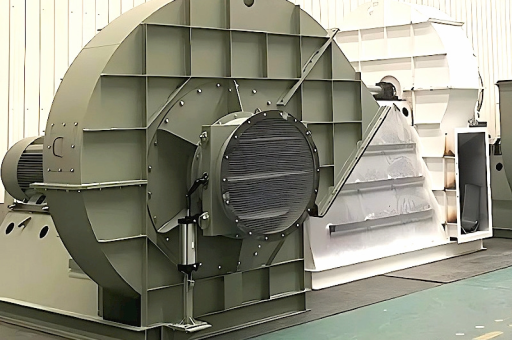
- Q345: A high-strength low-alloy steel (Chinese standard, similar to ASTM A572 Grade 50 or S355JR). It is used for high-temperature, high-stress, or abrasive environments (like oven walls). It resists warping and cracking under thermal stress.
- Industrial Centrifugal Fan: Used for moving large volumes of air against moderate to high pressure. The impeller likely has backward-curved airfoil blades (efficient for ovens).
"Oven Wall Cooling" This defines the application:
- Purpose: The fan is mounted on or near an oven wall to recirculate hot air, extract fumes, or cool the oven's exterior shell.
- Key Challenge: Thermal expansion. The fan shaft and housing must handle high heat without seizing.
Why might the fan be "driving backward" for Oven Wall Cooling?
If the fan is rotating in the wrong direction, it will pull cold air into the oven instead of exhausting hot air, or it will move very little air. This causes overheating of the oven walls or poor process efficiency.
Common Causes:
- Electrical Phase Reversal: A three-phase motor will run backwards if any two of the three supply wires (L1, L2, L3) are swapped. Fix: Swap any two phase wires.
- Coupling Misalignment: The motor and fan shaft are not aligned coaxially. This puts stress on the coupling, bearings, and can cause the fan to "fight" the rotation direction (especially if using a fluid coupling or belt drive that allows slip).
- Belt Drive Issue: If the fan is belt-driven, the belt might be installed incorrectly (figure-8 pattern causing reverse rotation), or the motor pulley is larger than the fan pulley (causing the fan to spin faster but in the wrong direction if belts are crossed).
Troubleshooting Steps for "Coupling Driving Backward" Issue
Step 1: Verify Rotation Direction
- Look at the fan housing for an arrow indicating the correct wheel rotation (CW or CCW).
- Jog the motor: Briefly start and stop the motor. Look at the impeller rotation through an access door or visible shaft end. Must match the arrow.
Step 2: Check the Coupling Type
- If Direct Drive (Flexible Coupling): Ensure the coupling halves are correctly aligned (parallel offset < 0.002", angular misalignment < 0.5°). A misaligned coupling can act like a brake.
- If Belt Drive: Ensure the belt is straight (not twisted). The tension should allow 1/2" deflection per foot of span.
Step 3: Test Electrical Phase
- On a 3-phase motor: Swap any two of the three power wires (L1 and L2, for example). This reverses the motor rotation. Be sure to verify current draw after change.
Step 4: Inspect for Mechanical Binding
- Thermal Expansion: If the oven is hot, the shaft may have expanded and is binding in the bearings or housing. Let the system cool down and check for free rotation by hand.
- Q345 Steel: This material is heavy and strong. If the impeller is warped from heat, it may rub against the inlet cone, forcing the coupling to drive backwards against resistance.
Summary of your scenario:
You have a heavy-duty (Q345) centrifugal fan on an oven wall. The coupling is likely trying to drive the impeller counter to its designed scroll direction, resulting in zero airflow or reverse airflow. This is causing the oven wall to overheat or fail to cool.
Recommended Action:
- Reverse the motor phase (most likely fix).
- Check the coupling alignment for thermal expansion gaps.
- Verify the fan rotation arrow matches the required oven cooling flow (e.g., pulling cold air from outside into the oven, or exhausting hot air out).
If you need assistance calculating the required CFM for cooling that oven wall, or selecting the correct coupling size (e.g., Lovejoy jaw-type or Grid coupling for high-torque Q345 fans), please provide the motor HP, RPM, and oven temperature.





