
This article's table of contents introduction:
- The Components Decoded
- Typical Applications
- Key Operational Characteristics (Performance Curve)
- A Practical Note: Maintenance & Installation
- Summary Table
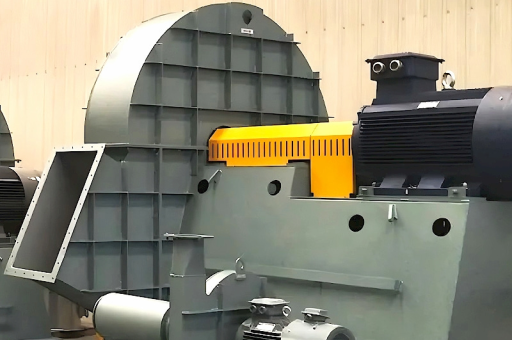
Based on the description "415V Alloy Steel V Belt Driven Backward Curved Centrifugal Flow Fan" , I can break down exactly what this equipment is, its typical applications, and its key characteristics.
This is highly specialized industrial equipment designed for moving large volumes of air against moderate to high resistance ("static pressure").
The Components Decoded
Let's dissect the name piece by piece:
- 415V: This is the standard three-phase industrial voltage in many countries (EU, Asia, Australia, UK). It indicates the fan requires a 3-phase power supply for its motor.
- Alloy Steel: This refers to the impeller (fan wheel) and likely the housing. Alloy steel (often containing Chromium, Molybdenum, or Manganese) provides:
- High Strength: Withstands high rotational speeds and stress.
- Wear Resistance: Handles particulate-laden air better than mild steel.
- Temperature Resistance: Suitable for moderately hot air (up to ~400-450°C depending on the specific alloy).
- V Belt Driven: The fan impeller is not directly connected to the motor shaft. Instead, a motor spins a small pulley, which drives a belt that spins a larger pulley on the fan shaft.
- Why use this? It allows you to change the fan speed easily by changing pulley sizes, which is crucial for tuning the airflow and pressure. It also protects the motor from shock loads.
- Backward Curved (BC) Centrifugal Fan: This is the most important performance characteristic.
- Design: The blades curve away from the direction of rotation.
- Efficiency: This is the most efficient centrifugal fan design (up to 85-90%).
- Performance: It has a non-overloading power curve. This means the motor won't burn out if the duct is suddenly blocked. The power draw peaks at its Best Efficiency Point (BEP) and drops.
- Noise: Generally quieter than forward curved or radial blade fans.
Typical Applications
Given the "Alloy Steel" and "Backward Curved" design, this fan is built for heavy-duty industrial processes where reliability and performance are critical.
- Industrial Ventilation: Factories, warehouses, and large workshops.
- Process Air Supply: Boilers, ovens, dryers, and furnaces (moving combustion air).
- Fume Exhaust: Handling air with light dust, smoke, fumes, or corrosive vapors (depending on the specific coating).
- Material Handling: Light dust, sawdust, paper trim, or granular material (if the fan is specifically rated for it).
- HVAC Systems: Large commercial or industrial HVAC systems where high static pressure is required.
Key Operational Characteristics (Performance Curve)
- High Pressure Capability: BC fans excel at moving air through long duct runs, HEPA filters, or against the resistance of a process (e.g., a burner).
- High Volume: They move a significant volume of air for their size.
- High Efficiency: Lower energy costs compared to other fan types (e.g., Forward Curved or Axial).
- Stable Operation: The backward curved design provides a very stable airflow even with changes in system resistance.
A Practical Note: Maintenance & Installation
- Vibration: This is a critical point for a V-belt driven fan. The fan wheel, shaft, bearings, and belt system must be precisely aligned and balanced. Vibration will destroy belts and bearings quickly.
- Belt Tension: Do not overtighten belts. This puts massive load on bearings and the shaft. Use a belt tension gauge.
- Safety: A V-belt drive is a "pinch point" hazard. The drive must be completely enclosed in a guard according to local safety regulations (e.g., OSHA, EU Machinery Directive).
- Motor Starter: A 415V (three-phase) motor of this type must be started with the correct motor starter (DOL, Star-Delta, VFD, or Soft Starter) to prevent large inrush currents.
Summary Table
| Feature | Meaning & Benefit |
|---|---|
| 415V | Requires 3-phase industrial power supply. High torque and power. |
| Alloy Steel | High strength, wear-resistant, temperature-tolerant. |
| V Belt Drive | Allows speed adjustment (pulley change), protects motor from shock. |
| Backward Curved | High efficiency (85-90%), non-overloading power curve, quiet, high pressure. |
| Centrifugal | Moves air by centrifugal force (as opposed to a propeller). |
In short: You have a high-efficiency, industrial-grade air-mover designed for demanding environments where you need to push a lot of air through a restrictive system.





