
This article's table of contents introduction:
- Introduction: The Backbone of Industrial Airflow
- What Is a V-Belt Driven High Temperature Material Handling Blower Centrifugal Fan?
- Key Components and How They Work Together
- Why V-Belt Drive Is Preferred for High-Temperature Applications
- Critical Design Considerations for Material Handling Fans
- Performance Characteristics: Flow, Pressure, and Temperature Tolerances
- Common Applications Across Industries
- Installation Best Practices for Longevity
- Maintenance and Troubleshooting Q&A
- Frequently Asked Questions (FAQ)
- Conclusion: Choosing the Right Fan for Your Operation
** Maximizing Industrial Efficiency: The Ultimate Guide to V-Belt Driven High Temperature Material Handling Blower Centrifugal Fan
Table of Contents
- Introduction: The Backbone of Industrial Airflow
- What Is a V-Belt Driven High Temperature Material Handling Blower Centrifugal Fan?
- Key Components and How They Work Together
- Why V-Belt Drive Is Preferred for High-Temperature Applications
- Critical Design Considerations for Material Handling Fans
- Performance Characteristics: Flow, Pressure, and Temperature Tolerances
- Common Applications Across Industries
- Installation Best Practices for Longevity
- Maintenance and Troubleshooting Q&A
- Frequently Asked Questions (FAQ)
- Conclusion: Choosing the Right Fan for Your Operation
Introduction: The Backbone of Industrial Airflow
In modern industrial environments, moving large volumes of hot, abrasive, or particulate-laden air is not just a task—it is a survival necessity. Whether you are operating a cement kiln, a steel mill, a grain dryer, or a chemical processing plant, one piece of equipment plays a critical role: the V-Belt Driven High Temperature Material Handling Blower Centrifugal Fan. This specialized fan is engineered to withstand extreme thermal stress while efficiently conveying dust, fumes, granules, and other solid materials through ductwork.
Unlike standard ventilation fans, this type of fan must manage three simultaneous challenges: high temperature (often exceeding 200°C/392°F), heavy particulate loading, and the mechanical shock of material impact. The V-belt drive system offers distinct advantages here—speed adjustability, vibration damping, and motor isolation from heat. In this guide, we will dissect the design, operation, selection, and maintenance of these robust machines, backed by real-world engineering principles.
What Is a V-Belt Driven High Temperature Material Handling Blower Centrifugal Fan?
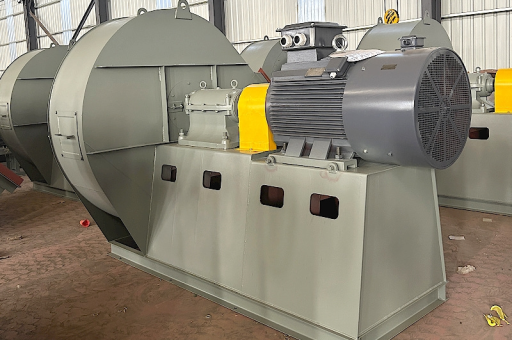
A V-Belt Driven High Temperature Material Handling Blower Centrifugal Fan is a mechanically driven air-moving device that uses a centrifugal impeller housed within a scroll-shaped casing. The term “V-belt driven” refers to the power transmission method: an electric motor spins a grooved pulley, which transfers torque through V-belts to a larger pulley on the fan shaft. This decouples the motor from the fan, allowing the fan to operate at a different (usually lower) rotational speed than the motor.
The “high temperature” designation indicates that the fan is built with heat-resistant materials such as stainless steel, alloy steel, or high-strength carbon steel, and uses specialized bearing and shaft cooling systems. “Material handling” means the fan is designed to pass solids (e.g., sawdust, grain, cement powder, metal shavings) through its impeller without clogging or excessive wear.
Core Specs of a Typical Unit:
- Airflow: 5,000 – 150,000 CFM
- Static Pressure: 10 – 60 in. w.g.
- Temperature Rating: 150°F to 1000°F (65°C to 538°C)
- Wheel Types: Radial blade, paddle wheel, backward inclined, or airfoil (depending on material)
Key Components and How They Work Together
A. Impeller (Wheel)
The impeller is the heart of the fan. For material handling, the wheel must have thick blades and a reinforced backplate. Radial or paddle-blade designs are ideal because they resist material buildup and are easier to clean.
B. V-Belt Drive System
This includes:
- Motor sheave (pulley) – small diameter, high speed
- Fan sheave – larger diameter, lower speed
- Belt(s) – multiple V-belts (classical or wedge type) in parallel
- Belt tension adjustment system (e.g., slide base or jacking bolts)
C. Shaft and Bearings
The fan shaft must be oversized and fitted with two separate bearing supports (pillow block or flange) to handle heavy radial loads. High-temperature fans often feature shaft cooling fins, heat slingers, or air purge collars to prevent heat migration into bearings.
D. Casing
The scroll housing is fabricated from heavy-gauge steel, often with replaceable wear liners at the cutoff and tongue. For high-temp service, casings may be insulated or jacketed for water cooling.
Why V-Belt Drive Is Preferred for High-Temperature Applications
Many industrial fans use direct drive or gear drive, but V-belt drives offer three unique benefits in hot, dirty environments:
-
Heat Isolation – The motor is physically separated from the fan shaft. In direct drive, heat travels along the shaft into the motor bearings, drastically reducing motor life. With V-belts, heat is dissipated into the belt and air gap before reaching the motor.
-
Speed Variability – A simple pulley change allows the fan speed (and hence airflow) to be adjusted without a VFD. For material handling, this is critical because dust loading may require different air velocities.
-
Shock Absorption – V-belts stretch slightly under sudden loads, cushioning the drivetrain when large chunks of material hit the impeller.
-
Ease of Maintenance – Belts can be replaced quickly. Motor bearings remain cooler and operate under lower axial stress.
Note: For temperatures above 500°F (260°C), special high-temperature belts (like Kevlar-reinforced or fiberglass-core) must be used to avoid belt degradation.
Critical Design Considerations for Material Handling Fans
When selecting or designing a V-Belt Driven High Temperature Material Handling Blower Centrifugal Fan, engineers must evaluate:
- Material Type and Density – Is it fibrous, abrasive, sticky, or hot? This determines wheel type, tip speed, and clearance.
- Operating Temperature Range – Expansion of steel must be calculated at peak temperature to prevent rubbing between wheel and inlet cone.
- Spark Resistance – If handling combustible dust (coal, wood, chemical), the fan may require ATEX or NFPA compliance, including non-sparking impellers (aluminum bronze or nylon coating).
- Corrosion Resistance – For acidic fumes (like HCl or SO₂), the fan must be built from Hastelloy, stainless steel 316, or fiber-reinforced plastic.
- Belt Safety Factor – Belts must be rated for the motor’s full locked-rotor torque, not just running load.
Performance Characteristics: Flow, Pressure, and Temperature Tolerances
A centrifugal fan’s performance is defined by its fan curve. For material handling:
- Pressure (SP) – Typically higher than standard fans ( > 15 in. w.g.) to overcome friction of ducts laden with debris.
- Volumetric Flow (CFM) – Single-width, double-inlet (SWDI or DWDI) designs move more air in confined spaces.
- Efficiency – While backward-inclined blades are 85% efficient; for material handling, radial blades (65–75% efficiency) are preferred because they are less prone to clogging.
- Temperature De-rating – Air density drops as temperature rises. At 500°F, the same fan moves approximately 60% less mass flow at the same pressure.
Example: A fan rated for 50,000 CFM at 70°F will deliver roughly 35,000 actual CFM (mass) at 450°F. The driver (motor) must be sized for the colder start-up condition.
Common Applications Across Industries
| Industry | Application | Temperature Range |
|---|---|---|
| Cement | Kiln waste gas, coal mill exhaust | 300–700°F |
| Steel | Hot fume extraction, annealing furnace | 400–1000°F |
| Wood/Pellet | Dryer exhaust, pneumatic conveying | 200–350°F |
| Chemical | Fume exhaust, reactor off-gas | 150–600°F |
| Grain/Ag | Grain dryer, seed cleaner aspiration | 120–250°F |
Installation Best Practices for Longevity
- Foundation – Mount on a rigid concrete base with vibration isolation pads.
- Belt Alignment – Use a laser alignment tool. Misaligned belts last 50% shorter.
- Tension – Adjust belts to the manufacturer’s deflection spec (typically 1/64” per inch of belt span).
- Inlet Box – Use a swept inlet (rather than a sharp 90° duct) to reduce turbulence and pre-swirl.
- Cooling Piping – For fans above 250°F, install a cooling fan on the bearing pedestal or an air purge system.
Maintenance and Troubleshooting Q&A
Q: V-belts are smoking after 2 months. What’s wrong?
A: Most likely misalignment or improper tensioning. Check motor and fan sheaves with a straightedge. Also verify belt cross-section (A, B, C, D) matches sheave grooves.
Q: The fan vibrates heavily at startup, then smooths out.
A: This indicates material buildup on the impeller. Unbalance from dust causes resonance. Install a cleanout port near the wheel inlet.
Q: Bearing temperature exceeds 200°F (93°C). Any fix?
A: Lubrication issues, belt over-tension, or heat-soak from the casing. Check grease schedule, loosen belt slightly, or add shaft cooling fins.
Q: Can I replace a failed motor with a higher horsepower one?
A: Not without consulting the fan manufacturer. Higher HP can overspeed the fan or overload the shaft and bearings.
Frequently Asked Questions (FAQ)
Q: What is the maximum temperature this fan can handle?
A: With standard carbon steel and grease-lubricated bearings, about 400°F (204°C). For higher temps (up to 1000°F), you need alloy steel, water-cooled bearings, and high-temp belts.
Q: How often should V-belts be replaced?
A: Typically every 2,000–3,000 operating hours, or if you see cracking, fraying, or glazing. The National Association of Belt Manufacturers recommends changing all belts in a set simultaneously.
Q: Can I use this fan for explosive dust?
A: Yes, but only if it is equipped with a non-sparking impeller, conductive casing grounding, and meets standards like NFPA 91 or ATEX Zone 21/22.
Q: What is the lifespan of a material handling fan?
A: With proper maintenance (bearing regreasing, belt inspection, wheel cleaning), a high-quality fan can last 15–20 years in continuous service.
Q: Is a V-belt drive more efficient than a VFD direct drive?
A: Direct drive with VFD is more efficient (5–8% better), but V-belt drive wins when you need isolation from heat, quick speed changes via pulley swaps, and easy maintenance.
Conclusion: Choosing the Right Fan for Your Operation
Investing in a V-Belt Driven High Temperature Material Handling Blower Centrifugal Fan is a strategic decision that impacts your plant’s uptime, energy consumption, and safety. The ideal fan is not the most expensive one—it is the one that matches your specific temperature, material type, pressure requirements, and maintenance capabilities.
To maximize fan lifespan:
- Always specify high-temp belts and bearings.
- Incorporate inspection ports for cleaning.
- Use predictive maintenance (vibration analysis, thermography).
If you are designing a new system or upgrading an old one, consult with a centrifugal fan manufacturer to perform a fan selection calculation that includes actual air density at operating temperature and material loading factor.
Remember: a well-selected fan runs quietly, lasts for decades, and never blocks your production line.
This article was compiled from industry best practices, ASHRAE handbooks, AMCA (Air Movement and Control Association) standards, and technical datasheets from leading fan OEMs.





