
This article's table of contents introduction:
- Component Breakdown
- Likely Application & Interconnection
- Key Specifications You Might See (Example)
- Is this a Request for a Quote or for Identification?
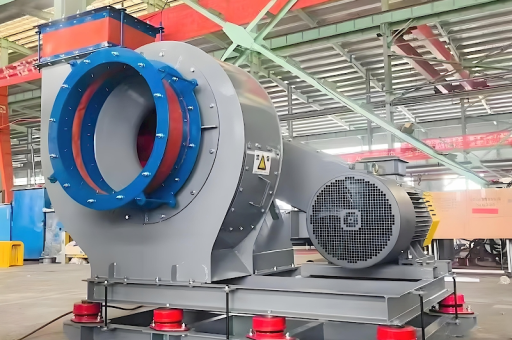
It appears you are describing a specific type of heavy-duty industrial fan that combines several critical features. Let’s break down the terminology and the application to clarify what makes this unit unique:
Component Breakdown
-
Heavy Duty AC Motor: This is the power source.
- AC (Alternating Current): Standard industrial power (e.g., 460V, 3-phase).
- Heavy Duty: Typically implies a TEFC (Totally Enclosed Fan Cooled) enclosure, or possibly a TEAAC (Totally Enclosed Air-to-Air Cooled) motor, designed to withstand dust, heat, and continuous operation. In foundries, motors often need VFD (Variable Frequency Drive) compatibility for speed control.
- Antiwear: This is a critical modifier. It suggests the motor has special bearings (high-temp grease, sealed) and possibly a reinforced shaft or coating to resist the abrasive dust environment.
-
Antiwear: This refers to the fan impeller, housing, and shaft.
- Material: Likely constructed from AR (Abrasion Resistant) steel or Hardox. Cast iron might be used for the housing, but the impeller blades are often treated with a chrome carbide overlay or a ceramic coating.
- Design: The impeller geometry is designed to minimize particle impact and wear.
- Purpose: To handle particulate-laden air (dust, sand, metal shavings) without eroding the blades, which would cause imbalance and vibration.
-
Foundry: The specific industry.
- Air Quality: Very hot (200-500°F+), laden with sand, scale, flux fumes, and metal particles.
- Regulations: Often requires high static pressure to overcome ductwork and pollution control equipment (baghouses, scrubbers).
- Reliability: These fans run 24/7. Failure means a furnace meltdown or production stoppage.
-
High Pressure: The aerodynamic performance characteristic.
- Definition: In HVAC/fan engineering, "High Pressure" usually refers to fans that generate 15” to 40”+ (inches of water gauge - w.g.) of static pressure.
- Blade Type: This can be achieved via:
- Backward Inclined (BI) or Airfoil (AF): Most efficient for high pressure, clean-ish air.
- Paddlewheel (Radial): Most rugged, best for high dust loading and material handling, but less efficient. Given the "antiwear" and "foundry" context, a Radial (Paddlewheel) or Radial Tip blade is highly likely.
- Forward Curved (FC): High volume, lower pressure (less likely here).
-
Centrifugal Fan: The physical design.
- Mechanism: Air enters axially (parallel to the shaft) and exits radially (perpendicular to the shaft). This creates high pressure.
- Housing: A spiral (volute) scroll that converts velocity into pressure.
Likely Application & Interconnection
You are describing a fan used for:
- Cupola/Arc Furnace Fume Exhaust: Moving hot, abrasive gases from the furnace to a baghouse.
- Sand Handling Conveying: Pneumatic transport of silica sand.
- Induction Furnace Cooling/Scavenging: High-pressure air to cool coils and remove dust.
- Shot Blast Exhaust: Handling high particle loading from shot blasting operations.
Why all these terms together? This is not a standard HVAC fan. It is a specialty, heavy industrial machine designed for the worst operating conditions in a metalcasting facility.
Key Specifications You Might See (Example)
| Parameter | Example Value |
|---|---|
| Motor Power | 100 HP, 460V, 3ph, 60Hz |
| Motor Frame | TEFC, 449T Frame, with VFD capability |
| Fan Type | Centrifugal, Radial Blade (Paddlewheel) |
| Impeller Wear Protection | 1/8” Hardox 500 with Chrome Carbide Overlay |
| Flow Rate (CFM) | 25,000 CFM |
| Static Pressure | 24” w.g. |
| Operating Temp | 300°F continuous |
| Bearing Type | Split pillow block, spherical roller, with high-temp synthetic grease |
Is this a Request for a Quote or for Identification?
- If you need a quote/replacement: Please provide the impeller diameter, inlet/outlet size, rotation (CW/CCW), exact CFM and SP required, and the mounting arrangement.
- If you are trying to identify a specific fan: Look for a nameplate on the fan housing (brands like New York Blower, Howden, Chicago Blower, Aerovent, Robinson).
- If you are troubleshooting: Most common issues with this type of fan are bearing failure (from high temp/dust ingress) and impeller imbalance (from uneven wear).
Would you like to know how to select the correct impeller wear protection for a specific foundry application, or do you have a technical question about the drive belt or VFD tuning for this fan?





