
This article's table of contents introduction:
- Material Analysis: 16Mn (Grade Q345B / ASTM A572 Gr.50)
- Speed Analysis: 730 r/min (Low-Speed, Heavy-Duty)
- Application: ID Fan (Induced Draft) in Power Plant
- Typical Design Features for this Specification
- Potential Issues & Engineering Considerations
- Summary: Is this a good specification?
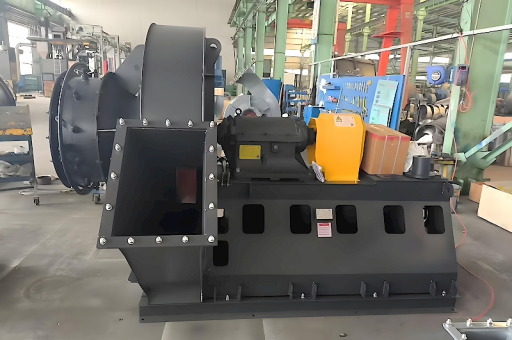
Based on the keywords you provided, here is a detailed technical breakdown of the 16Mn Industrial Air Supply 730r/min ID Fan used in a Power Plant.
This specification describes a Medium-Duty, Induced Draft (ID) Fan designed for flue gas handling, constructed from 16Mn (Q345B) steel.
Material Analysis: 16Mn (Grade Q345B / ASTM A572 Gr.50)
- What it is: 16Mn is a Chinese standard low-alloy, high-strength structural steel (now more commonly designated as Q345B). It is the standard material for power plant fans in China and many Asian markets.
- Why used for ID Fans:
- Higher Strength: It has a yield strength of ~345 MPa, which is about 30-40% stronger than standard Q235 (A36) carbon steel. This allows for thinner, lighter impellers and casings to achieve the same structural integrity.
- Wear Resistance: Provides moderate resistance to the abrasive nature of fly ash in flue gas.
- Weldability: Good weldability, essential for fabricating complex fan impellers and volutes.
- Limitation: 16Mn is not corrosion-resistant. If the flue gas is wet or contains acidic condensate (typical in FGD systems or wet stacks), a Cor-Ten steel or Stainless Steel (SS316L) overlay would be required. 16Mn is suitable for dry or high-temperature flue gas service.
Speed Analysis: 730 r/min (Low-Speed, Heavy-Duty)
- Drive Type: This speed is characteristic of a fan directly coupled to a 6-pole electric motor (Synchronous speed ~1000 rpm - slip to ~980 rpm) or more commonly, gearbox driven, but most likely a direct drive via a low-speed motor (specifically an 8-pole motor: Synchronous 750 rpm, actual slip to ~730 rpm).
- Mechanical Implications:
- High Torque: Low speed (730 rpm) means the fan shaft and bearings must handle very high torque to move the large volume of gas.
- Large Diameter Impeller: To achieve the required air flow (m³/s) at low speed, the impeller must be very large in diameter. This fan is physically large.
- Low Wear: Lower tip speed results in significantly less erosion from fly ash compared to a high-speed (1480 rpm) fan.
- Low Noise: Lower rotational speed produces less aerodynamic noise.
Application: ID Fan (Induced Draft) in Power Plant
This is the negative pressure fan located between the boiler economizer/air heater and the stack (or FGD system).
Key Operational Parameters:
- Function: Creates a negative pressure (vacuum) at the furnace exit, pulling flue gas through the boiler, air heater, and pollution control equipment.
- Environment:
- Temperature: High. Typical inlet temperatures range from 120°C to 180°C (after Air Heater). The temperature can spike during boiler operation changes or bypass scenarios.
- Medium: Flue gas containing fly ash, SOx, NOx, CO2, N2, and water vapor.
- Erosion Risk: High. The fly ash particles act as an abrasive, eroding the leading edges of the blades.
- Corrosion Risk: Medium to High if the gas temperature drops below the acid dew point (~120-150°C depending on sulfur content).
Typical Design Features for this Specification
-
Impeller Type: Backward-Curved / Backward-Inclined Blades (BC/BI).
- Reason: Highly efficient, self-limiting power curve (prevents motor overload), and the curved blades help shed fly ash buildup.
- Construction: Hollow airfoil blades (for highest efficiency) or single-thickness plate blades (for durability and lower cost). For 16Mn, plate blades are likely.
-
Shaft: High-strength alloy steel (e.g., 40Cr or 45# steel) threaded into the impeller hub. Runs on heavy-duty spherical roller bearings to handle the radial load and axial thrust from the duct pressure.
-
Bearing Assembly: Oil-lubricated (oil bath or circulating oil) or grease-lubricated split pillow blocks. Often equipped with vibration probes and temperature RTDs.
-
Coupling: Gear type or flexible diaphragm coupling to transmit high torque. Often includes a torque-limiting device or shear pins.
-
Casing: Heavy-duty 16Mn steel plate (8mm to 16mm thick, depending on size). Includes inspection doors for cleaning and maintenance.
-
Inlet Box: A rectangular-to-round transition to smoothly guide gas into the impeller eye. Often includes an inlet damper (louver or radial) for flow control.
-
Drive Motor: Low-speed (8-Pole) Squirrel Cage Induction Motor.
- Specification: 6kV or 10kV high voltage.
- Power Rating: Likely in the range of 800 kW to 2500 kW (depending on the boiler size, e.g., 200MW, 300MW, 600MW unit).
- Starting: Soft starter or VFD (Vapor/Fluid Coupling for large fans).
Potential Issues & Engineering Considerations
| Issue | Cause with 16Mn | Solution |
|---|---|---|
| Blade Erosion | Fly ash impact at high velocity. | Weld hardfacing (Stellite/Chrome Carbide) on leading edges. Apply ceramic tiles or epoxy coating on the blade face. |
| Blade Corrosion | Wet flue gas (cold start, low load, or after FGD). | Upgrade material to Corten A (Corrosion resistant) or SS316L for critical blades. Maintain gas temperature above dew point. |
| Fatigue Cracking | Resonance at 730 rpm / harmonics. | Perform modal analysis (FEA) on the impeller. Modify blade pass frequency. |
| Bearing Overheating | Misalignment or shaft deflection due to massive impeller weight. | Precision laser alignment. Use self-aligning spherical roller bearings with a circulating oil system. |
| Unbalance | Ash buildup on hollow blades or blade erosion. | Install online washing system or shot cleaning. Perform dynamic balancing on site (ISO 1940 G2.5 or G6.3). |
Summary: Is this a good specification?
Yes, for a standard coal-fired plant with dry flue gas.
- Pros: Cost-effective, high strength, durable against mechanical stress.
- Cons: Poor corrosion resistance if the gas becomes wet. Requires surface protection (coatings/hardfacing) to survive >3 years in high-dust service.
Recommendation for Procurement: Ensure the scope of supply includes:
- Inlet silencer (if noise is critical).
- Expansion joints (inlet/outlet).
- Lube oil system (forced oil circulation if >1000 kW).
- Auxiliary cooling fan for bearings (since low speed, self-cooling may be insufficient at higher ambient temps).
- Vibration monitoring system (two probes per bearing, X&Y induction).





