
This article's table of contents introduction:
- Table of Contents
- 1. Introduction to Q345 Industrial Heavy Duty Centrifugal Fans
- 2. Key Design Features of Single Suction Cooling Centrifugal Flow Fans
- 3. Material Advantage: Why Q345 Steel is the Industry Standard
- 4. Performance Characteristics and Efficiency Metrics
- 5. Typical Applications in High-Temperature and Heavy-Duty Environments
- 6. Maintenance and Operational Best Practices
- 7. Frequently Asked Questions (FAQ)
- 8. Conclusion
Q345 Industrial Single Suction Cooling Centrifugal Flow Fan Heavy Duty: Design, Performance, and High-Temperature Application Guide**
Table of Contents
- Introduction to Q345 Industrial Heavy Duty Centrifugal Fans
- Key Design Features of Single Suction Cooling Centrifugal Flow Fans
- Material Advantage: Why Q345 Steel is the Industry Standard
- Performance Characteristics and Efficiency Metrics
- Typical Applications in High-Temperature and Heavy-Duty Environments
- Maintenance and Operational Best Practices
- Frequently Asked Questions (FAQ)
- Conclusion
Introduction to Q345 Industrial Heavy Duty Centrifugal Fans
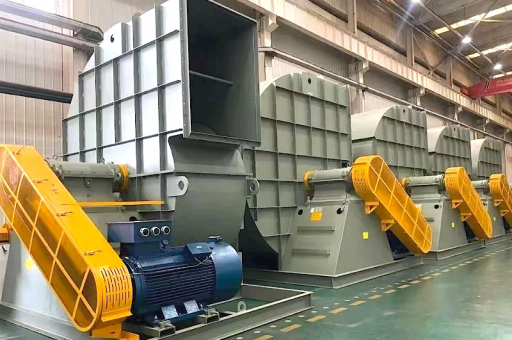
In modern industrial ventilation, cooling, and exhaust systems, the Q345 Industrial Single Suction Cooling Centrifugal Flow Fan Heavy Duty represents a critical component for handling high-temperature, high-pressure, or dusty airflows. Unlike standard centrifugal fans, the Q345 variant is engineered with low-alloy high-strength structural steel (Q345, equivalent to ASTM A572 Grade 50) to withstand mechanical stress, thermal expansion, and corrosive conditions typically found in steel mills, power plants, cement factories, and chemical processing units.
The single suction design allows air to enter from one side of the impeller, simplifying duct connections and reducing footprint. Combined with a heavy-duty housing and cooling features (such as external cooling fins or shaft cooling discs), this fan type ensures reliable long-term operation at temperatures ranging from -20°C to 400°C (or higher with specialized coatings).
Key Design Features of Single Suction Cooling Centrifugal Flow Fans
Single Suction Impeller
The impeller is designed with backward-curved or radial blades, optimized for high static pressure and moderate flow rates. The single inlet reduces turbulence and allows easier balancing compared to double-suction designs.
Cooling System Integration
Heavy-duty units often incorporate a dedicated cooling fan mounted on the motor shaft end, or a separate cooling air path that circulates around the bearing housing and shaft seal. Some models use water-cooled bearing housings for extreme temperature environments.
Heavy-Duty Casing
The volute casing is fabricated from Q345 steel plate (typically 6–16 mm thickness) with reinforced flanges and stiffening ribs to prevent vibration and deformation under high temperature.
Bearing and Shaft Assembly
Oversized spherical roller bearings with high-temperature grease lubrication are standard. The shaft is often made of 40Cr (or 45# steel) and heat-treated to resist bending fatigue.
Drive Options
Most heavy-duty centrifugal fans use V-belt drives for variable speed control, or direct-coupled drives for high-speed applications. Couplings are selected to absorb thermal expansion and misalignment.
Material Advantage: Why Q345 Steel is the Industry Standard
Q345 is a Chinese standard low-alloy high-strength structural steel, widely adopted in industrial fan manufacturing due to its:
- Yield strength: ≥345 MPa (vs. Q235’s 235 MPa) – allowing thinner yet stronger fan housings.
- Impact toughness: Good low-temperature performance (down to -20°C without brittle fracture).
- Weldability: Excellent for arc welding, common in fan fabrication.
- Corrosion resistance: When painted or galvanized, Q345 provides acceptable service life in mildly corrosive environments.
For heavy-duty applications where ABS, fiberglass, or aluminum fans fail under heat or pressure, Q345 steel offers the optimal balance of cost, strength, and thermal stability.
Comparative Table – Material Properties
| Material | Yield Strength (MPa) | Max Service Temp (°C) | Weldability | Weight | Cost |
|---|---|---|---|---|---|
| Q235 | 235 | 350 | Good | Heavy | Low |
| Q345 | 345 | 400 (with coating) | Excellent | Moderate | Medium |
| 304 Stainless | 205 | 700+ | Fair | Heavy | High |
Performance Characteristics and Efficiency Metrics
Pressure-Flow Curve
The Q345 single suction centrifugal fan delivers a steep pressure rise at low flow rates, making it ideal for systems requiring high static pressure (e.g., baghouse dust collectors, kiln exhaust).
Efficiency Range
Typical peak static efficiency reaches 75–82% depending on blade design. Backward-curved blades offer better efficiency (up to 85%) but require higher rotational speeds.
Noise Levels
At nominal operating point, noise typically ranges from 80–95 dB(A). Silencers or acoustic enclosures may be required for indoor installations.
Temperature Rise
Due to the heavy-duty motor and cooling fan, the air stream temperature rise across the fan is usually 2–8°C, which must be considered in thermal system design.
Vibration Limits
ISO 14694 Grade G6.3 (heavy-duty industrial) or Grade G2.5 (high-precision) is typical for balanced impellers.
Typical Applications in High-Temperature and Heavy-Duty Environments
| Industry | Application | Temperature Range | Key Requirement |
|---|---|---|---|
| Steelmaking | EAF furnace fume extraction | 250–400°C | Heat-resistant bearings, cooling shroud |
| Cement plant | Kiln exhaust fan | 200–350°C | Abrasion-resistant impeller coating |
| Power plant | Boiler induced draft (ID) fan | 150–180°C | Variable speed drive, corrosion protection |
| Chemical | Hot air recirculation | 120–300°C | Explosion-proof motor, spark-resistant impeller |
| Mining | Ventilation / dust collection | Ambient to 80°C | Heavy-duty housing, abrasion liners |
Maintenance and Operational Best Practices
- Weekly inspection: Check bearing temperature (max 70°C), vibration (≤4.5 mm/s rms), and belt tension.
- Monthly cleaning: Remove dust accumulation on impeller blades to prevent imbalance.
- Quarterly bearing re-greasing: Use high-temperature lithium-based grease.
- Annual impeller dynamic balancing: If vibration increases above 6.3 mm/s.
- Cooling system check: Ensure water or air cooling passages are not blocked.
- Shaft seal monitoring: Replace when visible leakage occurs at the shaft penetration.
Common Failure Modes & Solutions
- Bearing overheating → Check cooling fan airflow; replace grease or bearing.
- Impeller imbalance → Clean blades; re-balance dynamically.
- Excessive noise → Check duct restrictions or misalignment; install flexible connectors.
- Casing corrosion → Apply high-temperature ceramic coating or upgrade to stainless steel.
Frequently Asked Questions (FAQ)
Q1: What is the maximum operating temperature of a Q345 industrial centrifugal fan?
A: Standard Q345 fans can operate continuously up to 350°C. With high-temperature coating and water-cooled bearings, they can handle 400–450°C. For above 450°C, stainless steel or Inconel alloys are recommended.
Q2: Can I use a single suction fan for both suction and discharge?
A: Yes, centrifugal fans are designed for one-direction airflow. However, reversed rotation will drastically reduce flow and efficiency. Always verify rotation direction during installation.
Q3: How do I choose between single suction and double suction?
A: Single suction is preferred for moderate flow, high pressure, and limited space. Double suction provides higher flow rates and lower noise but requires more axial space and balancing complexity.
Q4: What is the maintenance interval for heavy-duty fans?
A: For continuous operation, bearings should be greased every 500 hours; full overhaul including bearing replacement is recommended every 5000–8000 operating hours or annually, whichever comes first.
Q5: How do I reduce fan noise without sacrificing performance?
A: Install a duct silencer (absorption or reactive type), use acoustic enclosures, or choose backward-curved blades for lower noise at the same duty point. Fan speed reduction (if process allows) also significantly lowers noise.
Q6: What is the energy cost impact of operating a heavy-duty centrifugal fan?
A: A typical 200 kW fan running 8000 hours/year at 85% efficiency costs approximately $110,000–$150,000 annually at industrial electricity rates. Selecting a high-efficiency impeller and variable frequency drive can reduce consumption by 15–30%.
Q7: Is Q345 steel suitable for corrosive environments?
A: Q345 offers moderate corrosion resistance. For aggressive chemicals, stainless steel (304/316) or coated Q345 (with epoxy or thermal spray lining) is recommended. Saltwater environments require additional sacrificial anodes or cathodic protection.
Conclusion
The Q345 Industrial Single Suction Cooling Centrifugal Flow Fan Heavy Duty remains a cornerstone of high-temperature industrial ventilation, exhaust, and cooling systems. Its high-strength steel construction, optimized single-suction impeller, dedicated cooling system, and robust bearing assembly deliver reliable performance in temperatures up to 400°C and pressures exceeding 5000 Pa.
When selecting a heavy-duty centrifugal fan, engineers must consider not only the material and blade design but also the operating temperature, particle loading, and maintenance access. By following the installation, balancing, and maintenance guidelines outlined in this article, operators can maximize uptime, reduce energy consumption, and extend fan life by 30–50% compared to under-specified units.
For more detailed sizing calculations, performance curves, or custom design inquiries, consult your fan supplier’s application engineer or reference ISO 12499 and ASME PTC 11 standards.





