
This article's table of contents introduction:
- The Core Specifications (What they mean)
- Likely Fan Type (Inference)
- Drive & Power Considerations
- Potential Applications
- Important Technical Questions to Ask
- Summary
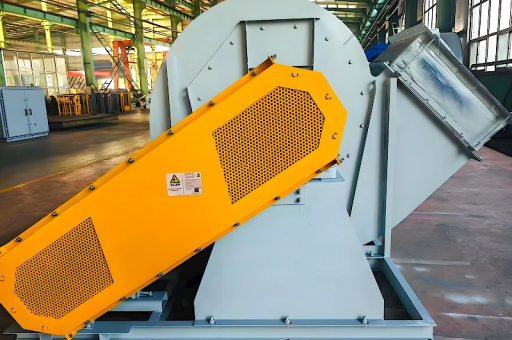
Based on the specifications you provided, here is a technical analysis and breakdown of what appears to be a very large, high-pressure industrial fan system. Please note that "Metallikon" does not appear to be a standard major brand name (like Howden, TLT-Babcock, or Cincinnati Fan), so it is likely either a specific model line, an OEM, or a regional manufacturer.
The Core Specifications (What they mean)
- 667,000 m³/h (Cubic Meters per Hour):
- Conversion: ~392,500 CFM (Cubic Feet per Minute).
- Context: This is an extremely high flow rate. This is not a typical HVAC fan. It is sized for heavy industrial processes such as a large mine ventilation shaft, a major steel mill (Basic Oxygen Furnace or Sinter Plant), a power plant's induced draft (ID) system, or a large tunnel ventilation system.
- 9,460 Pa (Pascals):
- Conversion: ~38 inches of water gauge (in. wg) or ~950 mm wg.
- Context: This is a very high static pressure for this flow rate. It confirms this is a heavy-duty fan. It must overcome significant system resistance (ductwork, scrubbers, baghouses, or long duct runs).
- Alloyed Steel:
- Context: The fan is made from alloy steel (e.g., Corten, Stainless Steel 316L, or abrasion-resistant steel like Hardox). This is required for:
- Corrosion resistance (handling acidic gases/flue gas).
- Abrasion resistance (handling dust/coal/ore particles).
- High-temperature stability (handling hot process gases).
- Context: The fan is made from alloy steel (e.g., Corten, Stainless Steel 316L, or abrasion-resistant steel like Hardox). This is required for:
Likely Fan Type (Inference)
Given the High Pressure (9460 Pa) and High Flow (667k m³/h), this is almost certainly a Centrifugal Fan (as you stated), but specifically a specific type:
- Most Likely: Airfoil (AF) or Backward-Inclined (BI) Bladed Fan.
- Why: These are the most efficient (80-88%) for high pressure, clean to moderately dusty air.
- Possible: Radial (R) or Radial-Tip (RT) Fan.
- Why: If the gas is heavily dust-laden (e.g., primary steelmaking fume exhaust), a radial design is more robust, though less efficient.
- Not Likely: Forward-Curved (FC) Fan. FC fans are for low pressure, high volume (e.g., clean air HVAC).
Drive & Power Considerations
- Power Consumption (Rule of Thumb):
- Fan Power (kW) ≈ (Flow m³/h Pressure Pa) / (3,600,000 Efficiency)
- Assuming 80% efficiency:
- (667000 9460) / (3,600,000 0.80) ≈ 2,191 kW (~2,900 HP)
- Conclusion: This fan will likely be driven by a large electric motor (2,000–2,500 kW) connected via a V-Belt Drive (for speed adjustment) or a Direct Drive (low maintenance). A Variable Frequency Drive (VFD) is highly recommended for energy savings and process control.
Potential Applications
Based on the power, pressure, and material, this specific fan is likely used in one of these heavy industries:
- Mining (Main Ventilation Fan): Moving fresh air or exhausting return air from a major underground mine.
- Steel Manufacturing (BOF / EAF): Exhausting fume from a Basic Oxygen Furnace or Electric Arc Furnace (handling hot, dusty gas).
- Power Generation (FGD / ID Fan): An Induced Draft fan pulling flue gas through a Flue Gas Desulfurization (FGD) scrubber (high pressure drop due to scrubber).
- Cement (Kiln ID Fan): Pulling hot gas through a preheater tower and baghouse.
- Large Tunnel Ventilation (Jet Fan replacement): In a long road/rail tunnel requiring high thrust.
Important Technical Questions to Ask
If you are sourcing, installing, or maintaining this fan, you must verify:
- Gas Temperature: Is it ambient or hot (e.g., 250°C / 480°F)? This dictates shaft cooling, bearing type, and expansion joints.
- Gas Composition: Is it corrosive (H2S, SOx) or abrasive (fly ash, cement dust)? This dictates alloy grade (316L vs. Corten vs. Abrasion-resistant lining).
- Dust Load: Is it clean air or heavy dust (e.g., 50 g/Nm³)? Heavy dust requires a different blade profile (radial) and wear plates.
- Sound Level: At 9460 Pa, this fan will be very loud. Sound attenuation (silencer) is likely mandatory.
- Vibration Monitoring: For a fan of this size, permanent vibration sensors (accelerometers) on the bearings are critical for safety.
Summary
The Alloyed Steel Metallikon 667000 m³/h @ 9460 Pa is a heavy-duty, high-pressure, high-volume industrial centrifugal fan designed for a demanding process environment (steel, mining, or power). Its cost is significant (likely hundreds of thousands of dollars/millions of Euros). Its performance and reliability are critical to the plant's operation.





