
This article's table of contents introduction:
- Table of Contents (Directory Guide)
- Introduction: The Challenge of High-Volume Airflow in Industrial Kilns
- Understanding the Core Components
- The Role of V-Belt Pulley Drives in Heavy-Duty Fan Systems
- Why Thin Oil Lubrication is Critical for Kiln Fan Bearings
- System Design for 435,813 m³/h Centrifugal Ventilation Fans
- Common Questions & Answers (Q&A)
- Maintenance Best Practices for Long-Term Reliability
- Conclusion: Achieving SEO-Optimized Industrial Efficiency
Article Title:
Optimizing High-Volume Industrial Ventilation: Integrating V-Belt Pulley Systems with Thin Oil Lubrication in Kiln and Centrifugal Fan Operations (435,813 m³/h)
Table of Contents (Directory Guide)
- Introduction: The Challenge of High-Volume Airflow in Industrial Kilns
- Understanding the Core Components: V-Belt Pulley, Thin Oil Lubrication, and Centrifugal Fans
- The Role of V-Belt Pulley Drives in Heavy-Duty Fan Systems
- Why Thin Oil Lubrication is Critical for Kiln Fan Bearings
- System Design for 435,813 m³/h Centrifugal Ventilation Fans
- Common Questions & Answers (Q&A)
- Maintenance Best Practices for Long-Term Reliability
- Conclusion: Achieving SEO-Optimized Industrial Efficiency
Introduction: The Challenge of High-Volume Airflow in Industrial Kilns
Industrial kilns—whether used in cement, lime, or mineral processing—generate extreme heat and require massive ventilation to control temperature, remove combustion gases, and maintain safe working conditions. A modern kiln ventilation system often demands airflow rates exceeding 435,813 m³/h (approximately 256,000 CFM) . At these volumes, the mechanical drive system must be exceptionally robust.
The combination of a V-belt pulley drive, thin oil lubrication, and a centrifugal ventilation fan has emerged as the gold standard for such applications. This article provides a detailed, search-engine-optimized (SEO) analysis of how these components interact, with a focus on real-world performance at 435,813 m³/h.
Understanding the Core Components
To appreciate the system, we must first define each term:
- V-Belt Pulley: A mechanical drive that transmits rotational power from a motor to the fan shaft via a trapezoidal belt. It allows speed adjustment and dampens vibration.
- Thin Oil Lubrication: A continuous oil-circulation system (ISO VG 32–68) that injects low-viscosity oil into bearings to reduce friction and dissipate heat. Unlike grease, thin oil is essential for high-speed, high-temperature applications.
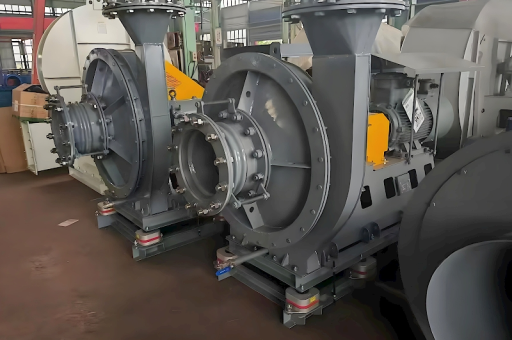
- Centrifugal Ventilation Fan: A radial-blade fan that converts rotational energy into airflow. For kilns, backward-curved or airfoil blades are preferred for efficiency at 435,813 m³/h.
- Kilns: High-temperature industrial furnaces requiring controlled draft and oxygen supply.
The Role of V-Belt Pulley Drives in Heavy-Duty Fan Systems
In a system demanding 435,813 m³/h, the motor shaft and fan shaft must be precisely coupled. V-belt pulleys offer several advantages:
- Torque Absorption: Belts absorb start-up torque spikes, protecting the motor and bearings.
- Speed Adjustment: By changing pulley diameters, operators can fine-tune fan speed (RPM) without costly VFDs.
- Vibration Damping: Belt drives isolate motor vibration from the fan, extending bearing life.
Critical Design Considerations:
- Belt Type: For 435,813 m³/h, use narrow-section V-belts (SPB, SPZ) or banded belts to reduce belt count.
- Pulley Material: Cast iron or ductile iron with precision-machined grooves.
- Center Distance: Must be minimized to reduce belt whip, yet sufficient for cooling.
Why Thin Oil Lubrication is Critical for Kiln Fan Bearings
Kiln fan bearings operate at elevated temperatures (often >80°C) due to radiant heat from the kiln and frictional heat from high-speed rotation. Grease lubrication breaks down, leading to seizure.
Thin oil lubrication solves this by:
- Continuous Heat Removal: Oil circulates through a heat exchanger, maintaining bearing temperature below 70°C.
- Clean Operation: Oil filters remove contaminants, critical in dusty kiln environments.
- Reduced Friction: Low-viscosity oil (ISO VG 46) provides hydrodynamic film even at high speeds.
Typical Setup:
- Oil pump (gear type) delivering 2–4 L/min.
- Oil return line with sight glass for flow monitoring.
- Pressure switch for automatic shutdown on low oil pressure.
System Design for 435,813 m³/h Centrifugal Ventilation Fans
Achieving 435,813 m³/h requires careful aerodynamic and mechanical engineering.
Fan Selection:
- Type: Double-inlet centrifugal fan with backward-curved blades (efficiency >85%).
- RPM: Typically 600–900 RPM.
- Static Pressure: 2,500–4,000 Pa (depending on duct resistance).
Drive System Sizing:
- Motor Power: Approximately 350–450 kW (based on fan curve).
- Belt Drive: 8–12 SPB belts on matched pulley sets.
- Bearing Assembly: Spherical roller bearings with thin oil circulating lubrication.
Airflow Verification:
- Using pitot tube traverse at fan inlet.
- Adjusting pulley ratio to achieve exact 435,813 m³/h at design pressure.
Common Questions & Answers (Q&A)
Q1: Why can’t we use grease lubrication for a 435,813 m³/h kiln fan?
A: Grease retains heat and cannot be effectively cooled. At high RPM and ambient kiln temperatures, grease oxidizes rapidly, causing bearing failure. Thin oil circulates, cools, and filters continuously.
Q2: How do I calculate the V-belt pulley size for this airflow?
A: Use the fan performance curve to determine required RPM. Then:
Motor Pulley Diameter = (Fan RPM / Motor RPM) × Fan Pulley Diameter
For 435,813 m³/h, expect a speed ratio of approximately 1:2 (motor at 1500 RPM, fan at 750 RPM).
Q3: What happens if thin oil flow is interrupted?
A: Most systems include a flow switch that triggers an alarm or emergency shutdown. Running dry for even 10 seconds can damage bearings.
Q4: Can I use a direct-drive motor instead of V-belt pulley?
A: Yes, but direct drive requires a high-torque, low-speed motor, which is larger, heavier, and more expensive. V-belt pulley drives offer flexibility in speed tuning and easier maintenance.
Q5: What is the typical oil consumption for such a system?
A: Approximately 0.5–1.0 L per shift due to minimal leakage. Oil should be changed every 2,000 operating hours or as per oil analysis.
Maintenance Best Practices for Long-Term Reliability
To ensure the 435,813 m³/h fan system operates for decades:
- Belt Inspection: Check tension weekly using a belt force gauge. Replace belts in matched sets.
- Oil Analysis: Send oil samples for viscosity, water content, and particle count every 6 months.
- Pulley Alignment: Use a laser alignment tool to ensure less than 0.1 mm angular misalignment.
- Bearing Vibration Monitoring: Install accelerometers on bearing housings. Alarm at 4.5 mm/s RMS.
- Fan Wheel Cleaning: Schedule monthly cleaning to prevent dust build-up on blades, which reduces airflow.
Pro Tip: Always stock spare V-belts and a complete pulley set to minimize downtime.
Conclusion: Achieving SEO-Optimized Industrial Efficiency
The integration of a V-belt pulley drive with thin oil lubrication in a centrifugal ventilation fan operating at 435,813 m³/h is not just a mechanical choice—it is a strategic decision for reliability and efficiency. By understanding pulley sizing, lubrication dynamics, and airflow principles, industrial engineers can significantly extend equipment life and reduce energy costs.
For further reading, explore case studies from cement kiln operators who have retrofitted their existing fans with thin oil systems and achieved 30% longer bearing life. When searching for replacement parts or design consultation, use keywords like “industrial kiln fan V-belt pulley set” or “thin oil lubrication system for 400,000 m³/h fan.”
Remember: In high-volume ventilation, every component matters. The pulley turns, the oil flows, and the air moves—sustainably.





