
This article's table of contents introduction:
- Definition of the Components
- Typical Applications
- Key Advantages of This Setup
- Engineering Considerations for Selection
- Operational Issues to Watch For
- Summary Example
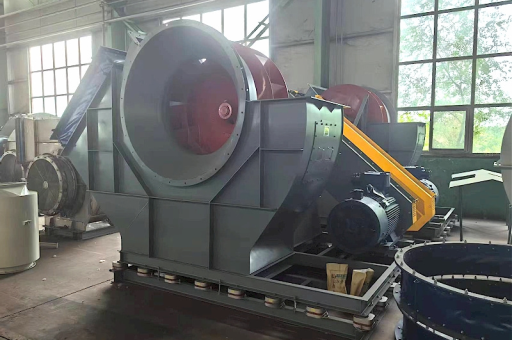
It seems you are describing a specific configuration of industrial ventilation equipment: a middle-pressure centrifugal fan that is coupling-driven, intended for use in air purification systems.
Below is a breakdown of what this system entails, its components, applications, and key engineering considerations.
Definition of the Components
-
Middle Pressure Centrifugal Fan:
- Pressure Range: Typically operates between 1,000 Pa and 3,000 Pa (or 4 to 12 inches w.g.). This is higher than low-pressure axial fans but less than high-pressure blowers.
- Design: Uses a forward-curved or radial-blade impeller. This design is optimal for moving large volumes of air against moderate resistance (e.g., from ductwork and filters).
- Characteristic: High efficiency for air purification because it can overcome the pressure drop caused by HEPA filters, carbon beds, or scrubbers without requiring excessive power.
-
Coupling Driven (Direct/Indirect):
- Mechanism: The fan impeller is not directly mounted on the motor shaft. Instead, a flexible coupling (e.g., tire-type, grid, or jaw coupling) or a belt-pulley system connects the motor to the fan.
- Purpose:
- Motor Isolation: Prevents motor bearing damage from fan vibration or heat.
- Speed Control: Allows the fan to run at a different speed than the motor (often slower for lower noise or higher torque).
- Maintenance: Allows replacing the motor without disturbing the fan housing or ductwork.
-
Air Purification:
- Usage: The fan draws contaminated air through a filtration or scrubbing system (e.g., pre-filters, HEPA filters, activated carbon, UV-C, or electrostatic precipitators).
- Challenge: The system must overcome the static pressure loss from the filter media.
Typical Applications
This configuration is common in industries requiring high air quality standards:
- Cleanrooms (ISO 5-8): HEPA-filtered air supply.
- Pharmaceutical Manufacturing: Removing dust and fumes.
- Chemical Fume Hoods: Exhausting corrosive vapors.
- Welding or Battery Manufacturing: Capturing fine particulate and toxic gases.
- HVAC for Commercial Buildings: High-efficiency filtration for recirculated air.
- Odor Control (Food Processing/Wastewater): Activated carbon or bio-filter systems.
Key Advantages of This Setup
| Feature | Benefit |
|---|---|
| Middle Pressure | Overcomes filter resistance (e.g., 500-2000 Pa drop across a HEPA filter). |
| Centrifugal Design | High static pressure capability; less prone to stalling than axial fans when filters clog. |
| Coupling Drive | Vibration isolation (protects motor bearings); allows for VFD installation (speed control to adjust airflow as filters load); simplifies motor replacement (no need to realign the impeller in the housing). |
| Air Purification | Suitable for both particle filtration (dust) and gas phase filtration (VOCs, odors). |
Engineering Considerations for Selection
If you are designing or specifying this system, consider:
-
Pressure Drop Calculation:
- Sum the pressure drop of the clean filter (initial) + dirty filter (end-of-life) + duct losses.
- The fan must operate at a stable point on its curve at the highest expected pressure drop.
-
Drive Type:
- Flexible Coupling: Best for direct power transmission (1:1 speed). Reduces misalignment issues.
- Belt Drive (V-belt or Timing Belt): Better for speed reduction (e.g., running a 1750 RPM motor down to 1200 RPM for lower noise). Requires belt maintenance.
-
Material Selection:
- Housing/Impeller: Carbon steel (standard), stainless steel (corrosive/sterile environments), or coated (for chemical resistance).
- Bearings: Must be sealed or purged if handling contaminated air.
-
Motor Protection:
- Use a Variable Frequency Drive (VFD) to control airflow precisely and to soft-start the motor.
- Ensure the motor is rated for inverter duty (if VFD used) and for the ambient temperature (hot air from purification process?).
-
Safety & Standards:
- ATEX/IECEx: If the air contains flammable dust or vapors (e.g., solvent recovery).
- ISO 16890 / EN 1886: For filtration efficiency and casing leakage.
- AMCA / ASHRAE: For fan performance certification.
Operational Issues to Watch For
- Filter Loading: As filters load, system resistance increases. A coupling-driven fan with a VFD can compensate by increasing speed, but this increases energy use.
- Coupling Alignment: Misaligned couplings cause vibration, bearing wear, and premature failure. Regular laser alignment is critical.
- Air Leaks: If the ductwork or fan casing leaks, purification efficiency drops. Test with a smoke pen.
Summary Example
"A hospital HVAC system uses a middle-pressure, backward-inclined centrifugal fan driven by a flexible grid coupling connected to a 30 HP, 1750 RPM motor. The fan pulls return air through a bank of MERV-8 pre-filters and HEPA filters (total drop: 2,500 Pa). The coupling allows the fan to be mounted on a concrete inertia base separate from the motor, reducing transmitted vibration into the ductwork."
Would you like me to elaborate on any specific area, such as sizing calculations for the coupling, VFD control strategies for filter loading, or material selection for corrosive air streams?





