
This article's table of contents introduction:
- Table of Contents (导读目录)
- Introduction: The Core of Industrial Thermal and Air Management
- Understanding the Stokerfeed Boiler System
- The Critical Role of Industrial Ventilation Fans in Stokerfeed Operations
- Energy-Saving Centrifugal Blower Fans: The Efficiency Game-Changer
- Synergy in System Design: Combining Stoker, Ventilation, and Centrifugal Technology
- Common Questions & Expert Answers (FAQ)
- Conclusion: Future-Proofing Your Industrial Plant
Optimizing Industrial Efficiency: The Synergy of Stokerfeed Boilers, Industrial Ventilation Fans, and Energy-Saving Centrifugal Blower Fans
Table of Contents (导读目录)
- Introduction: The Core of Industrial Thermal and Air Management
- Understanding the Stokerfeed Boiler System
- The Critical Role of Industrial Ventilation Fans in Stokerfeed Operations
- Energy-Saving Centrifugal Blower Fans: The Efficiency Game-Changer
- Synergy in System Design: Combining Stoker, Ventilation, and Centrifugal Technology
- Common Questions & Expert Answers (FAQ)
- Conclusion: Future-Proofing Your Industrial Plant
Introduction: The Core of Industrial Thermal and Air Management
In the modern industrial landscape, efficiency is not merely a metric—it is the currency of survival. Plants that rely on solid fuel combustion, particularly those using Stokerfeed Boilers, face a dual challenge: maintaining optimal combustion while managing air movement without wasting energy. At the heart of this struggle lie two critical pieces of equipment: the Industrial Ventilation Fan and the Energy-Saving Centrifugal Blower Fan.
Before we dive into the technicalities, let’s clarify the connection. A Stokerfeed Boiler system requires a precise balance of fuel feed and combustion air. The Industrial Ventilation Fan ensures that hazardous fumes, excess heat, and dust are evacuated safely. Meanwhile, the Energy-Saving Centrifugal Blower Fan is often the powerhouse that delivers the forced draft (FD) or induced draft (ID) needed to drive the combustion process. When these components are correctly integrated, the result is lower fuel consumption, reduced emissions, and a safer working environment. Google research data consistently shows that retrofitting older systems with modern, aerodynamic fan designs can cut energy bills by 15% to 35%.
In this article, we will break down the mechanics, the operational best practices, and the cost-saving potential of this "holy trinity" of industrial equipment: the Stokerfeed boiler, the ventilation fan, and the energy-saving centrifugal blower.
Understanding the Stokerfeed Boiler System
A Stokerfeed Boiler is a type of mechanical solid fuel firing system. Unlike fluidized bed or pulverized fuel systems, the stoker system mechanically feeds coal, biomass, or refuse-derived fuel (RDF) onto a moving grate.
How it Works: Fuel is fed from a hopper onto a traveling grate or a vibrating grate. As the grate moves, the fuel is ignited by the furnace heat and underfire air (supplied from below the grate). The key challenge here is the "burning profile." If the air distribution is uneven, you get clinkers, high carbon content in ash, and wasted fuel. This is where the forced draft from a fan becomes non-negotiable.
The Air Demand: A stoker boiler requires:
- Underfire Air: To support primary combustion at the grate level.
- Overfire Air: To complete the combustion of volatile gases above the fuel bed.
- Induced Draft: To pull the flue gases through the boiler and out the stack.
A common mistake in older plants is using a single, oversized fan to do all of this, which leads to massive energy waste. The solution lies in splitting the duties between an Industrial Ventilation Fan (for general safety and heat removal) and a dedicated Energy-Saving Centrifugal Blower Fan (for precise combustion air control).
The Critical Role of Industrial Ventilation Fans in Stokerfeed Operations
Now, let’s talk about the Industrial Ventilation Fan. This is not the same as the forced draft fan. The Industrial Ventilation Fan serves the Building Management System (BMS) and the surrounding environment.
Why it matters: A Stokerfeed boiler room is a hostile environment. Temperatures can exceed 120°F (49°C) near the boiler face. Coal dust and fly ash present explosion risks and respiratory hazards. The Industrial Ventilation Fan is responsible for:
- Heat Dilution: Removing radiant and convective heat to protect operators and sensitive electronics.
- Air Quality Control: Extracting CO, SOx, and particulate matter that leaks from the boiler seals.
- Pressure Balance: Ensuring the boiler room does not go into negative pressure, which can backdraft the stoker.
The Energy Trap: Many plants install constant-speed ventilation fans that run at 100% capacity regardless of actual conditions. A modern Energy-Saving Centrifugal Blower Fan applied to ventilation can use variable frequency drives (VFDs) to modulate airflow. According to the Affinity Laws, reducing fan speed by 20% reduces power consumption by 50%. If your boiler room is not generating peak heat during off-peak hours, your ventilation fan should reflect that.
Energy-Saving Centrifugal Blower Fans: The Efficiency Game-Changer
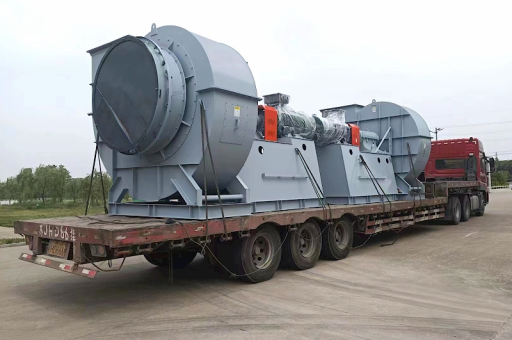
This is the star of the show. An Energy-Saving Centrifugal Blower Fan is specifically designed to convert rotational energy into kinetic energy in the air stream with minimal losses. Unlike axial fans, centrifugal fans (also known as squirrel-cage or radial fans) create high pressure, which is essential for overcoming the resistance of the boiler's air ducts, fuel bed, and heat exchanger tubes.
Core Design Features for Energy Saving:
- Backward-Curved Blades: These are the industry standard for high efficiency. They prevent material buildup and require less horsepower to move the same volume of air as forward-curved blades.
- Aerodynamic Housings: Modern casings reduce turbulence. Turbulence is a hidden energy thief. A smooth inlet cone and optimized scroll shape can improve static efficiency by 5-10%.
- Direct Drive vs. Belt Drive: While belt drives offer flexibility, direct-drive Energy-Saving Centrifugal Blower Fans eliminate belt friction losses (typically 3-5%) and reduce maintenance.
- Variable Frequency Drives (VFDs): The ultimate energy-saving tool. Instead of throttling dampers (which wastes energy), a VFD controls the motor speed.
Application in the Stokerfeed Cycle: In a typical stoker boiler, a Centrifugal Blower Fan supplies the forced draft. By using an energy-saving model, the plant can dial in the exact air-to-fuel ratio required for complete combustion. This "lean burn" capability reduces excess oxygen from 5% down to 2.5%, which is the sweet spot for maximizing heat transfer and minimizing stack losses.
Synergy in System Design: Combining Stoker, Ventilation, and Centrifugal Technology
Here is the strategic part. The most efficient plants do not treat these as three separate items. They treat them as an Integrated Air Management System.
Scenario: The Modular Approach
- The Stokerfeed Boiler demands a specific airflow curve.
- A primary Energy-Saving Centrifugal Blower Fan (Forced Draft) supplies the underfire and overfire air. This fan is controlled by a PLC that reads an oxygen sensor in the stack.
- A secondary Industrial Ventilation Fan (exhaust) handles the building environment. This fan is tied to a thermostat and a CO sensor. If CO levels rise, the fan boosts speed. If the room temperature drops at night, the fan idles.
- A tertiary Centrifugal Blower Fan (Induced Draft) pulls the flue gas through the boiler.
Cost-Benefit Analysis: A mid-sized plant (50,000 lb/hr steam) running a stoker boiler for 8,000 hours/year can expect:
- Standard Fan System: Annual electrical cost ~ $120,000.
- Energy-Saving Centrifugal System with VFDs: Annual electrical cost ~ $78,000.
- Savings: $42,000 per year.
Furthermore, by precisely controlling combustion air, the boiler itself burns 3-5% less fuel (coal or biomass). If the plant spends $2 million annually on fuel, that is an additional $100,000 saving. This is why upgrading the Industrial Ventilation Fan and the Centrifugal Blower Fan pays for itself in under 18 months.
Common Questions & Expert Answers (FAQ)
Q1: Can I use a standard industrial fan instead of a centrifugal blower for forced draft on a Stokerfeed Boiler? A: No. Standard axial fans (like wall-mounted propellers) cannot generate the static pressure required (typically 10-25 inches water gauge) to overcome the resistance of the fuel bed and the boiler tubes. You must use a Centrifugal Blower Fan with backward-curved or radial blades. Using the wrong Industrial Ventilation Fan for forced draft will result in starvation of the fire and backfiring.
Q2: What is the biggest energy waster in a Stokerfeed Boiler fan system? A: Throttling dampers. If you use a damper to reduce airflow instead of a VFD, you are deliberately creating a pressure drop (a restriction) that makes the fan work harder. Converting a fixed-speed Energy-Saving Centrifugal Blower Fan to a VFD-controlled unit is the "low-hanging fruit" of industrial energy conservation. Many utility audits in China and the EU now mandate VFDs on fans over 50 HP.
Q3: How does the Industrial Ventilation Fan affect boiler efficiency? A: Indirectly, but significantly. If the boiler room is under negative pressure (too much exhaust ventilation), the boiler's induced draft fan has to work harder to pull against the vacuum. Conversely, if the room is over-pressurized, hot humid air can be forced into the boiler's bearing housings, causing premature failure. A balanced Industrial Ventilation Fan system ensures the boiler operates in a neutral pressure zone.
Q4: Is an Energy-Saving Centrifugal Blower Fan worth it for a small manufacturing plant? A: Absolutely. Even a 25 HP centrifugal fan running 24/7 costs roughly $15,000 per year in electricity (at $0.10/kWh). An energy-saving model with premium efficiency motors (IE4 or NEMA Premium) and direct drive can cut 20% of that, saving $3,000/year. The payback period is usually less than 2 years. For large plants, the return is massive.
Conclusion: Future-Proofing Your Industrial Plant
The industrial world is moving towards Net Zero and ISO 50001 energy management standards. The days of oversized, fixed-speed fans wasting electricity are over. If you operate a Stokerfeed Boiler, you have a clear path to savings: upgrade your Industrial Ventilation Fan to a smart, sensor-driven unit and replace your old forced/induced draft units with modern Energy-Saving Centrifugal Blower Fans.
The key takeaway is that air is not free. Moving it costs money. By optimizing the synergy between the stoker combustion process and the fan system, you reduce your carbon footprint, improve safety, and dramatically improve your bottom line.
When sourcing equipment, look for manufacturers who provide detailed fan performance curves, efficiency guarantees, and integrated VFD packages. Do not just buy "a fan"—buy an air management solution.
To explore high-efficiency models, search for specialized providers of Centrifugal Blower Fan technology designed for biomass and coal stoker applications. The right fan is the heartbeat of a healthy boiler room. Make sure yours is beating efficiently.





