
This article's table of contents introduction:
- System Components
- Critical High-Temperature Considerations
- Common Applications
- Common Problems & Troubleshooting
- Key Specification Questions
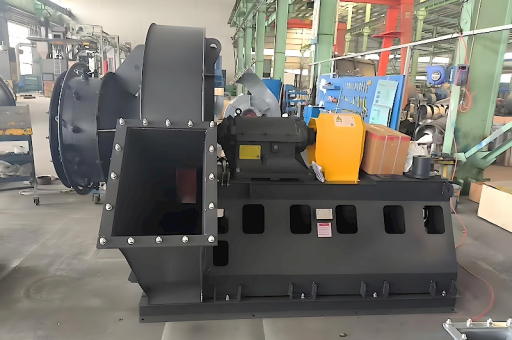
It appears you are describing a V-belt driven, centrifugal ventilation fan used as a high-temperature air blower.
This is a very common configuration in industrial settings (foundries, bakeries, kilns, drying ovens, fume extraction). Here is a breakdown of the system, critical considerations for high-temperature operation, and common issues.
System Components
- Motor: The prime mover (usually AC induction, constant speed or VFD controlled).
- V-Belt Drive: Transfers power from the motor to the fan. Allows for speed (RPM) adjustments by changing pulley diameters. Provides shock absorption and some slip protection.
- Centrifugal Fan: Moves air/ gas by centrifugal force.
- Scroll Housing: Directs the high-velocity air outward.
- Impeller (Wheel): The rotating part. In high-temp applications, this is crucial.
- Backward Curved: Most efficient for clean, high-temp air.
- Radial (Paddle Wheel): Very robust, handles high heat and dirty/gritty air well.
- Forward Curved: Less common for high-temp due to stress limitations.
- Air/Gas: The fluid being moved. In high-temp scenarios, density changes drastically, affecting motor load.
Critical High-Temperature Considerations
A standard fan will fail quickly in high heat. Modifications are required:
A. Material of Construction (Impeller & Housing)
- Standard (Fails): Mild steel/aluminum. Loses strength, deforms, or melts.
- High-Temp (Required): Stainless steel (304/316L, or better, heat-resistant alloys like Inconel). Heavier gauge steel to resist warping. Impeller should be stress-relieved and welded properly.
B. Bearing & Lubrication
- The Shaft Heat Path: Heat travels down the fan shaft to the bearings.
- Mitigation: The shaft between the impeller and the bearings is often longer than standard to act as a heat sink. Shaft cooling fins or a cooling fan disc can be mounted on the shaft near the bearings.
- Bearings: Require high-temperature grease (EP grease for up to ~120°C / 300°F, or specialized synthetic grease for higher). For extreme temps (250°C+), water-cooled bearing housings or remote-mounted bearings are necessary.
C. Shaft Seal
- Standard seals melt.
- Need: High-temp lip seals, Teflon (PTFE) labyrinth seals, or purged air seals (injecting compressed air into the seal to cool and prevent hot gas from reaching the bearing area).
D. Motor Load (Amp Draw) - CRITICAL
- The Physics: Hot air is less dense than cold air.
- Cold Start Danger: If the fan is started while cold, but designed for hot air, the denser cold air will cause the motor to draw significantly higher amperage. This will trip the overloads or burn out the motor.
- The Rule: Always start the fan AFTER the system is hot, or use a VFD (Variable Frequency Drive) to limit the speed during cold start-up.
Common Applications
- Kiln Combustion Air
- Oven/ Dryer Exhaust
- Fume Extraction (welding, chemical processing)
- Grain Drying
- Glass Manufacturing
- Boiler Induced Draft (ID Fans)
Common Problems & Troubleshooting
| Symptom | Likely Cause | Solution |
|---|---|---|
| Excessive Vibration | Thermal warping of the impeller; imbalance due to dust build-up; loose V-belt or pulley. | Check impeller for cracks/runout. Clean impeller vanes. Re-tension belts. |
| Motor Overload (Tripping) | Cold air start; V-belt too tight; Wrong pulley size (fan running too fast); Internal rub due to housing warpage. | Preheat system; Adjust belt tension; Verify pulley ratio; Check clearance. |
| Bearing Failure | Heat migration; Lack of high-temp grease; Misaligned pulleys. | Add shaft cooling; Use correct grease; Align sheaves. |
| V-Belt Squealing / Slipping | Belts softened by heat; Motor pulley diameter too small (poor wrap angle). | Use Wrapped V-belts (not raw edge) for high temp; Increase motor pulley size. |
| Reduced Airflow | Air density change (warmer = less mass flow); Damper closed; Impeller worn or dirty. | Verify design specs; Adjust damper; Clean impeller. |
Key Specification Questions
If you are selecting or troubleshooting this fan, you need to know:
- Operating Temperature: Max continuous temp (°C/°F) and peak temp.
- Gas Type: Clean air? Dusty? Corrosive fumes?
- Required Flow: CFM or m³/hr at the operating temperature.
- Static Pressure: InH₂O or Pa.
- Motor Power: The fan power increases at cold conditions. You design for the hot case, but the motor must handle the cold air (often requiring a heater starter or VFD).
In summary: A V-belt driven centrifugal high-temperature blower is a robust industrial solution, but it requires specialized materials (stainless/high alloy) and thermal management (cooling shaft, high-temp grease) . The most common operational failure is motor overload during a cold start due to the increased density of the air.
If you have a specific symptom (e.g., "The bearings fail every 3 months" or "The motor trips on start-up"), please share more details for a targeted diagnosis.





