
This article's table of contents introduction:
- Breaking Down the Specification
- Key Engineering & Selection Challenges
- Critical Design Features for Antiwear at 2900 RPM
- Operational Risks at 2900 RPM in Biomass
- Suggested Inquiry for a Supplier
- Summary
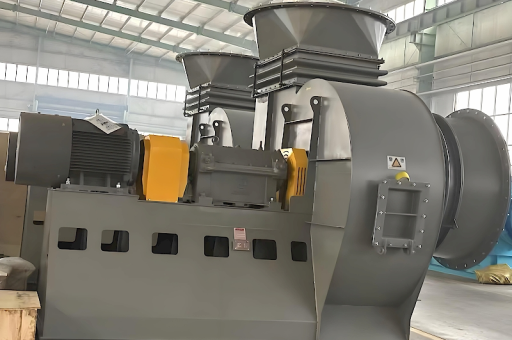
It appears you are describing a high-speed, free-standing industrial fan (likely an ID Fan, FD Fan, or PA Fan) designed for a biomass power plant, running at 2900 RPM, and requiring anti-wear protection.
Here is a breakdown of what this specification means, the associated challenges, and the critical engineering requirements for such a fan.
Breaking Down the Specification
- Biomass Boiler: The fuel is wood chips, pellets, agricultural waste, or husks. This creates highly abrasive fly ash and often corrosive gases.
- Antiwear: The fan must have sacrificial liners, hard-faced blades, or wear-resistant coatings to survive the particulate-laden gas stream.
- Free Standing: The fan is not mounted directly on a concrete foundation but on a structural steel frame or baseplate (overhung or pedestal bearing design). This implies critical rotor dynamics and structural stiffness.
- 2900 r/min: This is a Direct Drive speed (2-pole motor, 50Hz grid). This creates a high tip speed (high erosion rate) and high stress on the impeller.
- Power Plant Fan: This is a critical piece of equipment. Failure means a boiler trip.
Key Engineering & Selection Challenges
For a fan running at 2900 RPM in a biomass plant, the three main killers are:
- Erosion (Abrasion): High speed (2900 RPM) throws particles at the blades with extreme kinetic energy.
- Imbalance: Uneven wear or ash buildup causes catastrophic vibration at 48 Hz (2900 RPM).
- Fatigue: High cyclic stress from the speed, combined with the weight of anti-wear liners, can crack the impeller.
Critical Design Features for Antiwear at 2900 RPM
If you are sourcing or specifying this fan, look for these features:
Impeller Construction (The Rotor)
- Material: High Tensile Steel (e.g., S355J2+N or Corten) or Stainless Steel (SS 316L) for corrosion resistance underneath the wear layer.
- Blade Profile: Backward Curved (e.g., FC or BCI type). Avoid radial blades (which act like sandblasters).
- Thickness: Blades must be thick (minimum 8mm-12mm) for the base material, with added wear protection.
- Wear Protection:
- Weld Overlay: Application of hard-facing (e.g., Chromium Carbide (Fe-Cr-C) or Tungsten Carbide) on the leading edges and pressure side of the blades. Mandatory for 2900 RPM.
- Ceramic Tiles: Application of 92%+ Alumina ceramic tiles bonded with high-strength epoxy or brazed. This is the gold standard for biomass fly ash.
- Sacrificial Liners: Bolt-on steel or ceramic wear plates on the casing and inlet cone (shroud).
Free Standing Baseplate (Structural Integrity)
- Dynamic Stiffness: The baseplate must be tuned to avoid resonance at 2900 RPM (48.3 Hz) and 5800 RPM (2x harmonic).
- Bearing Housing: Must be heavy-duty, cast iron or fabricated steel, with a short overhang to minimize shaft deflection.
- Vibration Monitoring: Must have accelerometer mounts (ICP sensors) for real-time monitoring.
Shaft & Bearings
- Shaft: Short, stubby shaft design to reduce bending stress.
- Bearings: Splitspherical roller bearings (e.g., SKF, FAG) with:
- High clearance (C3 or C4) to handle thermal expansion.
- Oil bath or circulating oil lubrication (grease will burn off at high ambient temps).
- High-temperature sealing (V-ring or labyrinth seals to keep ash out).
Casing Design
- Double Wall: Outer structural wall, inner lining of wear-resistant steel (Hardox 400/500 or similar).
- Access Doors: Full-size access doors for inspection and replacement of wear liners without unbolting the fan.
Operational Risks at 2900 RPM in Biomass
- Ash Fouling: Biomass ash is sticky (due to potassium and alkali content) at high temperatures. It can cake on the impeller. Solution: Compressed air or steam sootblowers inside the fan casing to clean the rotor while running.
- Corrosion: Many biomass fuels contain high chlorine (e.g., straw, MBM). This causes severe high-temperature corrosion (Active Oxidation). Solution: Use of high-nickel alloys (Inconel 625 overlay) on the impeller.
Suggested Inquiry for a Supplier
If you are purchasing this fan, ask the manufacturer these specific questions:
- "What is the blade tip speed at 2900 RPM? (Calculate: Diameter in meters x Pi x 48.3 Hz)."
- "What is the anti-wear strategy for the blades? Hardfacing? Ceramic tiles? What thickness?"
- "What is the critical speed of the rotor? Is it rigid or flexible at 2900 RPM?"
- "What bearing clearance do you recommend for a 2900 RPM free-standing fan in a high temperature (>150°C) biomass application?"
- "Do you have a balancing specification? (ISO 1940 G2.5 or better is needed)."
Summary
| Parameter | Specification | Implication |
|---|---|---|
| Fan Type | Centrifugal, Backward Curved | High efficiency, self-limiting power curve. |
| Speed | 2900 RPM | Direct drive. High erosion. Mandatory dynamic balancing. |
| Mount | Free Standing | Requires stiff baseplate, no building resonance. |
| Antiwear | Chromium Carbide / Ceramic | Costly but necessary for biomass. |
| Bearing Life | L10h > 100,000 hours | Requires oil lubrication, high temp seals. |
Recommendation: If the gas stream contains high moisture or sticky ash, you may need to consider a slower speed fan (1450 RPM) with a heavy-duty belt drive instead of 2900 RPM direct drive. The higher speed greatly accelerates wear and vibration issues in biomass plants.





