
This article's table of contents introduction:
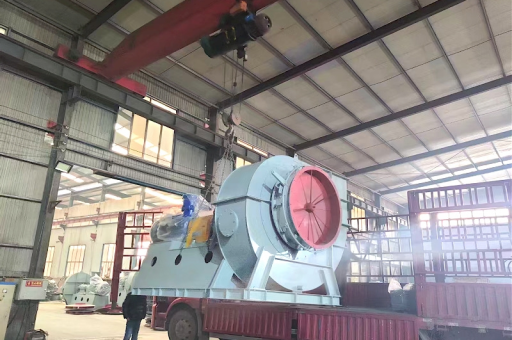
- System Context (What does it do?)
- Critical Components of the Specification
- Common Performance Parameters (Estimates)
- Why 2900r/min is a key constraint
- Potential Problems with this Fan Type
- Summary Datasheet (Example)
- Need a specific quote or design calculation?
This appears to be a request for information or a specification regarding a specific type of industrial fan used in a coal-fired power plant or industrial boiler system.
Here is the breakdown of what that description means and the typical technical context for a "Primary Air Pulverized Coal Drying 2900r/min Centrifugal Exhaust Fan."
System Context (What does it do?)
This fan is a Primary Air (PA) Fan. Its job is not just to move air, but to:
- Dry the coal: Hot air (often mixed with flue gas) is blown into the pulverizer (mill) to evaporate moisture from the raw coal.
- Convey the coal: Once the coal is ground to a fine powder, this air stream carries it from the mill to the burner.
- Supply combustion air: It provides the initial air for combustion at the burner.
The specific function described ("Drying") emphasizes the thermal duty. In many plants, a Hot PA Fan handles this. The term "Exhaust Fan" here is slightly misleading in a classic ventilation sense. In a coal mill system, the Mill Exhauster Fan is the fan that sucks the air and coal through the mill and then pushes it into the burner pipes. This is almost certainly what is being referred to.
Critical Components of the Specification
-
Fan Type: Centrifugal
-
Speed: 2900 r/min (Revolutions per Minute)
- This implies Direct Drive.
- At 50 Hz (common in Europe, Asia, Africa), a 4-pole motor runs at ~1500 rpm, and a 2-pole motor runs at ~3000 rpm (synchronous speed).
- 2900 rpm is the actual running speed (slip) of a standard 2-pole AC induction motor.
- Key Takeaway: This is a high-speed, high-pressure fan. It is not a low-speed, high-volume fan.
-
Design: Centrifugal
- Type: For PA fans and mill exhausters, the most common types are:
- Radial / Radial Tip: Very robust, handles high dust loading (abrasive coal dust), handles high temperatures, and has high pressure capability.
- Backward Inclined / Backward Curved: More efficient than radial, but more sensitive to erosion from coal dust.
- Forward Curved: Rarely used for this duty due to pressure limitations.
- Type: For PA fans and mill exhausters, the most common types are:
-
Medium: Pulverized Coal Drying
- The fan handles hot, dusty air. Normal operating temperature is often between 80°C and 150°C (175°F - 300°F), but can be higher if using pre-heated air.
- The dust is highly abrasive (silica in coal/ash).
- Critical Design Feature: Erosion Protection.
- Casing liners (hard-faced or ceramic tiles).
- Wear plates on the impeller blades and shrouds.
- Hard surfacing (Stellite or chrome carbide overlay) on leading edges.
Common Performance Parameters (Estimates)
For a fan of this type and speed, you can expect:
| Parameter | Typical Value (Estimate) | Notes |
|---|---|---|
| Speed | 2900 - 2980 rpm | Direct coupled to 2-pole motor. |
| Flow Rate | 50,000 - 150,000 m³/hr | Varies wildly by boiler size (e.g., 300 MW boiler). |
| Static Pressure | 800 - 1500 mmWg (mm of Water Gauge) | High pressure to overcome mill, duct, and burner resistance. |
| Temperature | Ambient to 150°C | Can spike higher if hot gas recirculation is used. |
| Motor Power | 150 kW - 500 kW | Large motors required for high pressure and dust loading. |
| Impeller Material | Hardox, Abrex, or Cast Iron (Ni-hard) | Must be wear-resistant. |
| Bearing Type | Sleeve or Rolling element | For high speed, rolling element (spherical roller) bearings with high-temperature grease are common. |
Why 2900r/min is a key constraint
- High Tip Speed: The impeller tip speed is very high (e.g., 80-100 m/s). This is necessary to generate the static pressure required to push the coal-air mixture long distances.
- Vibration Sensitivity: At this speed, the fan rotor must be dynamically balanced to high precision (ISO G2.5 or G6.3). A small amount of wear from coal dust will quickly cause severe vibration.
- Bearing Stress: The bearings must be rated for a high L10 life and continuous operation. Oil lubrication (flood or oil mist) is often used instead of grease at these speeds.
Potential Problems with this Fan Type
- Erosion: The #1 killer. The impeller blades will wear thin, usually at the leading edge and the backplate, leading to imbalance and cracking.
- Rotor Imbalance: Due to erosion and/or coal dust accumulation.
- High Temperature: If the air temperature spikes above design (e.g., due to a mill fire or hot gas ingress), the shaft can warp, or the impeller can fail under thermal stress.
- Shaft Seal Leakage: The seal where the rotating shaft enters the fan casing is prone to leakage of hot, dusty air. Labyrinth seals or pressurized seals are needed.
Summary Datasheet (Example)
| Item | Specification |
|---|---|
| Application | Primary Air / Mill Exhauster for Pulverized Coal |
| Fan Type | Centrifugal, Single Inlet, Direct Drive |
| Rotation (View from Drive End) | 2900 rpm (Clockwise or Counter-clockwise) |
| Impeller Diameter | ~900 mm - 1200 mm (depending on flow) |
| Casing | Heavy-gauge steel with erosion-resistant liners |
| Bearings | NSK / SKF 223XX series spherical roller |
| Coupling | Flexible (Diaphragm or Grid) |
| Motor | 2-pole Induction, 400V / 6000V, IP55 |
| Sound Level | > 85 dBA (requires silencers on ducts) |
Need a specific quote or design calculation?
To get a precise answer, you would need to provide:
- Flow (m³/hr or CFM)
- Static Pressure (mmWg or Pa)
- Temperature (°C)
- Gas density
- Dust concentration (g/Nm³)
- Altitude (m) (affects motor power)
If you provide these, I can give more specific engineering guidance.





