
This article's table of contents introduction:
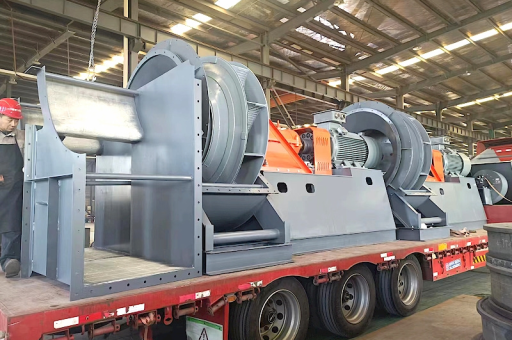
- What is this piece of equipment?
- Key Applications of this Fan in a Cement Kiln:
- Critical Design & Material Specifications
- Typical Technical Parameters (Example)
- Why is this specific fan so critical to the cement plant?
- Leading Manufacturers of this Equipment (Examples)
- Key Questions to Ask a Supplier:
It sounds like you are looking for information on industrial centrifugal fans specifically designed for use in cement rotary kiln applications, which are constructed from carbon steel and offer large capacity.
Here is a detailed breakdown of what that entails, the specific requirements for a cement kiln fan, and the key selection criteria.
What is this piece of equipment?
This is a heavy-duty, high-temperature industrial fan used in the pyro-processing section of a cement plant. Its primary job is to provide the necessary airflow (combustion air) and draft (negative pressure) to the rotary kiln. It is the "lungs" of the kiln system.
Because cement manufacturing involves high temperatures, abrasive dust, and large volumes of air, the fan must be exceptionally robust.
Key Applications of this Fan in a Cement Kiln:
- Primary Air Fan (Kiln Burner Fan): Supplies air to the main burner at the discharge end of the kiln. Requires high pressure.
- Kiln Induced Draft (ID) Fan: Pulls hot gases (up to 350°C / 660°F) from the preheater tower through the kiln. This is often the largest and most critical fan in the plant.
- Grate Cooler Fans: While not directly a "kiln fan," these supply under-grate air to cool the clinker. They must handle very hot, dusty air being recirculated back to the kiln.
Critical Design & Material Specifications
When you specify a "Large Capacity Carbon Steel Cement Rotary Kiln Industrial Centrifugal Fan," you are looking at these specific features:
Material: Carbon Steel (with high-temperature treatment)
- Base Material: Q235B or standard carbon steel is common for the housing.
- Impeller Material: Usually Q345B (16Mn) or higher-grade carbon steel for better strength at elevated temperatures.
- Why Carbon Steel? It offers a good balance of strength, weldability, and cost. For standard kiln gas temperatures (Under 400°C / 750°F), carbon steel with proper heat treatment is suitable.
- Important: The impeller must be stress-relieved after welding to prevent distortion at high RPM and temperature. The shaft must be robust (e.g., 45# carbon steel).
Design Type: Centrifugal Fan (Backward Curved)
The most common type for this application is a Backward Curved (BC) or Backward Inclined (BI) blade centrifugal fan.
- Efficiency: High (75-85%).
- Performance: Handles high pressure and high volume.
- Self-Limiting: The power curve peaks before overloading the motor.
- Dust Handling: Better than forward-curved fans, but still requires dust collection upstream.
Key Features for "Large Capacity" & "Cement" Service:
- Wear Protection: The fan casing and impeller should have weld-on wear plates (hard facing) on the leading edges of the blades and the scroll liner to combat abrasion from cement dust and clinker particles.
- High-Temperature Bearings: Water-cooled or air-cooled bearing housings are mandatory. The bearings must be rated for the high radiant heat from the kiln.
- Shaft Seal: A labyrinth seal or double-acting mechanical seal is needed to prevent hot, dusty gas from leaking out along the shaft.
- Variable Speed Drive (VSD): Almost always used to control airflow precisely for combustion efficiency and to reduce wear during startup.
Typical Technical Parameters (Example)
| Parameter | Typical Specification for a Cement Kiln ID Fan |
|---|---|
| Flow Rate (Capacity) | 200,000 m³/h to 1,500,000 m³/h (117,000 CFM to 880,000 CFM) |
| Pressure | 2,500 Pa to 8,000 Pa (10" w.g. to 32" w.g.) |
| Operating Temperature | 80°C to 350°C (176°F to 662°F) |
| Impeller Diameter | 2,000 mm to 5,000 mm (6.5 ft to 16 ft) |
| Main Motor Power | 200 kW to 5,000 kW |
| Wheel Type | Backward Inclined (BI) or Aerofoil |
| Drive | Direct Drive (Preferred) or V-Belt |
Why is this specific fan so critical to the cement plant?
- The "Heart" of Combustion: It directly controls the flame shape, temperature, and length inside the kiln. An unstable fan leads to poor clinker quality (free lime, under-burning).
- System Draft: The ID fan must overcome the resistance of the preheater tower, the rotary kiln, and the dust collector. If it fails, the kiln must be shut down immediately.
- Energy Consumption: The kiln fan is one of the largest single energy consumers in a cement plant. A highly efficient (85%+) backward-curved fan can save hundreds of thousands of dollars in electricity per year.
- Reliability: Unplanned downtime of a kiln fan costs a cement plant $50,000 to $100,000+ per day in lost production and repair costs.
Leading Manufacturers of this Equipment (Examples)
If you are sourcing this fan, consider these global and regional brands known for cement industry expertise:
- Howden (USA/Global)
- FläktGroup / Greenheck (USA/Europe)
- TLT-Turbo (Germany)
- Zibo Longqiang (China) - Very popular in Asian markets.
- Suzhou Bibo (China)
- Cement Plant OEMs (e.g., Sinoma, FLSmidth, ThyssenKrupp) often supply the fan as part of the total kiln package.
Key Questions to Ask a Supplier:
- "What is the guaranteed efficiency at the design point?"
- "What is the impeller alloy and is it stress-relieved?"
- "What type of bearing cooling system do you recommend?"
- "What is the critical speed of the rotor?" (Must be well above operating speed)
- "What is the wear plate thickness on the impeller and casing?"
- "Can you provide a FEM analysis (Finite Element Method) for the impeller for high-temperature operation?"
In summary: This is a very specific, high-stakes piece of capital equipment. You need a fan that is oversized in material, robust in design, and highly efficient to handle the extreme thermal and abrasive environment of a cement rotary kiln. It is a critical component for the profitability and reliability of the entire cement plant.





