
This article's table of contents introduction:
- Putting It All Together: Probable Definition
- Important Check: Is it really a "Forward Blast" furnace?
It appears you are describing a specific type of industrial fan, likely used in biomass boilers, coal-fired furnaces, or industrial burners. Let's break down the key terms you've combined to understand the intended component.
"Aluminium Alloyed"
- Meaning: The fan impeller (wheel) or housing is made from cast or fabricated aluminum alloy (e.g., LM6, 6061, or A356).
- Why used:
- Lightweight: Reduces bearing load and startup inertia.
- Corrosion Resistance: Ideal for damp flue gases or coastal environments.
- Spark Resistance (Non-sparking): Crucial for forward blast furnaces where unburned fuel particles might be present. Aluminum is less likely to produce sparks than steel if it strikes the housing.
"High Air Flow"
- Meaning: The fan is designed for a high CFM (Cubic Feet per Minute) or m³/h relative to its static pressure.
- Impact: Typically implies a backward-curved or airfoil blade design for efficiency, OR a forward-curved blade design for high volume at low pressure. Given your mention of "Forward Blast," we will prioritize the latter.
"Forward Blast Furnace"
- Correcting the term: You likely mean a Forward-Curved Centrifugal Fan used as a Forced Draft (FD) fan for a furnace / boiler.
- Function:
- Forward-Curved Blades: The blades curve in the direction of rotation. This design traps air between blades and accelerates it outward.
- Result: Delivers very high air volume at low to moderate static pressure. It is compact and quieter than backward-curved fans.
- "Blast Furnace" Context: In a real steel-making blast furnace, high pressure (from backward-curved or radial fans) is needed. However, in smaller boiler furnaces (steam boilers, industrial heaters), forward-curved fans are very common for combustion air.
"Boiler Fan"
- Primary Application:
- Forced Draft (FD) Fan: Pushes fresh air into the combustion chamber to support burning.
- Induced Draft (ID) Fan: Pulls flue gases out of the boiler (less likely to be "forward blast").
Putting It All Together: Probable Definition
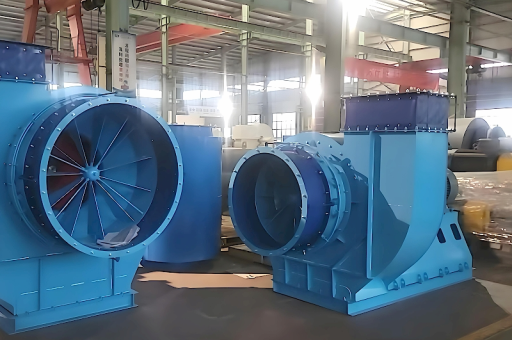
You are likely describing a Forward-Curved Centrifugal Fan with an Aluminum Impeller, designed for High Volume Airflow into a Boiler/Furnace.
Typical Specifications (Example)
| Parameter | Value (Typical) |
|---|---|
| Type | Forward Centrifugal (Squirrel Cage / Sirocco) |
| Impeller Material | Cast Aluminium Alloy (e.g., Grade A356-T6) |
| Housing Material | Mild Steel (or Aluminium for corrosive gases) |
| Airflow | 5,000 – 50,000 CFM (varies) |
| Static Pressure | 2 – 15 in. w.g. (Low to Medium) |
| Temperature | Up to 100°C (Standard) or 200°C (High-temp mods) |
| Application | Combustion air supply for biomass/coal boilers |
Why use Aluminum in this role?
- Safety: Reduces the risk of explosion in coal dust or gas environments.
- Efficiency: Lighter wheel means less power loss from inertia.
- Maintenance: Resists rust from acidic condensation (common in boiler startup/shutdown).
Important Check: Is it really a "Forward Blast" furnace?
If the furnace is a high-pressure blast furnace (steel industry), forward-curved fans are rarely used; they cannot generate the high static pressure required (50+ in. w.g.). In that case, you need a Radial (Paddle Wheel) or Backward-Curved fan.
Are you looking for:
- A specification sheet for this fan?
- A replacement impeller for a specific boiler?
- A nomenclature clarification (FD vs. ID fan)?
Let me know your exact need (e.g., "Find a supplier in the UK," "Calculate the power needed," or "Confirm if Aluminium is safe for coal dust"), and I can give you a precise answer.





