
This article's table of contents introduction:
- Core Definitions
- Key Technical Specifications (Typical for a Blast Furnace Application)
- Construction & Materials (Material Selection Table)
- Critical Design Features for Blast Furnace Application
- Performance & Operational Risks
- Typical Configurations for Blast Furnace Fans
- Which Industry Standards Apply?
- Summary for Your Application
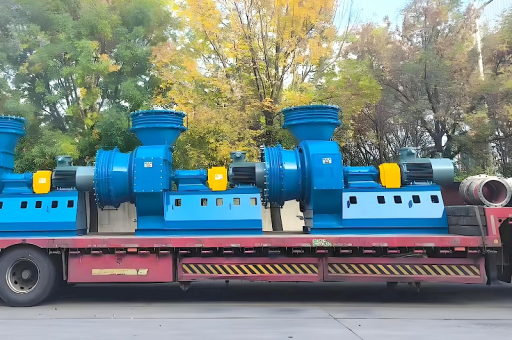
Your query appears to refer to a Q345 steel, high-volume centrifugal fan designed for blast furnace applications involving high-temperature gas handling.
Here is a detailed breakdown of what this piece of equipment is, its specifications, materials, and critical design considerations.
Core Definitions
- Q345 (Now Q355 in newer GB standards): A Chinese low-alloy high-strength structural steel (similar to ASTM A572 GR50 or EN S355JR). It offers good strength, weldability, and toughness. For high-temperature fans, the standard Q345 may be insufficient if the gas temperature exceeds 300-350°C (572-662°F) without special coatings or design modifications.
- High Volume (High Flow): Blast furnaces require massive amounts of air (up to 10,000–20,000 m³/min or more) to sustain the combustion process. The fan is often a double-suction, double-width (DWDI) centrifugal type to handle this flow.
- Blast Furnace: The primary reactor for ironmaking. The fan supplies "hot blast" (preheated air) into the tuyeres.
- High Temperature: For a blast furnace, the "cold blast" is typically 100-200°C, but the "hot blast" can be 900°C to 1,200°C after passing through a hot stove. The fan here is usually for the cold blast or combustion air for the stoves.
- Centrifugal Fan: Uses a rotating impeller to increase the pressure and flow of a gas.
Key Technical Specifications (Typical for a Blast Furnace Application)
| Parameter | Typical Value | Notes |
|---|---|---|
| Flow Rate (Q) | 3,000 – 25,000 Nm³/min | High volume, often controlled by inlet guide vanes (IGV) |
| Total Pressure (P) | 40 – 80 kPa (0.4 – 0.8 bar) | Blast furnace back pressure is high |
| Operating Temp | 100°C – 250°C (Standard) / 400°C+ (Special) | Standard Q345 steel is used for cold blast. For hot blast, you need alloy steel (e.g., 16Mo3, 15CrMo, or stainless steel 310S). |
| Impeller Type | Backward-curved, backward-inclined, or radial | Backward-curved is high efficiency; radial is for heavy dust or high wear. |
| Motor Power | 1,000 – 10,000+ kW | Synchronous or induction motors with VFD / fluid coupling |
| Material | Impeller & Casing: Q345R (Pressure Vessel Grade) | Caution: Q345 loses strength above 350°C. |
Critical Insight: For a true "high temperature" blast furnace fan (handling gas >350°C), Q345 is not suitable unless the fan is located on the cold blast side (before the hot stove). If it's for hot stove combustion air or hot blast, the material must be upgraded.
Construction & Materials (Material Selection Table)
| Component | Standard (Q345) | High-Temp Option (>350°C) |
|---|---|---|
| Impeller Blades | Q345B / Q345R (up to 250°C) | 15CrMo (500°C) / 12Cr1MoV (580°C) / 310S (1000°C) |
| Hub & Backplate | Q345R | 15CrMo or Cr-Mo alloy steel |
| Main Shaft | 45# Steel (C45) | 35CrMo or 40CrNiMo (for heat & fatigue) |
| Casing | Q345R (Water-cooled if needed) | Q345R with refractory lining OR 15CrMo |
| Bearings | Rolling (SKF/FAG) with cooling | Rolling or Tilting pad thrust bearings (oil/water cooling) |
| Seals | Labyrinth / Carbon ring | High-temp graphite or gas barrier seals (to prevent leakage of CO/CO2) |
Critical Design Features for Blast Furnace Application
- Wear Resistance: Blast furnace gas contains abrasive dust (iron ore, coke fines). The impeller and casing often have hard-facing (Stellite or ceramic coating) on leading edges.
- Vibration Monitoring: Due to high speed (often 1,500–3,000 RPM) and large mass, the fan must have continuous vibration monitoring (ISO 10816-3) with automatic trip alarms.
- Water Cooling: The shaft near the bearing housing, and sometimes the casing itself, requires a water jacket to prevent heat transfer to the bearings and lubricant.
- Critical Speed: The rotor (impeller + shaft) must be designed to operate well below the first lateral critical speed (typically 30-40% margin) to avoid resonance.
- Gas Leakage: For blast furnaces, the gas often contains lethal CO (carbon monoxide). Shaft seals must be double-sealed with a N₂ purge to prevent gas escape into the atmosphere.
Performance & Operational Risks
- Surge: A major risk in high-pressure centrifugal fans. A surge control system (anti-surge valve, recirculation line, or fast-acting IGV) is mandatory to prevent reverse flow and catastrophic impeller failure.
- Thermal Expansion: Q345 expands linearly. The casing and shaft must allow for thermal growth (e.g., flexible expansion joints on the inlet/outlet ducts, axial sliding bearing housings).
- Erosion: Over time, blade thinning occurs. Scheduled thickness testing (UT) is required every 6-12 months.
Typical Configurations for Blast Furnace Fans
- Single-Stage, Double-Suction (SS/DWDI): Most common for high volume, moderate pressure.
- Single-Stage, Single-Suction (SS/SI): For smaller blast furnaces or booster fans.
- Multi-Stage: For very high pressure (e.g., top gas recovery turbines or high-pressure hot stoves).
- Series Operation: Sometimes two fans in series for extreme pressure requirements.
Which Industry Standards Apply?
- GB/T 1236 (ISO 5801): Performance testing
- JB/T 8689 / JB/T 8822: Fan design, vibration, and balance
- API 673 (if international): For large, critical-service centrifugal fans
- GB/T 150 / ASME VIII: Pressure vessel design for casings
Summary for Your Application
- If Q345 + High Volume + Blast Furnace (Cold Blast side <250°C): Yes, this is a standard configuration. Ensure wear protection and good lubrication.
- If Q345 + High Volume + Blast Furnace (Hot Blast side >350°C): Do not use Q345 unless the casing is refractory-lined and the impeller is made of alloy steel. Use 15CrMo, 310S, or Inconel for the impeller.
Would you like me to provide a specific 3D model concept, a material list for a specific temperature (e.g., 200°C vs. 800°C), or a sizing calculation for a given flow and pressure?





