
This article's table of contents introduction:
- Table of Contents
- Introduction: The Critical Role of the Cement Kiln Fan
- What is a Carbon Steel Anticorrosion Cement Kiln High Pressure Centrifugal Fan?
- Why Carbon Steel? – Material Selection and Anticorrosion Strategies
- How Does It Work? – Operating Principles and High-Pressure Performance
- Key Application Areas in the Cement Industry
- Common Challenges: Corrosion, Wear, and High Temperature
- Frequently Asked Questions (FAQ)
- Maintenance Best Practices for Longevity and SEO-Ready Keywords
- Conclusion: Choosing the Right Fan for Your Cement Plant
** The Ultimate Guide to Carbon Steel Anticorrosion Cement Kiln High Pressure Centrifugal Fans: Design, Applications, and Maintenance
Table of Contents
- Introduction: The Critical Role of the Cement Kiln Fan
- What is a Carbon Steel Anticorrosion Cement Kiln High Pressure Centrifugal Fan?
- Why Carbon Steel? – Material Selection and Anticorrosion Strategies
- How Does It Work? – Operating Principles and High-Pressure Performance
- Key Application Areas in the Cement Industry
- Common Challenges: Corrosion, Wear, and High Temperature
- Frequently Asked Questions (FAQ)
- Maintenance Best Practices for Longevity and SEO-Ready Keywords
- Conclusion: Choosing the Right Fan for Your Cement Plant
Introduction: The Critical Role of the Cement Kiln Fan
In modern cement manufacturing, the Carbon Steel Anticorrosion Cement Kiln High Pressure Centrifugal Fan is not just an auxiliary component—it is the lungs of the kiln system. These fans are designed to handle the demanding task of supplying high-pressure airflow to the kiln burner, preheater, and calciner, ensuring complete combustion of fuel and efficient heat transfer. Without a reliable, corrosion-resistant fan, the cement production process would face severe downtime, reduced thermal efficiency, and premature equipment failure.
The unique operating environment of a cement kiln presents extreme challenges: temperatures exceeding 350°C (662°F), abrasive dust particles, and corrosive gases containing sulfur, chlorine, and alkali compounds. This is where the engineered combination of carbon steel with advanced anticorrosion coatings becomes indispensable. This article provides a comprehensive, SEO-optimized deep dive into the design, performance, and maintenance of these critical industrial fans.
What is a Carbon Steel Anticorrosion Cement Kiln High Pressure Centrifugal Fan?
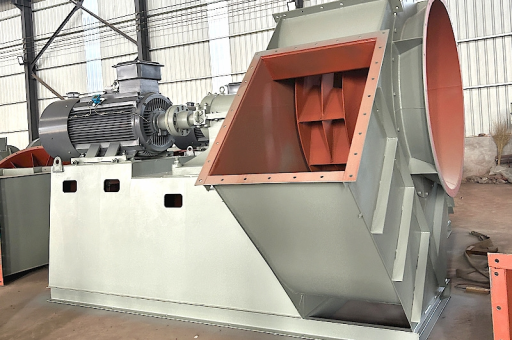
A Carbon Steel Anticorrosion Cement Kiln High Pressure Centrifugal Fan is a specialized industrial fan engineered to move large volumes of air or gas against high static pressure, while resisting chemical attack from kiln exhaust gases. The term "centrifugal" refers to its operating principle: air enters axially at the center of the impeller, is accelerated radially by rotating blades, and exits tangentially, creating high pressure.
Key Components:
- Impeller: Made from high-strength carbon steel (e.g., Q235 or Q345 grade), often reinforced with wear-resistant liners.
- Housing: Thick carbon steel plate (typically 6–12 mm) welded to form a scroll-shaped casing.
- Shaft: Forged and precision-machined to minimize vibration.
- Anticorrosion Layer: A specialized coating (e.g., epoxy phenolic, polyurethane, or rubber lining) applied to all gas-wetted surfaces.
- Drive System: Direct-coupled or belt-driven motor, usually with a variable frequency drive (VFD) for energy optimization.
Compared to standard fans, these units are built to operate at higher blade tip speeds (up to 120 m/s) and handle gas temperatures up to 450°C with cooling systems.
Why Carbon Steel? – Material Selection and Anticorrosion Strategies
Why not stainless steel? While stainless steels like 304 or 316 have excellent corrosion resistance, they are 3-5 times more expensive than carbon steel and have lower mechanical strength at elevated temperatures. Carbon steel, especially grades with higher carbon content (0.25–0.40%), offers superior strength-to-weight ratio, excellent weldability, and lower cost.
The Anticorrosion Solution: Since bare carbon steel will rapidly corrode in a cement kiln atmosphere containing SO₂, NOₓ, HCl, and moisture, a multi-layered anticorrosion system is applied:
- Surface Preparation: Abrasive blasting to Sa 2.5 standard (near-white metal).
- Primer Coat: High-temperature zinc-rich epoxy primer for cathodic protection.
- Intermediate Coat: Glass flake-filled vinyl ester resin to block moisture permeation.
- Top Coat: Fluorocarbon or polysiloxane coating for UV and chemical resistance.
This coating system can withstand pH values from 2 to 12 and temperatures up to 200°C continuously, with intermittent peaks up to 300°C. Some manufacturers also use hard-facing with tungsten carbide on the blade leading edges to combat abrasive wear from clinker dust.
How Does It Work? – Operating Principles and High-Pressure Performance
Centrifugal Action: The fan impeller rotates at high speed (typically 1450 or 2900 RPM depending on 50/60 Hz power). The rotating blades impart kinetic energy to the gas. The air is forced outward by centrifugal force, creating a low-pressure zone at the impeller eye and a high-pressure zone at the volute outlet.
Pressure & Flow Characteristics:
- High Pressure: These fans generate static pressure from 5000 Pa to 25,000 Pa (20 to 100 inches of water gauge). The high pressure is necessary to overcome the resistance of the kiln bed, preheater cyclones, and ductwork.
- Flow Rate: Typical capacities range from 50,000 m³/h to 500,000 m³/h for large cement lines (e.g., 5000 TPD production).
- Efficiency: Modern designs achieve aerodynamic efficiencies of 78–85% through backward-curved blades and optimized inlet guide vanes.
Tip: For SEO, use keywords like "high static pressure centrifugal blower," "cement kiln induced draft fan," and "corrosion resistant industrial fan" in your content.
Key Application Areas in the Cement Industry
The Carbon Steel Anticorrosion Cement Kiln High Pressure Centrifugal Fan is deployed in three primary applications:
- Kiln Induced Draft (ID) Fan: Located at the kiln outlet, it pulls combustion gases through the rotary kiln, maintaining slight negative pressure for safety and efficiency.
- Preheater Fan: Supplies air to the top of the preheater tower, supporting raw meal precalcination.
- Cooler Fan: Forces ambient air through the clinker cooler to recover heat and quench the clinker.
Each application requires slightly different fan designs:
- ID fans need maximum corrosion and high-temperature resistance.
- Preheater fans require dust-handling capability (often equipped with dust plows or wear liners).
- Cooler fans prioritize high air volume and moderate pressure.
Common Challenges: Corrosion, Wear, and High Temperature
Acidic Condensation When kiln exhaust gases cool below the acid dew point (approximately 80–100°C for sulfuric acid), acidic moisture condenses inside the fan housing and impeller. This leads to rapid corrosion. Solution: Use of air preheaters to maintain gas temperature above dew point, plus corrosion-resistant linings.
Erosion by Particulate Even with cyclone separators, fine cement dust (often containing hard SiO₂ particles) erodes the fan blades at high velocities. Solution: Hard-facing with Stellite or tungsten carbide, or applying ceramic tiles on high-wear areas.
Fatigue Cracking High cycling between shut-down and hot operation, combined with high centrifugal stresses, can lead to stress-corrosion cracking at weld joints. Solution: Regular non-destructive testing (NDT) like magnetic particle inspection.
Bearing Failures Hot gas conduction through the shaft leads to bearing overheating. Solution: Water-cooled bearings or extended shaft arms with heat sinks.
Frequently Asked Questions (FAQ)
Q1: What is the typical lifespan of a carbon steel anticorrosion cement kiln fan? A: With proper coating maintenance and regular balancing, these fans can last 8–12 years in continuous service. Blade replacement intervals are typically 3–5 years for high-wear areas.
Q2: How do I choose between a direct-drive and belt-drive cement kiln fan? A: Direct-drive is more efficient (no belt losses) and requires less maintenance, but it is limited to fixed speed unless paired with a VFD. Belt-drive allows speed changes by changing sheaves, but consumes more power and requires belt tensioning and alignment.
Q3: Can I use a standard fan without anticorrosion coating for cement kilns? A: Absolutely not. Standard fans will fail within months due to corrosion and erosion. The environmental conditions inside a cement kiln require specialized materials and coatings.
Q4: What is the maximum temperature that carbon steel can handle in this application? A: Carbon steel begins to lose its mechanical strength above 400°C. For continuous operation above 350°C, it is advisable to use a cooling system (e.g., fresh air damper) or switch to alloy steel grades.
Q5: How do I know when to replace the fan impeller? A: Perform vibration analysis regularly. If vibration exceeds 4.5 mm/s RMS (ISO 14694 Grade BV-5), or if visible cracks or pitting deeper than 1.5 mm are found on the blades, the impeller should be repaired or replaced.
Maintenance Best Practices for Longevity and SEO-Ready Keywords
Maintaining a Carbon Steel Anticorrosion Cement Kiln High Pressure Centrifugal Fan requires a proactive strategy. Here is a checklist:
- Weekly: Check bearing temperature (should be below 75°C), listen for unusual noise, inspect belt condition (if belt drive).
- Monthly: Perform vibration measurement at bearing housings (acceleration and velocity). Compare with baseline data.
- Quarterly: Inspect anticorrosion coating condition. Touch up any areas with peeling or blistering using high-temperature epoxy primer.
- Annually: Balance the rotor (at least Grade G6.3 per ISO 1940), replace lubrication oil, and perform wet-magnetic particle testing on all welds.
SEO Keywords to Include:
- cement kiln fan maintenance schedule
- high pressure centrifugal blower repair
- corrosion protection in cement plants
- carbon steel fan blade wear solutions
- VFD application for cement kiln fan
Pro Tip: Many plant operators fail because they neglect the inlet box and turning vanes. These areas see high turbulence and often accumulate dust that leads to imbalance. Install access doors and clean them during scheduled outages.
Conclusion: Choosing the Right Fan for Your Cement Plant
The Carbon Steel Anticorrosion Cement Kiln High Pressure Centrifugal Fan is a well-engineered solution that balances cost, durability, and performance. When specified correctly with the right anticorrosion system, material thickness, and aerodynamic design, it can deliver reliable service for over a decade in the harshest industrial environment: the cement kiln.
When sourcing a fan from a manufacturer (consider brands with experience in cement industry like fan, fan, or fan), always ask for:
- A guaranteed static pressure at design flow.
- Coating warranty against corrosion for at least 2 years.
- Impeller balancing report to G2.5 grade.
- Documentation of hard-facing thickness on blade edges.
Remember, the fan is not just equipment—it is a critical asset that dictates your plant's uptime and energy consumption. Invest in quality, maintain it rigorously, and your production line will run smoother, longer, and more profitably.
Disclaimer: This article is intended for educational and informational purposes. Always consult with certified mechanical engineers and fan manufacturers for specific site conditions and safety standards.





