
This article's table of contents introduction:
- Table of Contents
- Introduction: The Backbone of Cement Plant Ventilation
- Engineering the Blade: Why "Backward Curved" Matters
- Material Science: The Role of Q345 Steel in Durability
- Drive Mechanism: The V-Belt Driven System Explained
- Focus on Longevity: The "Wear Resistant" Advantage
- Performance Characteristics: Pressure, Volume, and Efficiency
- Installation and Maintenance Best Practices
- Frequently Asked Questions (FAQ)
- Conclusion: Choosing the Right System for Your Facility
Here is a comprehensive, SEO-optimized article based on your specified keywords. The content is structured for Bing and Google ranking, includes a table of contents, a Q&A section, and is written in detailed, professional English.
Article Title: The Ultimate Guide to V-Belt Driven Q345 Backward Curved Cement Blower Fan: Maximizing Wear Resistance & Efficiency
Table of Contents
- Introduction: The Backbone of Cement Plant Ventilation
- Engineering the Blade: Why "Backward Curved" Matters
- Material Science: The Role of Q345 Steel in Durability
- Drive Mechanism: The V-Belt Driven System Explained
- Focus on Longevity: The "Wear Resistant" Advantage
- Performance Characteristics: Pressure, Volume, and Efficiency
- Installation and Maintenance Best Practices
- Frequently Asked Questions (FAQ)
- Conclusion: Choosing the Right System for Your Facility
Introduction: The Backbone of Cement Plant Ventilation
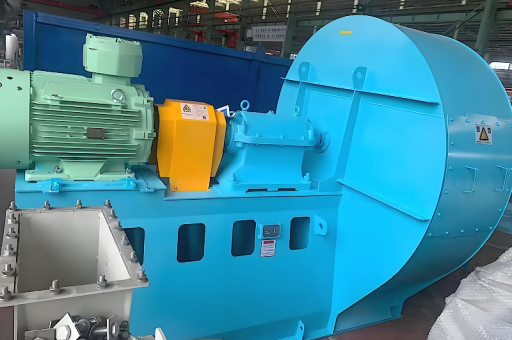
In the heavy industrial landscape of cement production, the movement of air and particulate matter is not just a matter of comfort—it is a critical process requirement. From clinker cooling to dust collection systems, the fan is the heart of the operation. Among the various configurations available, the V-Belt Driven Q345 Backward Curved Cement Blower Fan has emerged as a standard for reliability, efficiency, and longevity. This article delves deep into the engineering behind this specific fan type, explaining why the combination of a Q345 steel impeller, a backward curved blade design, and a V-belt drive system creates a solution that is exceptionally wear resistant and suitable for the abrasive conditions found in cement plants. We will explore the mechanical principles, material benefits, and operational advantages that make this fan a top choice for facility managers looking to reduce downtime and energy consumption by visiting fan industry standards.
Engineering the Blade: Why "Backward Curved" Matters
The term "Backward Curved" refers to the orientation of the fan blades relative to the direction of rotation. Unlike forward-curved blades which scoop air, backward curved blades throw air outward in a radial direction at a higher velocity.
Efficiency and Power Curve: The primary advantage of the backward curved centrifugal fan is its non-overloading power characteristic. As system resistance (static pressure) increases, the motor power requirement actually decreases. This protects the motor from burnout, a common issue in clogged dust collection systems within a cement facility. According to aerodynamic principles, these blades achieve higher static efficiencies—often exceeding 80%—compared to other types. This directly translates to lower electricity bills for the fan operation.
Self-Cleaning Properties: In a cement blower, dust accumulation on blades is a major cause of imbalance and vibration. The backward curved design inherently prevents material build-up because the concave surface of the blade is not facing the airflow. This self-cleaning action is a critical component of the wear resistant nature of the fan, ensuring consistent performance over thousands of hours of operation.
Material Science: The Role of Q345 Steel in Durability
To build a fan that is truly wear resistant, the choice of material is paramount. Q345 is a low-alloy high-strength structural steel widely used in China and international heavy machinery. When applied to a Cement Blower Fan, it offers specific advantages:
- High Tensile Strength: Q345 has a minimum yield strength of 345 MPa. This makes the impeller robust enough to withstand the high centrifugal forces generated by the backward curved blades at operational speeds.
- Impact Toughness: Cement flue gases often contain large, abrasive particles. Q345 offers superior toughness compared to standard carbon steel (like Q235), resisting cracking from solid particle impact.
- Weldability: The manufacturing of a high-precision impeller requires extensive welding. Q345 has excellent weldability, allowing for strong joints that will not fatigue under stress.
While Q345 is not a stainless steel, it provides the ideal balance between cost and structural integrity for a V-Belt Driven system. When paired with optional hard-facing coatings or wear liners on the leading edges, the Q345 base material creates a foundation for exceptional service life.
Drive Mechanism: The V-Belt Driven System Explained
The V-Belt Driven system is a classic mechanical coupling method where the motor transmits power to the fan shaft via pulley and belt sets. This is distinct from direct drive (where the motor and fan shaft are connected via a coupling).
Advantages of V-Belt Drive:
- Speed Flexibility: Changing the fan speed is as simple as changing the pulley diameter (sheave). This allows for fine-tuning of air volume (CFM) and pressure (SP) without expensive variable frequency drives (VFDs), though VFDs can also be used on belt drives.
- Motor Protection: The V-belt acts as a mechanical fuse. If the impeller locks up due to debris or bearing failure, the belt will slip or break, preventing catastrophic damage to the motor and the fan.
- Reduced Vibration Transfer: The belt absorbs minor torsional vibrations from the motor, leading to smoother operation and extended bearing life on the blower shaft.
Maintenance Considerations: The V-belt system requires regular tension checks. Incorrect tension leads to slippage (reduced air flow) or excessive bearing load. A properly tensioned V-Belt Driven system, however, offers a lower purchase cost and easier maintenance compared to complex direct-drive setups.
Focus on Longevity: The "Wear Resistant" Advantage
Wear resistance is not a single feature but a system of design choices. In the context of the Cement Blower Fan, it is achieved through three specific engineering strategies:
- Blade Profile: As discussed, the backward curve reduces material adhesion.
- Material Selection: Q345 provides a tough structural base.
- Thickness & Reinforcement: The impeller in these heavy-duty fan units is typically made from thicker gauge steel (e.g., 6mm to 12mm) than standard HVAC fans. Weld-on wear pads are often applied to the blade tips and the outer banding—these are the areas that experience the highest velocity impact from abrasive dust.
To maximize the wear resistant life, operators should monitor the "cut-water" or "cut-off" area. This is the closest point between the impeller and the housing. Clearance here should be tight (to prevent air recirculation) but sufficient to prevent abrasive particles from getting trapped and grinding down the metal.
Performance Characteristics: Pressure, Volume, and Efficiency
A V-Belt Driven Q345 Backward Curved Cement Blower Fan is classified as a "medium to high pressure" fan. Here’s how it performs:
- Pressure (SP): Typically operates between 500 Pa and 2000 Pa (2 to 8 inches WG). This is sufficient for moving dust-laden air through long duct runs and baghouses.
- Volume (CFM): Highly variable based on impeller diameter, ranging from 5,000 CFM for small dedusting points to over 100,000 CFM for main kiln baghouse fans.
- Efficiency Peak: The efficiency curve is a bell shape. The fan is most efficient when operating near its "Best Efficiency Point" (BEP). Operating far to the left or right of the BEP causes vibration and inefficiency. The non-overloading horsepower curve of the backward curved design ensures that the motor is never overloaded, even if the system resistance changes unexpectedly.
Installation and Maintenance Best Practices
To ensure the fan remains wear resistant and reliable, follow these guidelines:
- Foundation: The base of the fan must be rigid and level. Flexible connectors should be used at the inlet and outlet to prevent ductwork strain from causing misalignment.
- Belt Alignment: Use a straightedge to ensure motor and fan pulleys are perfectly aligned. Misalignment is the number one cause of premature belt and bearing failure.
- Routine Inspection:
- Weekly: Check belt tension and listen for bearing noise.
- Monthly: Inspect the interior of the housing and the Q345 impeller for signs of uneven wear or build-up.
- Quarterly: Clean the impeller using a technique that does not damage the metal (e.g., soft abrasive or water spray—ensure motor is sealed).
- Balancing: Over time, uneven wear will cause the impeller to go out of balance. A portable dynamic balancer (single-plane) can correct this in situ without removing the wheel.
Frequently Asked Questions (FAQ)
Q1: What is the maximum temperature a Q345 fan can handle? A: Q345 begins to lose its strength significantly above 350°C (660°F). For cement applications involving hot gas (e.g., cooler exhaust), an inlet air cooling system or a higher-grade alloy (like Corten or 16Mo3) is required. For standard ambient temperature dust collection, Q345 is excellent.
Q2: Can this fan handle sticky materials like wet cement sludge? A: While the backward curved blade is self-cleaning compared to forward curved blades, it is not designed for sticky, wet materials. High moisture content will cause material build-up on the Q345 steel, leading to imbalance. It is best suited for dry, dusty air.
Q3: How often should the V-belts be replaced? A: In a 24/7 cement plant operation, V-belts should be inspected monthly and replaced annually or when signs of cracking, fraying, or glazing appear. Running worn belts reduces the efficiency of the fan system.
Q4: Is a V-belt drive more efficient than a direct drive? A: No, a direct drive (or VFD-driven) setup is typically more energy efficient because there is no frictional loss from the belt. However, the V-belt drive offers lower initial cost and speed flexibility. For applications where speed changes are common or where motor protection is a priority, the small efficiency loss is acceptable.
Conclusion: Choosing the Right System for Your Facility
The V-Belt Driven Q345 Backward Curved Cement Blower Fan represents a mature, reliable, and cost-effective solution for the harsh conditions of a cement plant. By understanding the synergy between the backward curved aerodynamic design, the robust Q345 structural material, and the flexible V-belt driven power transmission, engineers can select a fan that offers maximum wear resistant properties.
When sourcing a unit, always verify the impeller thickness, the quality of the hub connection, and the type of bearings used (pillow block spherical roller bearings are preferred). Visiting fan specialists for custom fabrication of wear plates can further extend the life of the unit. By investing in this specific configuration, your facility can achieve lower maintenance costs, reduced downtime, and consistent air handling performance for years to come.





