
This article's table of contents introduction:
- Decoding the Specification
- Typical Applications
- Critical Engineering Parameters
- Key Design Features to Look For
- Supplier / Manufacturing Note (For 16Mn Material)
- Summary for Procurement
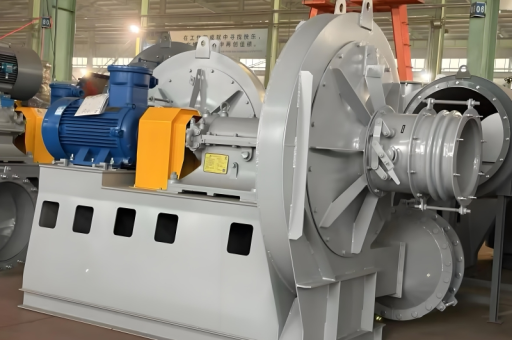
Based on your specifications, it appears you are looking for a high-pressure, anti-fraying (abrasion-resistant) gas delivery fan designed to handle flue gas, likely from a boiler, kiln, or industrial furnace. The 16Mn designation refers to the steel grade used for the impeller and casing.
Here is a breakdown of what this specification means and what you need to know for selection and procurement.
Decoding the Specification
- 16Mn (Q345B/Q355B): This is a low-alloy, high-strength structural steel.
- Why used: It has excellent mechanical properties, good weldability, and higher tensile strength than standard carbon steel. Crucially, it has better erosion and wear resistance than Q235, making it suitable for gas streams containing dust or particulate matter.
- Modern Equivalent: 16Mn is an older Chinese standard. You will often find it replaced by Q355B or Q345B.
- Double Inlet (Double Suction): The fan draws air in from both sides of the impeller.
- Why used: For High Pressure + High Volume. It provides higher flow rates (CFM/m³/h) while maintaining structural balance. It significantly reduces the axial thrust load on the bearings compared to a single inlet fan.
- High Pressure: This fan is designed to overcome significant system resistance (measured in Pa or mmH₂O). This is necessary when pushing gas through long ductwork, bag filters, scrubbers, or heat exchangers.
- Anti-fraying: This is a descriptive term for abrasion/erosion resistance.
- Key features:
- Thicker Impeller Blades: Designed with a sacrificial wear thickness (e.g., 8mm to 16mm thick steel).
- Replaceable Liner Plates: The casing volute (the spiral housing) is fitted with wear-resistant liner plates (often made of 16Mn or even harder alloys like NM400/Hardox) in the tongue and scroll areas where erosion is most severe.
- Reinforced Blades: Often "welded overlay" hardfacing is applied to the leading edge of the blades.
- Key features:
- Gas Delivery: Implies the fan is handling a hazardous, hot, or particle-laden gas, not just clean air. Sealing against gas leakage is critical.
Typical Applications
- Power Plants: Induced Draft (ID) fans for boilers.
- Cement Plants: Kiln exhaust, raw mill fans.
- Steel Mills: Sintering machines, blast furnace gas.
- Chemical & Fertilizer: Coal gasification, exhaust from dryers.
- Mining & Mineral Processing: Material conveying (pneumatic transport).
Critical Engineering Parameters
To get a proper quote and ensure the fan works, you must provide these:
A. Gas Conditions
- Gas Temperature: (e.g., 200°C, 400°C). This determines if you need a cooling shaft, expansion joints, or special bearings.
- Gas Composition: Is it corrosive (SOx, NOx)? Is the dust abrasive (silica, fly ash)?
- Dust Concentration: (g/Nm³). This dictates the thickness of the liner plates and the required anti-wear technology.
- Moisture Content: Will there be condensation? This can cause dust buildup (balance issues) or corrosion.
B. Performance Point
- Volume Flow Rate: (m³/h or CFM) – at inlet conditions.
- Total Pressure Rise: (Pa, kPa, or mmH₂O).
- Density of Gas: Required to convert static pressure to fan static pressure.
- Altitude / Barometric Pressure: Important for calculating gas density.
C. Mechanical Configuration
- Drive Type:
- Direct Drive (D-connection): Motor shaft directly coupled to impeller.
- Belt Drive (C-connection): Allows speed changes. More common for adjustable performance.
- VFD Ready: Most modern installations use a Variable Frequency Drive.
- Arrangement:
- Typical for Double Inlet: Arrangement 3 (Single width, double inlet, bearings on both sides) or Arrangement 7 (Double width, double inlet, two bearings).
- Rotation & Discharge Angle: (e.g., Rot. CW, Discharge Top Horizontal - 0°, 90°, 180°).
- Shaft Seal: For "Gas Delivery," a compressed graphite packing or mechanical seal is needed to prevent gas from leaking along the shaft to the bearings or the outside.
Key Design Features to Look For
- Backward-Curved Blades (High Efficiency): For high-pressure applications, backward-curved centrifugal blades are standard. They are non-overloading (motor won't burn out if resistance changes) and more efficient than forward-curved fans.
- Housing Split (Horizontally or Vertically): For maintenance. A horizontal split casing allows you to lift the top half to access the impeller without removing the ductwork.
- Reinforced Shaft: Must be sized correctly to avoid critical speed vibration issues.
- Labyrinth Seals vs. Carbon Ring Seals: For high-temperature/corrosive gas, carbon ring seals are superior.
Supplier / Manufacturing Note (For 16Mn Material)
- Weld Qualification: Ask the supplier if they have a WPS (Welding Procedure Specification) for 16Mn (Q355B) . Improper welding (use of wrong filler rod or lack of pre-heat) will lead to cracking.
- Preheating: Thick sections of 16Mn may require preheating to 100-150°C before welding.
- Stress Relieving: For high-pressure, high-temperature fans, the impeller should be stress-relieved (heat treated) after welding to remove residual stress. This prevents the impeller from distorting or cracking during operation.
Summary for Procurement
To order a 16Mn Double Inlet Flue Gas Fan High Pressure Anti-fraying Gas Delivery fan, you should specify:
Fan Type: Double Inlet, Double Suction Centrifugal Fan Material: Impeller & Casing: Q355B (16Mn) Wear Protection: Replaceable 16Mn liner plates on casing; hardfacing on leading edge of blades. Application: Flue gas / hot gas / particle-laden gas. Temperature: e.g., 250°C max. Flow: m³/h @ Fan Inlet. Pressure: Pa (Total Pressure). Drive: e.g., Belt Driven / VFD / Direct Driven. Seal: Carbon ring or Graphite packed gland. Arrangement: e.g., Arr. 3.
Warning: Do not use a standard "Air Handling" fan for this service. It will fail rapidly due to abrasion and heat. The 16Mn and anti-fraying features are non-negotiable for reliability.





