
This article's table of contents introduction:
- Why "Heavy Duty V-Belt Driven"?
- The "High Pressure" Requirement
- "High Wear Resistance" (The Construction)
- Typical Components of This System
- Best Applications for This Setup
- What to Look For When Buying
- Example Sizing (Rough Estimate)
- Safety Warning
Based on your keywords, it seems you are looking for a high-performance, industrial-grade dust collection fan system that uses a heavy-duty V-belt drive to handle high static pressure and abrasive materials.
Here is a breakdown of what that specification means, why it is important, and what you should look for when sourcing or specifying this equipment.
Why "Heavy Duty V-Belt Driven"?
- Torque & Starting: V-belts absorb the high starting torque of a motor without shocking the fan wheel or motor bearings. This is critical for high-inertia dust collectors.
- Speed Control (Pulley Ratio): You can easily adjust the fan speed (RPM) by changing the sheave (pulley) sizes. This allows you to "tune" the system to the exact static pressure required by your ductwork.
- Motor Protection: If the fan wheel jams (e.g., a large piece of debris), the belt will slip or break, protecting the expensive motor from burning out.
- Cost-Effective: For high-horsepower applications (15 HP+), V-belt drives are often cheaper and more robust than direct-drive variable frequency drives (VFDs) for the same initial cost.
The "High Pressure" Requirement
- Static Pressure (SP): Standard axial fans (like a box fan) can't push air through long ducts or filters. A "high pressure" centrifugal fan (usually a Radial Blade or Backward Inclined design) can generate 10” to 30”+ of water gauge (WG) pressure.
- Application: This is needed for long duct runs, high-filter-resistance systems (like cartridge collectors or baghouses), or pneumatic conveying (pulling heavy dust through pipes).
"High Wear Resistance" (The Construction)
Dust is abrasive. A standard fan will wear out quickly. To handle this, you need specific features:
- Material: Fan wheel (impeller) should be heavy-gauge steel or AR (Abrasion Resistant) plate. Never aluminum or thin sheet metal.
- Thickness: The blade tips and backplate must be thick (e.g., 3/16" or 1/4") to withstand erosion.
- Liners: Some models have sacrificial wear plates or liners (rubber or ceramic tile) inside the housing.
- Blade Type: Radial blade fans are best for high pressure and heavy dust, though they are less efficient. Backward inclined (BI) or Airfoil (AF) are more efficient but less tolerant of harsh dust.
Typical Components of This System
| Component | Specification |
|---|---|
| Fan Wheel | Radial or Backward Inclined, heavy steel |
| Housing | Heavy-gauge welded steel, bolted access door |
| Drive | V-belt (A, B, C, or D section depending on HP) |
| Motor Base | Adjustable slide base for belt tensioning |
| Inlet / Outlet | Round or rectangular flanges, often with dampers |
Best Applications for This Setup
- Woodworking: Collecting sawdust, chips, and shavings from moulder, planers, and sanders. The high pressure overcomes cyclone resistance.
- Welding & Plasma Cutting: Capturing fine, abrasive metal fumes.
- Cement & Concrete: Handling heavy, coarse particles.
- Grain Handling: Moving grain dust (explosion-proof models required).
- Mining & Quarrying: High abrasion environments.
What to Look For When Buying
- Fan Curve: The supplier must provide a fan curve showing CFM vs. Static Pressure. Ensure it matches your duct system's pressure drop.
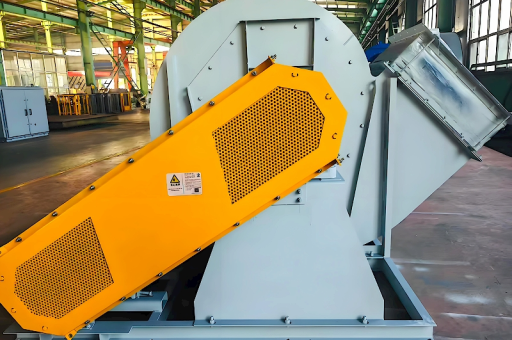
- Belt Guard: Mandatory for safety. Must be heavy-duty steel, not mesh.
- Access Door: A large, quick-opening door on the housing is essential for cleaning out debris and inspecting the wheel.
- Bearings: Look for heavy-duty pillow block bearings with grease fittings. Sealed bearings are not ideal for 24/7 industrial use.
- Vibration Isolation: Should be mounted on rubber-in-shear or spring isolators (especially if on a roof or mezzanine).
Example Sizing (Rough Estimate)
- 5 HP System: ~2,000 CFM @ 6-8" SP. Suitable for a small shop with 1-2 machines.
- 15 HP System: ~5,000 CFM @ 10-12" SP. Suitable for a medium-sized shop or industrial line.
- 50 HP+ System: ~15,000+ CFM @ 15-20" SP. Large industrial baghouse systems.
Safety Warning
- Never run a V-belt driven fan without the belt guard. A broken belt can snap like a whip and cause serious injury.
- Check spark resistance: If you are collecting combustible dust (wood, metal, grain), you may need a spark-resistant construction (aluminum wheel in a steel housing) or a dampener system, as a steel wheel hitting steel housing can create sparks.
If you are looking for a specific brand or model, let me know your required CFM and Static Pressure, and I can help you narrow it down.





