
This article's table of contents introduction:
- The Core Function in a Cement Plant
- Key Design Features for Efficiency & Energy Savings
- The "Efficient Energy Saving" Advantage in Numbers
- Operational Best Practices (How to Keep it Efficient)
- How to Source or Specify This Fan
- Leading Manufacturers & Brands
- Summary
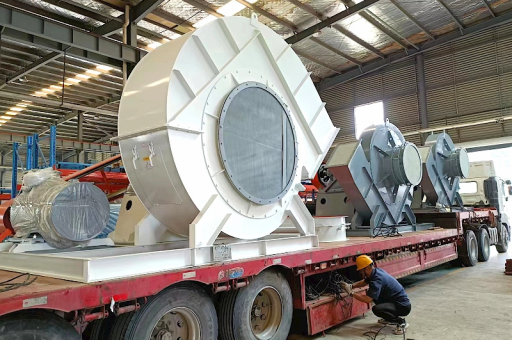
This is a highly specific and technical piece of industrial equipment. To provide the most accurate and helpful response, let's break down what makes a Cement Rotary Kiln Centrifugal Fan both "Efficient" and "Energy Saving."
This isn't a single product name, but rather a description of a critical fan type used in cement production, optimized for maximum performance with minimal power consumption.
Here is a comprehensive breakdown of the technology, design features, and operational strategies behind this equipment.
The Core Function in a Cement Plant
A centrifugal fan is used in several key stages of the cement kiln system, but the most critical for "efficient energy saving" is the Induced Draft (ID) Fan at the kiln's exhaust, or the Kiln Baghouse Fan.
- Primary Role: To pull combustion gases (hot air, CO2, dust) through the kiln, preheater, and cooling system.
- The Challenge: These gases are extremely hot (200-400°C), abrasive, and laden with sticky dust. The fan must overcome high system resistance while maintaining precise negative pressure for optimal combustion and safety.
Key Design Features for Efficiency & Energy Savings
An "efficient" centrifugal fan is not just a standard fan with a high-efficiency motor. It's a system designed from the impeller out.
| Feature | Why It Saves Energy |
|---|---|
| Backward-Curved (BC) or Airfoil Impeller | The most efficient blade design (>85% static efficiency). It prevents dust buildup (unlike forward-curved blades) and handles high volumes against moderate to high pressure. |
| Optimized Volute Casing | Smooth, streamlined air paths with no sharp turns. Reduces turbulence and pressure drop inside the fan itself. |
| Variable Frequency Drive (VFD) | The single biggest energy saver. Instead of using dampers or inlet vanes to control flow (which wastes energy as heat), a VFD matches the fan's speed exactly to the process demand. A 20% reduction in speed can yield a 50% reduction in power consumption (Affinity Laws). |
| High-Efficiency Motor (IE4/IE5) | Premium efficiency motors (e.g., NEMA Premium or IE4/IE5 synchronous reluctance) reduce electrical losses by 15-30% compared to older standard motors. |
| Wear-Resistant Impeller & Lining | Ceramic tiles, hard-faced wear plates, or abrasion-resistant steel. Why? If fan blades wear unevenly, the balance is lost, causing vibration and a dramatic drop in aerodynamic efficiency. A worn impeller can consume 10-20% more power to move the same air. |
| Inlet Guide Vanes (IGVs) | A secondary control method to VFDs. IGVs pre-swirl the air entering the impeller, reducing the work required. Modern systems use VFDs for primary control and IGVs for fine-tuning or backup. |
| Bearings & Lubrication System | Low-friction bearings (e.g., spherical roller bearings) with automatic oil lubrication. Reduced friction directly translates to lower parasitic torque and energy loss. |
The "Efficient Energy Saving" Advantage in Numbers
| Traditional Fan System | Modern High-Efficiency System | Estimated Energy Saving |
|---|---|---|
| Control Method: Inlet Damper | Control Method: VFD + IGVs | 30-50% |
| Impeller: Forward-Curved | Impeller: Backward-Curved Airfoil | 15-25% |
| Motor: Standard IE1/IE2 | Motor: IE4/IE5 Premium | 10-20% |
| Bearings: Grease-packed | Bearings: Oil-lubricated, low-friction | 2-5% |
| Casing: Standard steel | Casing: Wear-lined, optimized flow path | 5-10% |
Real-World Scenario: A 5000 TPD cement plant running a 2,500 kW ID fan for 8,000 hours per year. A 20% energy saving (500 kW) at $0.10/kWh saves $400,000 annually.
Operational Best Practices (How to Keep it Efficient)
Even the best fan will lose efficiency if not operated correctly.
- Pressure Optimization: The fan should operate at the minimum required static pressure. Over-pulling the kiln (e.g., -1000 Pa when -800 Pa is sufficient) wastes significant energy.
- Leakage Control: Air leaks in the ductwork before the fan force it to move more air than necessary, increasing power draw. Seal all flanges, inspection doors, and expansion joints.
- Dust & Fouling Management: Check for dust buildup on impeller blades. A 1mm layer of sticky dust can reduce efficiency by 5%. Use online cleaning systems (e.g., compressed air jets or water sprays) if possible.
- Vibration Monitoring: Increased vibration signals imbalance or bearing wear. An imbalanced fan requires more energy and causes premature failure.
- Periodic Performance Testing: Every 6-12 months, measure actual air flow (m³/s), static pressure (Pa), and motor power (kW). Compare to the fan's original performance curve. A shift to the right (more flow at same pressure) indicates system leakage; a shift down indicates fan wear.
How to Source or Specify This Fan
When requesting a quote for an Efficient Energy Saving Cement Rotary Kiln Centrifugal Fan, provide this information to the supplier:
- Fan Type: Induced Draft (ID) Fan for Kiln Exhaust
- Operating Conditions:
- Gas Volume (Nm³/h or m³/s at actual conditions)
- Gas Temperature (Normal and Maximum)
- Static Pressure Required (Pa)
- Gas Density
- Dust Load (g/Nm³) and Particle Size Distribution
- Target Efficiency: Request a minimum static efficiency of 85% at the design point.
- Control System: Specify a VFD (e.g., low-voltage or medium-voltage) with communication protocol (e.g., Profibus, Modbus).
- Material Requirements:
- Impeller: 16MnCr5 or similar abrasion-resistant steel, with hard-facing (e.g., Stellite or ceramic tiles) on leading edges.
- Casing: Wear-resistant liners (e.g., Alumina ceramic tiles or basalt lining).
- Motor: IE4 efficiency class, squirrel-cage induction or synchronous reluctance.
- Standards: ISO 13779 (or local equivalent) for fan performance testing.
Leading Manufacturers & Brands
These companies are known for specialized high-efficiency centrifugal fans for cement kilns:
- Howden (Global leader, known for heavy-duty, highly engineered fans)
- TLT-Turbo (Siemens spin-off, highly efficient for large kilns)
- Robinson Fans (American, excellent for high-temp & abrasive service)
- FLAKT Woods (European, strong in industrial ventilation & cement)
- Greenheck (Good for smaller, packaged solutions)
- Cincinnati Fan (Reliable for medium-duty applications)
- Korfmann (Specialist in heavy industrial fans)
Summary
An "Efficient Energy Saving Cement Rotary Kiln Centrifugal Fan" is not a single device but a system-optimized solution combining:
- ✅ Backward-curved (airfoil) impeller for 85%+ efficiency
- ✅ VFD control to match demand and cut power consumption by up to 50%
- ✅ Wear-resistant materials to maintain efficiency over time
- ✅ Premium IE4/IE5 motor to minimize electrical losses
- ✅ Proper system design & maintenance to avoid parasitic losses
The key takeaway: The fan itself is only half the story. The control system (VFD) and the ductwork/process optimization are where the largest, most sustainable energy savings come from.





