
This article's table of contents introduction:
- Table of Contents
- 1. Introduction to Double Suction Industrial Centrifugal Blowers
- 2. Voltage Specifications: 380v / 415v / 440v – What’s the Difference?
- 3. Design & Working Principle of Double Suction Blowers
- 4. Key Performance Parameters (Airflow, Pressure, Efficiency)
- 5. How to Select the Right Blower for Your Industrial Application
- 6. Common Applications: HVAC, Mining, Cement, Power Plants
- 7. Advantages Over Single-Suction & Axial Fans
- 8. Installation, Maintenance & Troubleshooting Tips
- 9. Frequently Asked Questions (FAQ)
- 10. Conclusion
The Complete Guide to Double Suction Industrial Centrifugal Blower 380v / 415v / 440v: Performance, Selection & Applications**
Table of Contents
- Introduction to Double Suction Industrial Centrifugal Blowers
- Voltage Specifications: 380v / 415v / 440v – What’s the Difference?
- Design & Working Principle of Double Suction Blowers
- Key Performance Parameters (Airflow, Pressure, Efficiency)
- How to Select the Right Blower for Your Industrial Application
- Common Applications: HVAC, Mining, Cement, Power Plants
- Advantages Over Single-Suction & Axial Fans
- Installation, Maintenance & Troubleshooting Tips
- Frequently Asked Questions (FAQ)
- Conclusion
Introduction to Double Suction Industrial Centrifugal Blowers
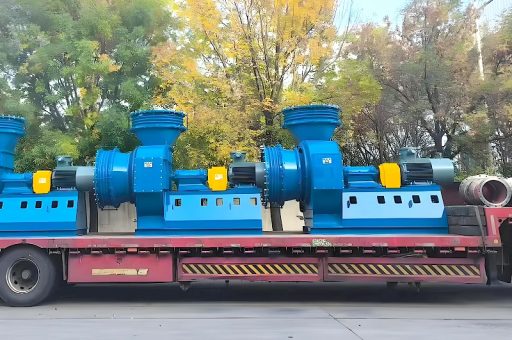
The Double Suction Industrial Centrifugal Blower (also known as a double inlet centrifugal fan) is a high-performance air-moving device designed for heavy-duty industrial environments. Unlike single-suction fans, the double suction design draws air from both sides of the impeller, resulting in higher airflow capacity, smoother operation, and reduced vibration.
These blowers are engineered to operate with three-phase electrical supplies of 380v, 415v, and 440v, making them compatible with global industrial grids. They are widely used in applications requiring continuous operation under high static pressure, such as cement plants, steel mills, power generation facilities, and large HVAC systems.
Key sectors that benefit:
- Cement & mining (dust extraction)
- Chemical processing (fume handling)
- Power plants (boiler forced draft & induced draft)
- Commercial HVAC (large-scale ventilation)
Voltage Specifications: 380v / 415v / 440v – What’s the Difference?
One of the most critical factors in selecting a Double Suction Industrial Centrifugal Blower is the voltage compatibility. The three common voltages – 380v, 415v, and 440v – are not interchangeable without proper motor configuration.
| Voltage | Standard Regions | Frequency | Common Motor Winding |
|---|---|---|---|
| 380v | China, Europe, parts of Asia | 50Hz | Δ (Delta) |
| 415v | UK, Middle East, India, Africa | 50Hz | Y (Star) or Δ (Delta) |
| 440v | USA (industrial), parts of Latin America | 60Hz | Δ (Delta) |
Why does voltage matter?
- Incorrect voltage can cause motor overheating, reduced torque, and premature failure.
- A 380v motor running on a 415v supply will draw excess current and burn out.
- A 440v motor under 380v will produce less than 70% of rated power.
Solution: Always verify the motor nameplate (e.g., 380v/660v, 415v/720v) to confirm whether the motor can be reconnected (Star/Delta) for multi-voltage use. Many modern double suction blowers come with dual-voltage motors (e.g., 380v/440v) to bridge the gap.
Design & Working Principle of Double Suction Blowers
A double suction centrifugal blower features an impeller with two inlets – one on each side of the wheel. Air enters symmetrically from both sides, passes through the impeller blades, and is discharged radially into a volute casing.
Core components:
- Impeller: Typically backward-curved or radial-bladed for high pressure.
- Casing: Split or modular construction for easy maintenance.
- Shaft & Bearings: Heavy-duty to handle axial thrust from dual inlets.
- Inlet Box/Damper: Often adjustable for flow control.
Flow symmetry reduces unbalanced forces, leading to lower noise and vibration compared to single-suction fans. This makes double suction blowers ideal for high-flow, continuous-duty applications.
Key Performance Parameters (Airflow, Pressure, Efficiency)
When evaluating a Double Suction Industrial Centrifugal Blower 380v / 415v / 440v, focus on these metrics:
- Airflow (CFM or m³/h): Double suction designs typically deliver 30–50% more airflow than single-suction units of the same size.
- Static Pressure (Pa or in.wg): Suitable for medium to high pressure (e.g., 2000–8000 Pa).
- Efficiency: Modern backward-curved impellers achieve 82–90% static efficiency.
- Motor Power (kW): Matches the voltage (e.g., 30 kW at 415v, 50 Hz).
Example specification:
Model: FAN-DS-2000 | Voltage: 415v / 3ph / 50Hz | Airflow: 35,000 m³/h | Static Pressure: 4,500 Pa | Motor: 45 kW.
How to Select the Right Blower for Your Industrial Application
Follow this step-by-step process:
- Define system resistance (static pressure): Duct length, filters, elbows all add resistance.
- Calculate required airflow: Based on room volume or process exhaust needs.
- Match voltage to local grid: 380v (China/Europe), 415v (UK/Middle East), 440v (US industrial).
- Choose impeller type: Backward-curved for low noise, radial for heavy dust.
- Consider material: Carbon steel for clean air, stainless steel for corrosive gases.
Pro tip: Always specify a double suction blower if your system requires > 20,000 m³/h at medium-to-high pressure. Single-suction fans become oversized and inefficient beyond this point.
Common Applications: HVAC, Mining, Cement, Power Plants
| Industry | Use Case | Voltage Common | Why Double Suction? |
|---|---|---|---|
| Cement | Kiln gas exhaust | 415v / 440v | Handles high-temperature, dusty gases with balanced flow |
| Mining | Underground ventilation | 380v / 415v | Low vibration ensures long bearing life in harsh conditions |
| Power Plant | Forced draft / induced draft | 440v (60Hz) | High pressure for boiler combustion air |
| HVAC | Large building air handling | 380v / 415v | Quiet operation for commercial environments |
Advantages Over Single-Suction & Axial Fans
vs. Single-Suction Centrifugal Fans:
- Higher capacity with same impeller diameter.
- Lower vibration due to balanced inlet flow.
- Reduced axial thrust on bearings.
vs. Axial Fans:
- Higher static pressure capability (axial fans struggle above 500 Pa).
- Better dust handling (axial fans accumulate dust on blades).
- More efficient in ducted systems with high resistance.
Trade-off: Double suction blowers are physically larger and require more space for inlet ducts.
Installation, Maintenance & Troubleshooting Tips
Installation:
- Provide straight inlet ducts (at least 1.5× duct diameter) on both sides.
- Use vibration isolators (spring or rubber) to prevent transmission.
- Ensure motor electrical supply matches nameplate (380v, 415v, or 440v).
Maintenance:
- Check bearing temperature monthly (should be < 80°C).
- Inspect impeller for wear or imbalance every 6 months.
- Grease bearings with high-temperature lithium grease per manufacturer schedule.
Troubleshooting: | Problem | Possible Cause | Solution | |-------------|-------------------|--------------| | Low airflow | Obstructed inlet / wrong rotation | Clean both inlets / swap motor phases | | Excessive vibration | Impeller imbalance | Inspect for dust build-up or erosion | | Motor overheating | Wrong voltage | Verify voltage with multimeter (380v vs 415v vs 440v) |
Frequently Asked Questions (FAQ)
Q1: Can a 380v Double Suction Blower be used on a 415v supply?
A: Only if the motor is dual-rated (e.g., 380v/415v). Otherwise, you risk motor burnout. Use a step-down transformer or select a 415v model.
Q2: What is the difference between double suction and back-to-back fans?
A: A double suction blower has a single impeller with two inlets. A back-to-back fan has two separate impellers on one shaft. Double suction is more compact and balanced.
Q3: Can I use a 440v blower on a 60Hz system?
A: Yes, 440v is the standard industrial voltage in many 60Hz regions. Ensure the motor is rated for 60Hz (check nameplate for 380v/60Hz or 440v/60Hz).
Q4: How often should I clean the impeller of a double suction blower?
A: In clean environments, annually. In dusty industrial applications (cement, mining), every 3–6 months. Use compressed air or soft brushes.
Q5: Are double suction blowers quieter than single suction?
A: Yes. Because air enters symmetrically from both sides, there is less turbulence and lower noise levels – typically 3–5 dB(A) quieter.
Q6: What is the typical lifespan of a double suction industrial centrifugal blower?
A: With proper maintenance, 15–25 years. Voltage mismatch and bearing neglect are the main causes of early failure.
Q7: Can I use a variable frequency drive (VFD) with these blowers?
A: Yes. VFDs are recommended for energy savings. Ensure the VFD output matches the blower motor voltage (380v, 415v, or 440v). Use sine-wave filters for long cable runs.
Conclusion
The Double Suction Industrial Centrifugal Blower 380v / 415v / 440v represents the pinnacle of industrial air-moving technology. Its dual-inlet design delivers higher airflow, lower vibration, and greater efficiency compared to traditional single-suction fans. Correct voltage selection is critical to performance and longevity.
When choosing a blower for your facility, always match the voltage to your local grid, verify the motor’s winding configuration, and assess the impeller type against your process requirements. With proper installation and routine maintenance, these blowers provide decades of reliable service in even the most demanding environments.
Remember: for high-pressure, high-volume, continuous-duty industrial applications – a well-selected double suction centrifugal blower is not just an option; it is the smartest investment you can make.
For more technical insights on industrial fans, visit [fan].





