
This article's table of contents introduction:
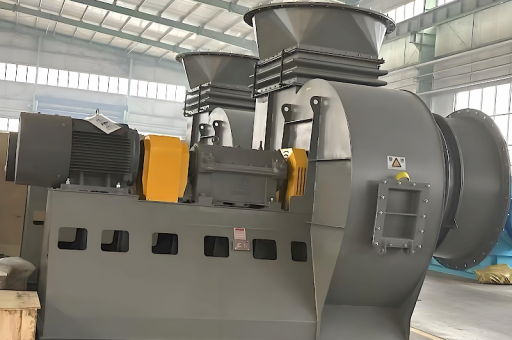
- What is a Single Suction Centrifugal Fan?
- Key Design Features for High Durability
- Performance Characteristics of Single Suction Fans
- Common Industrial Applications
- How to Specify a "High Durable" Fan
- Summary: Why Choose a High Durable Single Suction Fan?
Here is a detailed overview of High Durable Industrial Centrifugal Fans (Single Suction) , covering their design, key features, applications, and what makes them "high durable."
What is a Single Suction Centrifugal Fan?
A single suction (or single inlet) centrifugal fan draws air into the impeller from only one side. This is the most common configuration for industrial fans. The air enters axially (parallel to the shaft) and is discharged radially (perpendicular to the shaft) at high velocity and pressure.
The "high durable" designation refers to fans engineered for continuous, heavy-duty operation in harsh environments, with extended service life and minimal maintenance.
Key Design Features for High Durability
To withstand demanding industrial conditions, these fans incorporate specific design and material choices:
- Robust Casing: Typically made from heavy-gauge steel (e.g., carbon steel, Corten steel, or stainless steel for corrosive environments). The casing often has continuous welded seams and flanged connections for maximum rigidity.
- Reinforced Impeller:
- High-Strength Steel: Backward-inclined, backward-curved, or airfoil blades are common for high efficiency and durability.
- Weld Construction: Blades are welded to the backplate and shroud, not bolted, to withstand high centrifugal forces and vibration.
- Inboard Bearing Design: Bearings are mounted inside the fan housing (or directly on the shaft within a robust bearing support) to reduce shaft deflection and protect bearings from the air/gas stream.
- High-Quality Bearings: Heavy-duty, oversized ball or roller bearings are used. They are often "regreasable" and sized for a specific L-10 life (e.g., 100,000+ hours). For high-temperature applications, bearings are water-cooled.
- Material Selection for Duty:
- Abrasion Resistance: For conveying dust, granules, or powders, the impeller and casing walls are fitted with replaceable wear plates or made from AR (Abrasion Resistant) steel (e.g., Hardox, T-1).
- Corrosion Resistance: Stainless steel (304, 316L) or special alloy impellers and coatings (e.g., Epoxy, Phenolic, or Elastomer linings).
- High Temperature: For gases up to 500°C (932°F) or higher, fans use alloy steel (e.g., Hastelloy, Inconel for extreme temps), high-temperature shaft seals, and water-cooled bearings.
- Shaft Seal: A durable mechanical seal or labyrinth seal prevents air/gas leakage, dust ingress, and protects the bearings.
- Vibration Isolation: Heavy-duty fan bases with integral vibration isolators (spring or rubber) to minimize transmitted vibration.
Performance Characteristics of Single Suction Fans
| Feature | Typical Range / Characteristic |
|---|---|
| Airflow | Low to very high (e.g., 500 to 500,000+ CFM) |
| Static Pressure | Medium to very high (e.g., 5" wg to 80" wg or more) |
| Efficiency | High (especially backward-inclined or airfoil blade designs) |
| Power | Low to extremely high (e.g., fractional HP to 500+ HP) |
| Temperature | Standard to 800°C+ (with specialist materials/cooling) |
| Drive Type | Direct Drive (shaft-mounted motor) or Belt Drive (for speed adjustment) |
Common Industrial Applications
- HVAC & Process Ventilation: Exhaust systems for factories, warehouses, tunnels.
- Combustion Air: Supplying air to boilers, furnaces, incinerators, and thermal oxidizers.
- Dust & Fume Collection: Baghouses, cartridge collectors, welding fume extraction.
- Material Conveying: Pneumatic conveying of powders, granules, wood chips, cement.
- Drying & Ovens: Textile dryers, spray dryers, food processing ovens.
- Mining & Quarrying: Ventilation, dust control at crushers and conveyors.
- Pollution Control: Flue gas desulfurization (FGD), scrubbers.
How to Specify a "High Durable" Fan
When ordering, you must provide:
- Airflow & Static Pressure: Required CFM and inches w.g. (or Pa).
- Duty: Continuous (24/7) or intermittent? Hours per year?
- Gas/Medium: Air, corrosive gas, high temperature, or dusty/abrasive stream. Provide detailed gas composition and temperature.
- Dust/Contaminants: Type, concentration (gr/ft³ or g/m³), particle size, hardness.
- Altitude & Ambient Conditions: Temperature, humidity, elevation.
- Mounting Orientation: Horizontal, vertical, or at an angle.
Summary: Why Choose a High Durable Single Suction Fan?
- Longer Service Life: Reduced downtime and replacement costs.
- Higher Reliability: Robust construction withstands vibration, thermal stress, and wear.
- Lower Total Cost of Ownership (TCO): Fewer maintenance cycles and less energy waste.
- Suitability for Harsh Conditions: Specifically designed for dust, heat, and corrosive gases.
Would you like to know more about specific impeller blade designs (backward, forward, radial) and which is best for your application, or perhaps size selection and fan laws?





