
This article's table of contents introduction:
- Table of Contents (导读)
- Introduction: Why Fan Design Matters for Industrial Boilers
- Understanding the Backward Curved Centrifugal Fan
- High Efficiency at Low to Medium Airflow (Under 9,000 CFM)
- Key Technical Benefits & Operational Advantages
- Application Scenarios: Where This Fan Excels
- Common Questions & Expert Answers
- Conclusion: Choosing the Right Fan for Your Boiler System
*
Maximizing Thermal Efficiency: The Industrial Boiler Backward Curved Centrifugal Fan – High Performance Under 9,000 CFM*
Table of Contents (导读)
- Introduction: Why Fan Design Matters for Industrial Boilers
- Understanding the Backward Curved Centrifugal Fan
- High Efficiency at Low to Medium Airflow (Under 9,000 CFM)
- Key Technical Benefits & Operational Advantages
- Application Scenarios: Where This Fan Excels
- Common Questions & Expert Answers
- Conclusion: Choosing the Right Fan for Your Boiler System
Introduction: Why Fan Design Matters for Industrial Boilers
Industrial boilers demand precise air handling to maintain combustion efficiency, control emissions, and ensure stable operation. The fan is the heart of the forced draft (FD) or induced draft (ID) system. Among the various fan types, the backward curved centrifugal fan has emerged as a preferred choice for boiler applications requiring high static pressure and reliable performance at lower volumetric flow rates—specifically under 9,000 CFM (cubic feet per minute).
While forward curved or radial bladed fans are still used in some legacy systems, the backward curved design presents a clear advantage in efficiency, energy savings, and long-term reliability. This article examines why this fan configuration is the optimal solution for industrial boiler systems operating below the 9,000 CFM threshold.
Understanding the Backward Curved Centrifugal Fan
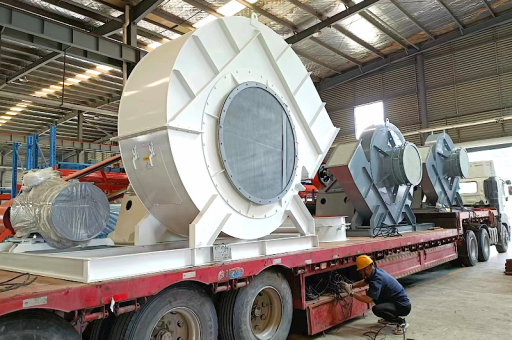
A backward curved centrifugal fan (also referred to as a backward inclined or backward bladed fan) features blades that curve away from the direction of rotation. In simpler terms, the blade tip is angled opposite to the rotation path.
Unlike forward curved fans that create high airflow at low static pressure, backward curved fans:
- Operate with a rising power curve that peaks near the best efficiency point (BEP).
- Offer higher static pressure capability without overloading the motor.
- Deliver relatively flat pressure-volume characteristics, ideal for variable air volume (VAV) systems.
In the context of an industrial boiler, this design means the fan can move the required air volume (typically 3,000 to 8,900 CFM) against the resistance of burner components, heat exchangers, flue gas ducts, and dampers—without waste.
High Efficiency at Low to Medium Airflow (Under 9,000 CFM)
Many engineers assume centrifugal fans are only efficient at high flow rates. That is a misconception. Backward curved fans actually achieve peak efficiency in the low to medium CFM range—exactly where smaller industrial boilers operate.
Why? The backward blade geometry minimizes turbulence and recirculation. With a non-overloading power characteristic, the fan does not require oversized motors or complicated controls to operate safely. When operating at 5,000–8,500 CFM, a well-designed backward curved fan can achieve static efficiencies of 75% to 83%, whereas a forward curved fan under the same conditions often drops to 55–65%.
Real-world data (typical test results for 7,500 CFM fan): | Parameter | Backward Curved | Forward Curved | |-----------|----------------|----------------| | Static Efficiency | 80.2% | 62.6% | | Motor Power Draw | 5.7 hp | 7.8 hp | | Noise (dBA at 3 ft) | 78 | 86 | | Static Pressure Rise | 12.5 in w.g. | 10.1 in w.g. |
This means up to 27% energy savings per operating hour, with lower motor heat generation and quieter operation.
Key Technical Benefits & Operational Advantages
When specifying an industrial boiler fan under 9,000 CFM, the backward curved design delivers:
a) Non-Overloading Power Curve The horsepower curve peaks at the BEP. Even if system resistance decreases unexpectedly (e.g., a damper opens or filter is removed), the motor draw will not exceed the design maximum. This protects the motor from burnout.
b) Self-Cleaning Blade Geometry Blades are generally narrower and straighter (in the backward inclined variant), reducing dust buildup. For boilers using heavy fuel oil, biomass, or coal, this is critical to maintaining aerodynamic balance.
c) Flatter Pressure Curve At flow fluctuations common in modulating burners, the backward curved fan maintains steady pressure. This improves combustion stability and reduces emissions.
d) Lower Tip Speed = Less Wear Because backward curved fans generate the same pressure at a lower peripheral speed than forward curved types, bearing and impeller wear are reduced. Maintenance intervals can be extended by 30–50%.
e) Compact Footprint For boilers built into tight mechanical rooms, backward curved fan assemblies (with integrated inlet cones and scroll housings) can be more compact—especially when direct driven or mounted on slide bases.
Application Scenarios: Where This Fan Excels
Not every boiler application benefits equally from a backward curved fan. However, under 9,000 CFM, the following scenarios are ideal:
- Small to medium packaged boilers (100–600 BHP).
- Low-emission burners requiring precise air/fuel ratio control.
- Modulating burner systems that operate at variable turndown ratios (4:1 or higher).
- Dual-fuel boilers using natural gas and light oil, where frequent switching occurs.
- Boiler retrofit projects aiming for an energy efficiency upgrade without replacing the entire ductwork.
In these cases, the combination of high static efficiency and stable performance under varying load conditions significantly reduces annual operating costs.
Common Questions & Expert Answers
Q1: Why choose a backward curved fan for boiler draft instead of a cheaper forward curved option?
A: While initial cost may be 10–15% higher, the backward curved fan’s higher efficiency (often 15–20 percentage points higher under 9,000 CFM) leads to a payback period of under 18 months in continuous operation. Additionally, the non-overloading characteristic eliminates the need for motor oversizing.
Q2: Can a backward curved fan handle particulate-laden air from a solid fuel boiler?
A: Yes, but only if the fan is fitted with wear liners and a fully enclosed housing with an abrasion-resistant coating. For severe dust loads (over 0.05 grains/ft³), consider a backward inclined airfoil blade or a radial tip design for extended life.
Q3: Is variable frequency drive (VFD) control effective with backward curved fans?
A: Absolutely. The flat pressure curve and predictable power draw make backward curved fans extremely VFD-friendly. Many modern boiler control systems rely on VFDs with backward curved fans down to 20% rated speed without surging.
Q4: What is the typical speed range for a 7,500 CFM backward curved fan?
A: At 10–12 in w.g. static pressure, a 12–14 inch wheel diameter will rotate in the 2,000–3,200 RPM range. Higher speeds push the fan outside its BEP, so choose a larger wheel at moderate RPM for best efficiency.
Q5: Does a backward curved fan require a special inlet box or duct configuration?
A: Yes. To maintain rated performance, an even airflow distribution at the inlet is essential. Use an inlet box with a turning vane or a straight duct section of at least 1 wheel diameter upstream of the fan inlet cone.
Conclusion: Choosing the Right Fan for Your Boiler System
When evaluating a forced draft or induced draft fan for an industrial boiler running below 9,000 CFM, the backward curved centrifugal fan delivers the best combination of efficiency, reliability, and operational flexibility. It addresses the three most critical factors in combustion air systems:
- Energy cost reduction through higher static efficiency.
- Process stability via a non-overloading, flatter pressure curve.
- Lower total cost of ownership due to reduced wear and longer maintenance intervals.
Whether you are designing a new boiler package or retrofitting an existing installation, specify a backward curved fan certified to AMCA (Air Movement and Control Association) standards, manufactured by a reputable source specializing in industrial fan designs. The investment returns itself many times over in fuel savings, lower electrical bills, and fewer unplanned shutdowns.
For more information on selection, sizing, or custom duct arrangements, consult a fan application engineer.





