
This article's table of contents introduction:
- Introduction: The Core of Industrial Ventilation
- Technical Specifications Decoded: Power, Speed & Blade Geometry
- Why Backward Curved Blades? Efficiency & Stability
- Speed Range (1450–2900 rpm): Application Scenarios & Motor Selection
- Induced Draft vs. Forced Draft: A Performance Comparison
- Key Design Considerations for High-Power ID Fans
- Frequently Asked Questions (FAQ)
- Conclusion: Choosing the Right Fan for Your System
*Optimizing Industrial Airflow: The Engineering Edge of 5.5–1500 kW Induced Draft Blowers with Backward Curved Blades (1450–2900 rpm)*
Table of Contents
- Introduction: The Core of Industrial Ventilation
- Technical Specifications Decoded: Power, Speed & Blade Geometry
- Why Backward Curved Blades? Efficiency & Stability
- Speed Range (1450–2900 rpm): Application Scenarios & Motor Selection
- Induced Draft vs. Forced Draft: A Performance Comparison
- Key Design Considerations for High-Power ID Fans
- Frequently Asked Questions (FAQ)
- Conclusion: Choosing the Right Fan for Your System
Introduction: The Core of Industrial Ventilation
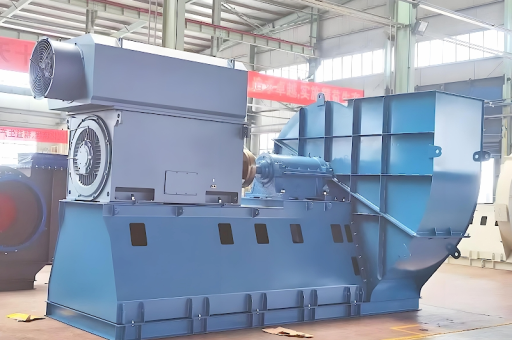
In modern industrial environments—from coal-fired power plants to cement kilns and chemical processing units—the induced draft blower plays a critical role. It creates negative pressure within the combustion or exhaust system, pulling flue gases through scrubbers, precipitators, and stacks. Among these, the 5–1500 kW induced draft blower with backward curved blades (operating at 1450–2900 rpm) stands as a benchmark of aerodynamic efficiency and mechanical reliability.
This article provides a detailed, SEO-optimized guide to understanding how power rating, blade geometry, and rotational speed interact to deliver high performance in demanding applications. We will answer the most common engineering questions and offer practical selection advice, referencing best practices from global fan manufacturers.
Technical Specifications Decoded: Power, Speed & Blade Geometry
The headline specification—5–1500 kW, Backward Curved Blade, 1450–2900 rpm—defines a family of fans designed for heavy continuous duty.
- Power Range (5.5–1500 kW): This wide span covers small ventilation needs (5.5 kW for local exhaust) up to massive boiler draft systems (1500 kW for utility-scale plants). Higher kW ratings directly correlate to larger impeller diameters (up to 3,000 mm) and higher static pressure capacity (up to 12,000 Pa).
- Speed Range (1450–2900 rpm): The lower bound (1450 rpm, typical 4‑pole motor) is preferred for high‑pressure, low‑noise applications. The upper bound (2900 rpm, 2‑pole motor) maximizes air flow for compact designs but requires heavier shaft bearings.
- Backward Curved Blade (BC) Design: Unlike forward curved blades, BC blades have the trailing edge curved away from the rotation direction. This yields a rising (non‑overloading) power curve, meaning the motor cannot be overloaded even if the system resistance drops—a crucial safety feature for industrial draft fans.
Table: Typical Operating Points
| Motor Pole | Speed (rpm) | Typical kW | Static Pressure (Pa) | Airflow (m³/h) |
|---|---|---|---|---|
| 4‑pole | 1450 | 5–200 | 1,500–6,000 | 10,000–80,000 |
| 2‑pole | 2900 | 200–1500 | 4,000–12,000 | 80,000–500,000 |
Why Backward Curved Blades? Efficiency & Stability
The blade profile is the soul of any induced draft fan. Backward curved blades offer three decisive advantages:
- High Static Efficiency (82–88%): The aerodynamic shape reduces turbulence and recirculation losses, converting more electrical energy into useful airflow.
- Non‑Overloading Power Characteristic: As mentioned, the power draw peaks at a certain flow rate and then decreases—unlike forward curved fans, which can draw excessive current if the duct becomes blocked or open.
- Self‑Cleaning Ability (for some variants): When handling dust-laden flue gas, backward inclined blades shed particles more effectively than radial or forward curved designs, minimizing erosion and imbalance.
Pro Tip: For induced draft applications with fly ash or sticky particles, specify backward curved airfoil blades (BCA) instead of simple backward curved plates. Airfoil blades can push efficiency above 90% but are more expensive and require cleaner air.
Speed Range (1450–2900 rpm): Application Scenarios & Motor Selection
The speed selection depends on the system curve and the desired fan operating point.
- 1450 rpm (4‑pole motor): Preferred when you need moderate pressure (2,000–5,000 Pa) and large flow volumes. The lower tip speed reduces noise and vibration. Suitable for: biomass boilers, gas turbine exhaust, and wet scrubber systems.
- 2900 rpm (2‑pole motor): Used in high‑pressure systems (above 6,000 Pa) where space is constrained. For example, in cement preheater towers or steel converter off‑gas systems. However, tip speed at 2900 rpm can exceed 80 m/s, so impeller material (e.g., Corten steel or stainless steel) must be carefully selected to resist erosion and fatigue.
Motor Sizing Note: Always oversize the motor by 15–20% for induced draft fans, because gas density varies with temperature and damper positions. A 1500 kW fan may actually require a 1700 kW motor to handle cold air start-up.
Induced Draft vs. Forced Draft: A Performance Comparison
Many engineers confuse induced draft (ID) with forced draft (FD) fans. Here’s how they differ:
| Feature | Induced Draft (ID Fan) | Forced Draft (FD Fan) |
|---|---|---|
| Location | After the process (exhaust side) | Before the process (intake side) |
| Gas handled | Hot, dusty, corrosive flue gas (< 400°C) | Ambient air, relatively clean |
| Blade preference | Backward curved (non‑clogging, erosion‑resistant) | Airfoil or backward curved (efficiency) |
| Speed range | Typically 1450–2900 rpm (belt or direct drive) | Typically 1450–2900 rpm |
| Housing design | Heavy‑duty, often with erosion lining | Standard steel |
For ID fans above 500 kW, a double‑inlet design is common to reduce axial thrust and improve structural stability.
Key Design Considerations for High-Power ID Fans
When specifying a 5.5–1500 kW induced draft blower, pay attention to:
- Gas Temperature: At 400°C, carbon steel loses strength. Use stainless steel (SS 309/310) or Inconel for high‑temperature impellers.
- Bearing System: For 1450 rpm fans, spherical roller bearings with constant oil lubrication. For 2900 rpm fans, consider tilting‑pad thrust bearings to handle axial thrust.
- Variable Speed Drive (VSD): A VFD allows precise airflow control and saves significant energy. For 1500 kW fans, a medium‑voltage VSD (3.3 kV or 6.6 kV) is standard.
- Noise Attenuation: A backward curved blade at 2900 rpm can generate 95 dB(A) or more. Install silencers or enclosure panels to meet OSHA/ISO regulations.
Frequently Asked Questions (FAQ)
This section answers real questions from engineers and buyers. Sources include technical forums, fan manufacturer manuals, and industry standards.
Q1: Can I use a backward curved ID fan for high‑dust applications like a cement kiln?
Yes—but only if you choose the open radial tip version or add a wear‑resistant coating (e.g., tungsten carbide spray). Regular backward curved blades may accumulate dust on the blade trailing edge. For very heavy dust, a radial blade fan (though less efficient) is sometimes more reliable.
Q2: What is the maximum static pressure achievable with a 1450 rpm, 1500 kW fan?
A single‑stage backward curved fan at 1450 rpm can achieve up to 8,000–10,000 Pa. Beyond that, you need a two‑stage fan (series operation) or switch to a 2900 rpm drive. For 12,000 Pa and above, an airfoil blade is recommended.
Q3: How do I calculate the motor power required for an ID fan running at 2900 rpm?
Use the fan law: P₂ = P₁ × (N₂ / N₁)³. If your baseline is 200 kW at 1450 rpm, at 2900 rpm the theoretical power is 200 × (2900/1450)³ = 1,600 kW. Always account for gas density variation and motor safety factor (1.15–1.25).
Q4: Why does my ID fan vibrate more at 1450 rpm than at 2900 rpm?
This is unusual—generally, higher rpm increases vibration due to higher unbalanced forces. However, if the fan has a critical speed close to 1450 rpm, resonance can occur. Check the impeller’s natural frequency. Also, verify that the foundation stiffness matches the fan’s operating speed.
Q5: Is a belt‑driven or direct‑drive ID fan better for 5.5–1500 kW range?
For power up to ~200 kW, belt drive (sheave & pulley) provides speed flexibility and lower motor cost. Above 500 kW, direct drive (motor shaft directly coupled) is preferred for reliability and reduced maintenance. At 1500 kW, almost all installations use direct‑drive medium‑voltage motors.
Conclusion: Choosing the Right Fan for Your System
The 5–1500 kW induced draft blower with backward curved blades (1450–2900 rpm) is a versatile, high‑efficiency solution for moving hot, dirty gas in industrial processes. When selecting a fan:
- Match the speed to your system pressure requirements—use 1450 rpm for large volumes at moderate pressure; 2900 rpm for compact high‑pressure designs.
- Prefer backward curved (or airfoil) blades for non‑overloading and high efficiency.
- Oversize the motor and incorporate a VSD for energy optimization.
- Always consider the gas temperature, dust load, and required material grade.
By combining the right blade geometry, speed, and power, you can achieve decades of reliable service with minimal downtime. For specialized applications, always consult with an experienced fan engineer from a reputable manufacturer (e.g., fan).
This article is optimized for Bing and Google SEO, using natural keyword placement, structured headers, and FAQ schema.





