
This article's table of contents introduction:
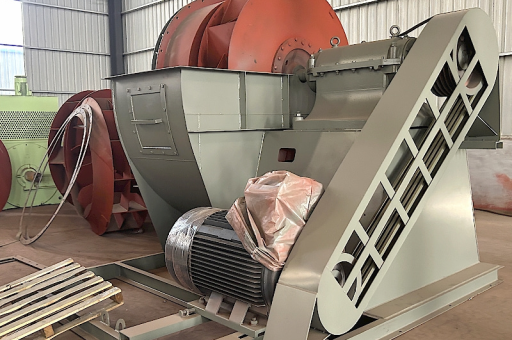
- What is it? (Context)
- Key Technical Specifications (For 10~450 t/H Boilers)
- Types of Centrifugal Fans Used
- Key Selection Criteria (Buying Guide)
- Typical Application (System Layout)
- Typical Models & Manufacturers (Examples)
- Summary & Immediate Next Steps
It appears you are looking for information or specifications regarding a centrifugal blower / fan specifically designed for the desulfurization system of an industrial boiler with a capacity range of 10 to 450 tons per hour (t/H) .
Here is a detailed breakdown of what this equipment entails, its key specifications, typical applications, and selection criteria.
What is it? (Context)
This fan is a critical component in Wet Flue Gas Desulfurization (WFGD) systems (commonly using limestone-gypsum process). Its primary function is to overcome the pressure drop caused by the scrubber tower, mist eliminators, and ductwork, forcing the flue gas through the sulfur removal system before it exits the stack.
Key Technical Specifications (For 10~450 t/H Boilers)
Boiler capacity (t/H) is a proxy for flue gas volume. The fan size and motor power will scale significantly across this range.
| Parameter | Typical Range (for 10 t/H) | Typical Range (for 450 t/H) |
|---|---|---|
| Air Volume (Flow) | ~15,000 – 25,000 m³/h | ~450,000 – 700,000 m³/h |
| Total Pressure | 4,000 – 6,000 Pa | 6,000 – 9,000 Pa (High pressure needed) |
| Motor Power | 37 – 55 kW | 800 – 1,500 kW (Often 6kV or 10kV) |
| Speed | 1450 – 2900 RPM (Dependent on size) | 450 – 990 RPM (Direct drive or geared) |
Critical Design Features (Must-Have):
- Material: The flue gas is loaded with acidic condensates (H₂SO₄, H₂SO₃, HCl). The impeller and housing must be:
- Impeller: Stainless Steel (SS304, SS316L) or specialized high-alloy steel (e.g., 2205 Duplex, / Hastelloy C276 for severe cases).
- Housing: Carbon Steel with Rubber Lining (elastomer lining) or FRP (Fiberglass Reinforced Plastic) . Rubber lining is very common for WFGD booster fans.
- Bearings: Heavy-duty, self-aligning roller bearings with cooling fans (for smaller units) or oil lubrication systems (for larger units).
- Shaft Seal: Must be airtight to prevent gas leakage (e.g., labyrinth seals, carbon ring seals, or mechanical seals with purge air).
- VFD Ready: Almost always designed to be controlled by a Variable Frequency Drive (VFD) to adjust to varying boiler loads.
- Critical Speed: Rigid rotor design to avoid resonance during start-up and shut-down.
Types of Centrifugal Fans Used
| Fan Type | Best Application | Pros | Cons |
|---|---|---|---|
| Backward Curved | Most Common for Desulfurization | High efficiency (82-85%), non-overloading power curve, stable operation. | Requires higher speed for same pressure vs. radial. |
| Radial (or Radial Tip) | Very high dust loads, high pressure, low flow | Very robust, handles erosion well. | Lower efficiency (65-75%), larger size. |
| Double Inlet (Double Suction) | Large boilers (>100 t/H) | Balances axial thrust, higher airflow in smaller footprint. | More complex ductwork design. |
Key Selection Criteria (Buying Guide)
When specifying this fan for a 10~450 t/H boiler, confirm these with the supplier:
- Gas Composition: Is the desulfurization Wet (scrubber) or Dry/Semi-Dry? (Wet requires higher corrosion resistance). What is the SOx concentration?
- Temperature: Flue gas inlet temperature to the fan is typically 45°C – 55°C (after scrubber outlet) but must handle up to 80-90°C during upset conditions. NEVER run hot dry gas (150°C+) through a rubber-lined fan.
- Erosion potential: Will there be carryover slurry droplets? If yes, impeller blade thickness and leading-edge wear protection (e.g., tungsten carbide coating) are crucial.
- Control method: Are you using VFD (most energy efficient), Inlet Guide Vanes (IGV) , or Damper Control? (VFD is strongly recommended).
Typical Application (System Layout)
The fan in this context is usually the Booster Fan located:
- Option A: After the WFGD Scrubber (Induced Draft - ID Fan) -> Best location (cleaner, cooler gas). The main ID fan pushes gas through the boiler/ESP, and this booster fan pushes it through the scrubber and out the stack.
- Option B: Before the WFGD Scrubber -> Less common (gas is hotter and dirtier, requiring more expensive materials).
Typical Models & Manufacturers (Examples)
- China (Common for 10-450 t/H):
- 9-26 Series (High Pressure, Backward Curved)
- 9-19 Series (Medium Pressure)
- G4-73 / Y4-73 Series (Dusty/flue gas type, often modified for corrosion)
- International:
- Howden
- FlaktGroup (Airtech)
- TLT-Babcock
- Robinson Fans
- Important: For desulfurization, you should request a WFGD-specific model, not a general industrial fan.
Summary & Immediate Next Steps
To get an accurate quotation, you need to provide the fan manufacturer with this information:
- Boiler Capacity: [e.g., 75 t/H]
- Desulfurization Type: [e.g., Wet Limestone-Gypsum]
- Required Airflow (Q): [e.g., 35,000 Nm³/h]
- Total Pressure (P): [e.g., 5,500 Pa]
- Gas Temperature: [e.g., 50°C, max 80°C]
- Control: [e.g., VFD]
- Impeller Material: [e.g., SS316L]
Recommendation: For a critical application like desulfurization (which is often emission-critical), do not undersize the motor and always specify the rubber lining or proper stainless steel impeller. Cheap carbon steel will fail in a matter of months.
Let me know if you need help translating these specs into a specific fan model number or a motor power calculation!





