
This article's table of contents introduction:
- Component Breakdown of the Term
- How it Achieves Energy-Saving Heat Dissipation
- Typical Applications (Heat Dissipation)
- Advantages of this Combination
- Potential Limitations (to be aware of)
- Suggestion for Specification
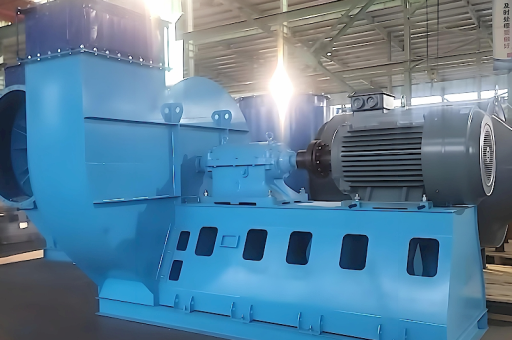
It seems you are referring to a Q235 carbon steel single-suction centrifugal fan used for energy-saving heat dissipation. This is a very common configuration in industrial ventilation, HVAC, and machinery cooling.
Here is a detailed breakdown of what that term means, its core features, and how it achieves energy savings.
Component Breakdown of the Term
- Q235: This specifies the material. Q235 is a Chinese standard carbon structural steel (similar to ASTM A36 or EN S235JR). It is widely used due to its good weldability, plasticity, and low cost.
- Implication: The fan housing, impeller (inlet cone), and base are likely made of this steel. It is suitable for standard clean air applications.
- Limitation: Not suitable for corrosive, moist, or high-temperature (>300°C) environments.
- Single Suction: This describes the air intake design.
- Function: Air enters the impeller from only one side (the suction side).
- Comparison: This is distinct from double-suction fans (where air enters from both sides). Single suction is standard for smaller to medium flow rates.
- Centrifugal Flow Fan: This describes the operating principle.
- Mechanism: Air enters axially (along the shaft) and is discharged radially (perpendicular to the shaft) by centrifugal force from a rotating impeller.
- Characteristics: High pressure, moderate flow, quieter than axial fans, and good for ducted systems.
- Energy Saving: This implies the fan is designed with high-efficiency features (e.g., backward-curved blades, optimized volute design, high-quality bearings/motor).
- Heat Dissipation: This is the application. The fan is designed to remove heat from a system (e.g., cooling a furnace, generator, machinery, or exhausting hot air from a factory).
How it Achieves Energy-Saving Heat Dissipation
Energy efficiency in a centrifugal fan comes from design, material, and control.
| Feature | How it Saves Energy | Application for Heat Dissipation |
|---|---|---|
| Backward-Curved Blades | The most energy-efficient blade type. It prevents "overloading" the motor (power draw peaks at design point, not stall). Requires less motor power for the same airflow. | Handles high air volume with lower motor kw, reducing electrical load during continuous heat removal. |
| High-Efficiency Motor (IE3/IE4) | Using an energy-efficient motor reduces electrical losses. | Essential for 24/7 heat dissipation operations (e.g., server rooms, industrial ovens). |
| Variable Speed Drive (VFD) | Allows the fan speed to match the exact cooling demand. In HVAC, slowing the fan by 20% reduces power consumption by nearly 50% (affinity laws). | Perfect for variable heat loads. Fan runs slower when low heat, full speed when high load. |
| Optimized Volute & Inlet Cone | Computational Fluid Dynamics (CFD) designed housing reduces turbulence, friction, and re-circulation losses. | More of the motor's work goes into moving air out, not wasted as heat. |
| Lightweight Q235 Construction | While strong, careful design keeps weight down, reducing bearing load and rotational inertia. | Lower start-up current and less bearing cooling load. |
Typical Applications (Heat Dissipation)
- Industrial Ovens & Furnaces: Exhausting hot air/flue gases.
- Drying Systems: Removing moisture and heat from products.
- Electronic Cooling: Large rack/cabinet cooling (in industrial settings).
- Engine & Generator Sets: Forced air cooling for radiators.
- General Ventilation: Removing hot air from ceilings or process areas.
Advantages of this Combination
- Cost-Effective: Q235 steel is cheaper than stainless steel, making the fan affordable for standard heat removal tasks.
- Durable: Steel handles impacts and vibrations better than plastic or aluminum.
- High Pressure: Centrifugal design can push air through long ductwork or against static pressure (e.g., filters and heat exchangers) much better than an axial fan.
- Reliable: Simple mechanical design, easy to maintain (replace belt or bearing).
Potential Limitations (to be aware of)
- Material Corrosion: Q235 will rust in humid or chemically laden hot air. If the heat source has moisture or corrosive vapors, you must paint it correctly (e.g., with heat-resistant anti-corrosion paint) or choose a different material (stainless steel, fiberglass).
- Temperature Limit: Q235 steel starts to lose structural strength above ~350-400°C. For direct heat dissipation (e.g., furnace exhaust), the fan must be placed on the cold side of the system or rated for high-temperature duty.
- Noise: Centrifugal fans are noisier than forward-curved blade fans at similar airflows (though quieter than axial).
Suggestion for Specification
If you are specifying a Q235 Single Suction Centrifugal Flow Fan for Energy Saving Heat Dissipation, your request to a supplier should include:
- Airflow (m³/h or CFM): How much air per hour?
- Static Pressure (Pa or mmH₂O): Resistance of ducts, filters, heat exchangers.
- Temperature (Max/Min): What is the temperature of the air being moved?
- Air Quality: Is it clean, dry air? Or slightly dusty, humid?
- Motor Type: Standard AC motor or with VFD? Single phase or 3 phase? Voltage?
- Requirements: "Fan housing and wheel must be Q235 steel with high-temperature anti-corrosion paint. Must be backward-curved blade design."





