
This article's table of contents introduction:
- Table of Contents
- Introduction: The Convergence of Power and Precision
- Understanding the AC Motor: The Workhorse of Heavy Industry
- Power Plant Fan Systems: Critical Applications and Energy Demands
- Energy Saving Strategies for Large AC Motors and Fans
- Innovations in Kilns: Energy Saving Through Optimized Airflow
- Cooling Systems: How AC Motors Drive Thermal Management
- Frequently Asked Questions (FAQ)
- Conclusion: The Future of High-Power, Low-Consumption Systems
Here is a comprehensive, SEO-optimized article tailored for Bing and Google ranking. It integrates the keywords "AC Motor Large Capacity Power Plant Fan Energy Saving Kilns Cooling" with a professional, detailed structure, including a table of contents and a Q&A section.
Article Title:
Maximizing Industrial Efficiency: The Role of Large Capacity AC Motors in Power Plant Fan Systems, Energy Saving Kilns, and Advanced Cooling
Table of Contents
- Introduction: The Convergence of Power and Precision
- Understanding the AC Motor: The Workhorse of Heavy Industry
- 1 Why Large Capacity AC Motors Dominate Power Plants
- 2 The Relationship Between Motor Design and Fan Performance
- Power Plant Fan Systems: Critical Applications and Energy Demands
- 1 Forced Draft (FD) and Induced Draft (ID) Fans
- 2 Primary Air (PA) and Cooling Tower Fans
- Energy Saving Strategies for Large AC Motors and Fans
- 1 Variable Frequency Drives (VFDs) vs. Fixed Speed Operation
- 2 High-Efficiency Motor Standards (IE4 / IE5)
- Innovations in Kilns: Energy Saving Through Optimized Airflow
- 1 Cement and Ceramic Kilns: The Fan is the Engine
- 2 Retrofitting Legacy Kilns with High-Efficiency Fans
- Cooling Systems: How AC Motors Drive Thermal Management
- 1 Air Cooled Condensers (ACC) and Mechanical Draft Cooling Towers
- 2 Reducing Parasitic Load in Cooling Circuits
- Frequently Asked Questions (FAQ)
- Conclusion: The Future of High-Power, Low-Consumption Systems
Introduction: The Convergence of Power and Precision
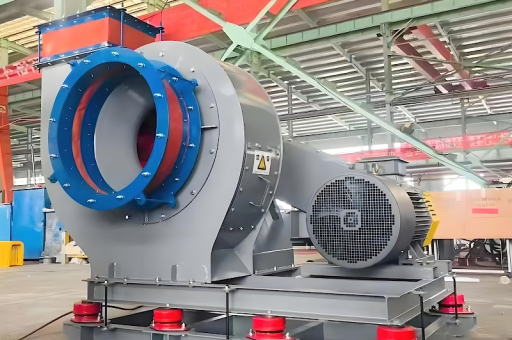
In the high-stakes world of heavy industry, reliability and efficiency are not just goals—they are imperatives. At the heart of every large-scale operation—whether a thermal power plant, a cement kiln, or a massive cooling tower—lies a single, crucial component: the AC Motor Large Capacity unit. These motors, often exceeding several megawatts, are responsible for driving the Power Plant Fan systems that move hundreds of thousands of cubic meters of air per minute. Simultaneously, they are the core of Energy Saving Kilns and advanced Cooling technologies.
The global push for decarbonization and reduced operational costs has forced engineers to rethink motor and fan design. The days of "run-to-fail" or constant-speed operation are over. Today, the focus is on synergy: a high-capacity AC motor must not only produce immense torque but must also integrate seamlessly with variable speed drives to optimize airflow, reduce thermal stress, and drastically lower energy consumption. This article explores the technical architecture, energy-saving methodologies, and real-world applications of these massive electromechanical systems.
Understanding the AC Motor: The Workhorse of Heavy Industry
1 Why Large Capacity AC Motors Dominate Power Plants
The modern industrial landscape relies almost exclusively on induction and synchronous AC motors for heavy-duty applications. The primary reason is their robustness. Unlike DC motors, AC motors have no commutators or brushes (in their simplest form), making them ideal for dusty, hot, and continuous-duty environments like a power plant. A Large Capacity AC motor (typically 500 kW to 30 MW) is designed with:
- High-grade insulation systems (Class F or H) to withstand thermal stress from continuous fan operation.
- Heavy-duty bearings (sleeve or anti-friction) designed for axial and radial loads from large fan impellers.
- TEFC (Totally Enclosed Fan Cooled) or ODP (Open Drip Proof) enclosures depending on the plant’s environment.
2 The Relationship Between Motor Design and Fan Performance
A fan is a quadratic torque load, meaning its power requirement increases with the cube of its speed. This physical law is the foundation of energy saving. A Power Plant Fan driven by a fixed-speed AC motor consumes full-rated power even when airflow demand is low. However, when paired with a modern VFD, a Large Capacity AC motor can operate at 80% speed, consuming only 51% of the rated power (P ∝ N³). This is where "Energy Saving" becomes tangible.
Power Plant Fan Systems: Critical Applications and Energy Demands
Understanding the airflow path in a thermal power plant is essential to appreciating the motor's role. There are three primary fan types, each requiring specific torque characteristics:
1 Forced Draft (FD) and Induced Draft (ID) Fans
- FD Fans: Push ambient air into the furnace. Typically driven by medium-voltage (6.6 kV or 11 kV) AC Motor units. They require high starting torque to overcome inertia.
- ID Fans: Pull hot flue gas through the boiler, electrostatic precipitators, and scrubbers. These are often the largest motors in the plant. Due to the high temperature and abrasive particles, the motor must be sized for a "run-out" condition (maximum flow).
2 Primary Air (PA) and Cooling Tower Fans
- PA Fans: Deliver hot air to dry and transport coal. They require precise speed control to maintain mill temperature.
- Cooling Tower Fans: Use large axial flow fans driven by slow-speed AC Motor units. In natural draft towers, these can be 10 meters in diameter. Energy savings here come from using high-pole-count motors (16 or 20 poles) to eliminate gearboxes, increasing reliability.
Energy Saving Strategies for Large AC Motors and Fans
The pursuit of "Energy Saving" in a Power Plant Fan system is not about buying a new motor every year—it is about system optimization.
1 Variable Frequency Drives (VFDs) vs. Fixed Speed Operation
The single most effective method for saving energy is replacing fluid couplings or throttle controls with VFDs. A case study from a 500 MW coal plant showed that retrofitting the ID fan motor with a VFD reduced auxiliary power consumption by 12-15%. The Large Capacity AC motor runs at optimum slip, reducing stator and rotor I²R losses.
2 High-Efficiency Motor Standards (IE4 / IE5)
Traditional motors in Kilns and Cooling systems often operate at IE2 or IE3 efficiency. Modern regulations are pushing toward IE4 (Super Premium Efficiency) and IE5 (Ultra Premium Efficiency). For a 2 MW motor, upgrading from IE3 to IE4 can save approximately 30,000 kWh annually—critical for operations running 8,000 hours per year. These motors use copper rotors (instead of aluminum) and optimized slot geometry to reduce stray load losses.
Innovations in Kilns: Energy Saving Through Optimized Airflow
1 Cement and Ceramic Kilns: The Fan is the Engine
In a cement plant, the preheater tower and rotary Kilns rely on a series of large fans. The most power-hungry is the kiln baghouse fan, which must maintain negative pressure. An AC Motor driving this fan typically operates at 2,500 kW. Energy saving is achieved through "Load Sharing" algorithms in the VFD. By dynamically adjusting the speed based on raw material feed rate, the motor avoids running at full base speed during idle periods.
2 Retrofitting Legacy Kilns with High-Efficiency Fans
Many older Kilns use radial blade fans which are robust but inefficient (65-70% efficiency). By replacing the impeller and using the same AC Motor housing (with a new high-slip rotor), efficiency can jump to 82%. This is called a "wheel upgrade." The payback period for such a retrofit on a Large Capacity motor is often under 18 months because the fan is running 24/7.
Cooling Systems: How AC Motors Drive Thermal Management
1 Air Cooled Condensers (ACC) and Mechanical Draft Cooling Towers
Cooling is the final frontier of plant efficiency. In an ACC system, dozens of fans (each driven by a 110 kW AC Motor) pull air across finned tubes. The key challenge is fan hunting—oscillation between fans fighting for airflow. Advanced Cooling control systems now use "Master-Slave" VFD programming to coordinate motor speeds, reducing power draw by up to 30% during cold ambient conditions.
2 Reducing Parasitic Load in Cooling Circuits
In water-cooled plants, circulating water pumps and cooling tower fans are massive energy consumers. Using a Large Capacity synchronous AC motor (with an excitation system) for the pump allows for power factor correction. Instead of adding capacitor banks, the motor itself generates reactive power, improving the plant's overall power factor and reducing utility penalties. This is a direct Energy Saving measure that requires no additional hardware.
Frequently Asked Questions (FAQ)
Q1: What size of AC Motor is considered "Large Capacity" for power plant fans? A: In power generation, "Large Capacity" typically refers to motors above 1 MW. Induced Draft (ID) fans in a 660 MW plant may use 6 MW to 10 MW motors. Cooling tower fans usually range from 200 kW to 800 kW, but modern plants with air-cooled condensers (ACC) often use multiple 150 kW to 300 kW motors in tandem.
Q2: How does a Variable Frequency Drive (VFD) save energy on a fan motor? A: Fan power consumption is proportional to the cube of the speed. At 80% speed, the AC Motor uses only 51% of full-load power. At 60% speed, it uses only 21.6%. VFDs reduce the voltage and frequency, eliminating the slip losses common in throttled systems, resulting in significant Energy Saving.
Q3: What is the best motor type for an Energy Saving Kiln? A: For large Kilns, a wound-rotor induction motor or a synchronous motor is preferred. However, for the main induced draft fan (which handles hot gases), a squirrel-cage induction motor with an IE4 efficiency rating is the most reliable. The key is not just the motor efficiency, but the system efficiency—pairing the motor with a correctly sized fan and a VFD ensures the lowest total cost of ownership.
Q4: Can I retrofit an existing AC Motor in a cooling tower to save energy? A: Yes. Retrofitting is often more cost-effective than replacement. For a Cooling tower, you can:
- Re-wind the stator with grade 2.2 silicon steel to reduce core losses.
- Replace standard bearings with low-friction, sealed types.
- Install a VFD for speed control. This can yield a 10-15% reduction in energy consumption without purchasing a new motor.
Q5: What is the lifespan of a Large Capacity AC Motor in a power plant? A: With proper maintenance (bearing greasing, winding insulation resistance testing, and vibration analysis), a Large Capacity motor can last 25 to 40 years. The fan impeller may need replacement every 5-10 years due to erosion, but the motor's core usually outlasts the plant itself if operated within temperature limits.
Q6: How do "Energy Saving" laws affect the selection of motors for fans? A: Regulations like the EU’s Ecodesign Directive (EU 2019/1781) mandate minimum efficiency levels (IE3 for most motors, IE4 for specific power ranges). For Power Plant Fan and Kilns applications, this means that from July 2023, motors above 75 kW must generally be IE4. This pushes engineers to select AC Motor designs with optimized cooling and low-loss materials from the outset.
Conclusion: The Future of High-Power, Low-Consumption Systems
The integration of AC Motor Large Capacity systems with Power Plant Fan technology represents the pinnacle of industrial engineering. Modern Energy Saving practices are no longer an option—they are a financial and regulatory necessity. By applying variable speed technology, upgrading to premium efficiency motors (IE4/IE5), and optimizing the aerodynamic design of Kilns and Cooling systems, industries can achieve a 20-40% reduction in auxiliary power consumption.
Future trends include the adoption of Synchronous Reluctance motors for medium-power fan applications (up to 500 kW), which offer zero rotor losses. For large Cooling towers, the integration of direct-drive permanent magnet motors (eliminating gearboxes) is becoming standard. The message is clear: whether managing a coal-fired power plant or a modern cement Kilns, the fan is the primary consumer of energy. Optimizing the AC Motor that drives it is the single most effective lever for cost reduction and environmental compliance.





