
This article's table of contents introduction:
- Breakdown of the Terms
- Why is this configuration used in a Lime Kiln?
- Key Operational Challenges & Risks
- Critical Maintenance & Design Considerations
- Summary for Practical Application
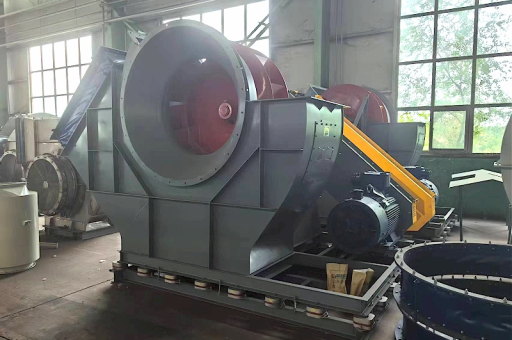
It appears you are asking about a specific industrial application: a coupling-driven, forward-curved (or forward-blade) high-pressure centrifugal fan used in a lime kiln system.
This is a very specific piece of heavy industrial equipment. Below is a technical breakdown of what this phrase means, the typical challenges, and key considerations for operation and maintenance.
Breakdown of the Terms
- Lime Kiln: A large, rotating cylindrical furnace (or vertical shaft kiln) used to produce quicklime (Calcium Oxide) by calcining limestone (Calcium Carbonate) at very high temperatures (~900-1100°C).
- Driving Forward: The fan is located after the kiln (on the exhaust side) or before the kiln (on the combustion air side). "Driving forward" likely refers to the fan being used to induce draft (ID fan) or force draft (FD fan) to push air/gas through the process.
- High Pressure Centrifugal Fan: A fan designed to generate a large pressure differential. In a lime kiln, this is crucial to overcome the resistance of the stone bed, ductwork, and pollution control equipment.
- Coupling: The mechanical connection between the fan's motor shaft and the fan impeller shaft. Common types include:
- Flexible Coupling: Used most often to absorb misalignment, vibration, and shock loads.
- Fluid Coupling (Variable Speed): Used for soft starts and speed control, common on large ID fans.
- Direct Drive / Rigid Coupling: Less common for high-power applications.
Why is this configuration used in a Lime Kiln?
Lime kilns require high volumes of air or exhaust gas to be moved against significant resistance. The high-pressure centrifugal fan is ideal for:
- Combustion Air (FD Fan): Pushing primary and secondary air into the kiln burner to support the fuel (coal, gas, oil, petcoke).
- Induced Draft (ID Fan): Pulling hot, corrosive, and dust-laden exhaust gases through the kiln, preheater, and dust collection system (baghouse or ESP).
The coupling is critical because the fan motor is typically a constant-speed electric motor. The coupling allows the fan to:
- Start up slowly (fluid coupling) to avoid thermal shock to the refractory lining and stone bed.
- Operate at different speeds (if a variable-speed coupling is used) to match the kiln's process needs without expensive VFDs.
Key Operational Challenges & Risks
Using a "Driving Forward" high-pressure fan in a lime kiln system creates several critical failure points:
| Component | Challenge | Root Cause |
|---|---|---|
| Impeller (Wheel) | Erosion | Abrasive limestone dust and high-velocity gas. The forward-curved blades are particularly susceptible to leading-edge wear. |
| Impeller | Build-up (Fouling) | Sticky lime dust, moisture, and condensation can create thick, uneven deposits that cause severe imbalance and vibration. |
| Shaft & Bearings | Misalignment | The coupling cannot absorb all thermal expansion from the hot gas. The kiln shell and ductwork can shift, causing misalignment at the fan shaft. |
| Coupling | Fatigue & Wear | Constant exposure to high temperature (radiated heat from ductwork), dust ingress, and high torque loads. Fluid couplings can overheat. |
| Motor | Overload | If the fan impeller becomes fouled or the ductwork plugs, the fan must work harder ("driving forward" against higher resistance) leading to motor overload or stalling. |
| System | Reverse Flow | If the fan stops while the kiln is under positive pressure, hot gases can flow backward through the fan, causing thermal damage to the coupling and bearings. |
Critical Maintenance & Design Considerations
If you are specifying, operating, or maintaining this system, focus on these areas:
A. For the Coupling:
- Alignment: Must be checked after any kiln refractory repair or ductwork replacement. Use laser alignment.
- Lubrication: Check coupling grease or oil level. Fluid couplings need correct oil type and level for proper torque transmission.
- Condition Monitoring: Watch for coupling wear (rubber elements) or overheating (fluid coupling).
B. For the Fan & System:
- Vibration Monitoring: Essential. An increase in vibration almost always indicates impeller imbalance due to erosion or build-up. Install accelerometers on the fan bearing housings.
- Cleaning Intervals: Plan for periodic impeller cleaning. Access doors in the fan housing are critical. Water or shot-cleaning systems are sometimes used.
- Temperature Control: Monitor the gas temperature at the fan inlet. High temps ( >400°C for standard fans) can cause impeller creep or failure. A cold damper bypass is often needed for start-up.
- Pre-Start Checks: Before starting the fan, ensure the main kiln damper is open to prevent the fan from "deadheading" (zero flow) which will cause immediate overheating and surging.
Summary for Practical Application
| Question | Answer |
|---|---|
| What is it? | A high-pressure centrifugal fan (usually an ID or FD fan) powered by a motor via a flexible or fluid coupling, used to push/pull gases through a lime kiln. |
| Main Risk? | Fouling/Erosion of the impeller leading to vibration, coupling failure, and system shutdown. |
| Key Maintenance? | Regular alignment checks, critical vibration analysis, and scheduled impeller cleaning. |
| Design Priority? | The coupling must be rated for high torque and allow for misalignment caused by thermal expansion of the kiln and ductwork. |
If you have a specific problem (e.g., excessive vibration, coupling failure, overheating, or flow issues) with your "Driving Forward High Pressure Centrifugal Fan Lime Kiln," please provide more details about the symptoms, and I can give more targeted troubleshooting advice.





