
This article's table of contents introduction:
- The Challenge: The Sintering Machine Environment
- Key Design Features for High Wear Resistance
- Specific Manufacturers Who Excel Here
- How to Specify & Order This Fan
- Cost Considerations
- Summary Checklist for a High Wear-Resistant Sinter Fan
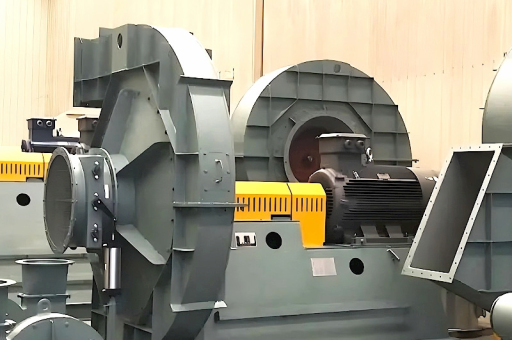
This is a highly specific and technical request. You are looking for Industrial Heavy Duty Centrifugal Fans specifically for a Sintering Machine application, with the critical requirement of High Wear Resistance.
Here is a detailed breakdown of what this entails, the key design features, and what to look for in such a fan.
The Challenge: The Sintering Machine Environment
A sintering machine (used in steel, iron, and non-ferrous metal production) creates a uniquely harsh environment for a centrifugal fan.
- Abrasive Dust: The fan handles the exhaust gas from the sintering bed, which contains fine, hard, abrasive iron ore dust, coke breeze, and fluxes (like limestone).
- High Temperatures: Exhaust gas temperatures typically range from 120°C to 200°C, with spikes possible.
- Corrosive Gases: The presence of sulfur dioxide (SO2), moisture, and chlorides can create acidic condensates, leading to chemical corrosion.
- Large Volumes & Pressure: These fans are massive, moving millions of cubic meters per hour against significant system resistance.
The primary failure mode is erosive wear on the impeller blades, casing, and inlet cone. This leads to imbalance, vibration, and premature failure.
Key Design Features for High Wear Resistance
To build a fan that survives in this environment, the manufacturer must integrate specific engineering solutions.
Impeller (The Most Critical Component)
- Material Selection:
- High-Strength Abrasion-Resistant Steel: The base material should be something like Hardox 400, 450, or 500, NM400/NM500, or AR400/AR500. These are quenched and tempered steels with high hardness (360-500 HBW).
- Stainless Steel (for corrosion/wear combo): For wetter gas streams, 316L or Duplex Stainless Steel (e.g., SAF 2205) is used to resist both corrosion and wear.
- Blade Geometry:
- Backward-Inclined / Airfoil (BI/BAF): The standard for high-efficiency sintering fans. The hollow airfoil shape reduces dust accumulation.
- Backward-Curved (BC): Simpler to manufacture and repair. Thicker, solid blades are possible.
- Radial Tip: More robust but less efficient. Can be designed with very thick, replaceable wear plates.
- Thickness Build-Up (Wear Liner):
- Blade Leading Edges: These are the first point of attack. They are often clad with chrome carbide overlay (CCO) or tungsten carbide weld overlays. A 3-6mm thick layer is common.
- Blade Wear Strips: Strips of abrasion-resistant steel (e.g., 8-12mm thick) are welded onto the pressure side of the blades.
- Backplate/Shroud: The inner surface of the backplate (disc) and the shroud (cover) are protected with replaceable liners (often bolted on).
- Weld-Overlay (Hardfacing): The entire blade pressure side can be overlaid with a chromium carbide or titanium carbide layer (e.g., Stellite or Eutectic alloys).
Casing (Volute)
- Material: Similar abrasion-resistant steel (NM400, Hardox 450) for the entire casing.
- Wear Liners: The key here is replaceability.
- Side Liners: Replaceable plates (12-20mm thick) bolted to the side walls of the casing.
- Cut-Off (Scroll Tongue) Liners: The most wear-prone area of the casing. Requires the thickest, most abrasion-resistant liner (e.g., 20-25mm thick, CCO-clad).
- Bottom Liners: The bottom half of the volute acts as a dust collection zone and requires heavy-duty liners.
Inlet Cone (Spinner/Mouth Ring)
- Material: Abrasion-resistant steel or cast steel.
- Wear Ring: A replaceable, hard-faced ring where the impeller and cone meet.
- Design: The cone must be designed to prevent dust ingress into the bearing housing.
Shaft & Bearings
- Shaft: Large diameter, alloy steel (e.g., 42CrMo4/AISI 4140) to handle heavy loads and vibration.
- Bearings: Heavy-duty spherical roller bearings in split pillow-block housings. They must be sized for a L10 life of >100,000 hours.
- Seals: A critical wear point. Labyrinth seals with a grease purge system are standard to keep dust out of the bearing housing. Isolation bearings (where the bearing sits outside the gas stream) are highly recommended.
Drive & Vibration
- Direct Drive (Preferred): A heavy-duty electric motor connected via a flexible coupling.
- Vibration Monitoring: **Continuous proximity probes (for sleeve bearings) or accelerometers (for roller bearings) are mandatory. Vibration limits should be ISO 10816-3 compliant.
- Variable Speed Drive (VSD): For energy efficiency and process control, a high-power VSD is typical.
Specific Manufacturers Who Excel Here
These are global and regional leaders known for heavy-duty, wear-resistant sintering fans:
- Howden (USA/Global): A dominant player. Their "Buffalo" fans are legendary. They use proprietary hardfacing techniques (e.g., "Howden Wearpak").
- Siemens / Flender (Germany/Global): Often provide complete drive and fan packages.
- TLT-Turbo / Babcock & Wilcox (Germany/Global): Known for high-efficiency, custom-engineered fans.
- New York Blower (USA): Offers a wide range of heavy-duty industrial fans.
- Robinson Industries (USA): Specializes in custom industrial fans for high-wear applications.
- Greenheck / Clarage (USA): A large, well-respected manufacturer.
- Zitron / Windy (Spain/Europe): Strong in the mining and steel sectors.
- Kruger Ventilation (Global): Industrial division offers robust designs.
How to Specify & Order This Fan
When you issue a Request for Quotation (RFQ), you MUST include these parameters:
- Flow Rate: (m³/hr or CFM)
- Pressure: (Pa or in. w.g.) - Static or Total.
- Gas Temperature: Minimum, Normal, and Maximum.
- Gas Composition:
- Dust loading (g/m³ or grains/dscf)
- Particle size distribution (P80, top size)
- Chemical composition of dust (No free silica? High Fe2O3?)
- Presence of SO2, HCl, moisture.
- Performance Requirements:
- Efficiency at operating point.
- Allowed Vibration levels.
- Required bearing life.
- Construction Requirements:
- "Abrasion-resistant steel for impeller & casing: please specify grade (e.g., Hardox 500)"
- "Chrome carbide overlay on blade leading edges: specify thickness and hardness (HRC)"
- "Replaceable wear liners for casing, cut-off, and side walls"
- "Shaft seals: Labyrinth with grease purge"
- "Vibration monitoring: Specify sensor type and monitoring system"
Cost Considerations
- Price Range: Expect a significant premium over a standard centrifugal fan. A large sinter fan (e.g., 4m diameter, 5MW motor) can cost $500,000 to $2,000,000+ .
- Maintenance Costs: High initial cost is offset by longer service life (2-5 years between major overhauls vs. 6-12 months for a standard fan).
Summary Checklist for a High Wear-Resistant Sinter Fan
| Component | Minimum Requirement |
|---|---|
| Impeller Material | AR400, Hardox 450, or equivalent |
| Blade Leading Edges | Chrome Carbide Overlay (CCO) (50-60 HRC) |
| Blade Wear Strips | Yes, AR500 or CCO-clad |
| Casing Material | AR400 or similar |
| Casing Liners | Replaceable, bolted (12-20mm, AR400+) |
| Cut-Off Liner | Heavy-duty (20-25mm, CCO-clad) |
| Shaft Seals | Labyrinth with grease purge |
| Bearings | Heavy-duty spherical roller, L10 >100k hours |
| Vibration Monitoring | Continuous, ISO 10816-3 |
In short: You are not looking for a standard fan. You need a custom-engineered, heavy-duty machine built with abrasion-resistant steel, replaceable wear liners, chrome carbide weld overlays, and robust bearings. Leading manufacturers like Howden, TLT-Turbo, and Robinson Industries have proven designs for this exact application. Specify your dust loading, temperature, and particle size clearly to get the correct design and wear protection strategy.





