
This article's table of contents introduction:
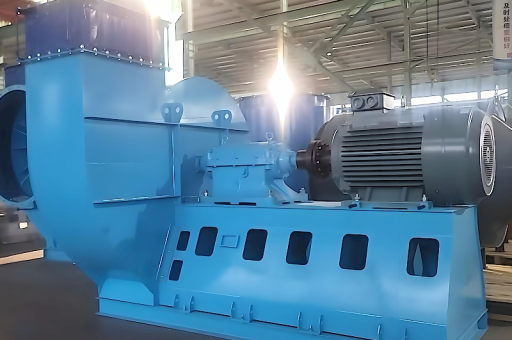
- Material: Carbon Steel
- Type: Double Suction (DS)
- Application: Material Handling
- Wheel Design: Backward Curved (BC)
- The "Conflict" in Your Specs
- Common Applications
- What is your specific question?
Your query seems to list key specifications for an industrial fan or blower, but it isn't a complete question. It appears you are describing or looking for a heavy-duty industrial centrifugal blower.
Here is a breakdown of what these specifications mean and what application they typically refer to:
Material: Carbon Steel
- What it means: The impeller (wheel), housing (volute), and shaft are made from standard mild steel (e.g., ASTM A36 or similar).
- Why used: Carbon steel offers high strength, durability, and weldability at a lower cost than stainless steel. It is suitable for handling clean or slightly dusty air, fumes, and particulate where high corrosion resistance is not required.
- Limitation: Not suitable for corrosive fumes, high humidity, or abrasive materials unless lined or coated.
Type: Double Suction (DS)
- What it means: Air enters the impeller from both sides (as opposed to single suction, which draws from one side).
- Why used:
- Higher Airflow: For the same impeller diameter, double suction allows for much higher volume (CFM).
- Balanced Axial Thrust: Because air pressure acts on both sides equally, axial loads on the bearings are greatly reduced. This extends bearing life and allows for a lighter shaft design.
- Space Saving: A double suction fan can often replace two smaller single-suction fans.
Application: Material Handling
- What it means: The blower is designed to transport bulk materials such as wood chips, sawdust, plastic pellets, grain, powders, or light trash through a duct system.
- Key Design Feature: Unlike standard blowers, material handling fans usually have radial or highly reinforced backward-inclined blades to prevent clogging and withstand impacts. However, a backward curved blade (see next point) is actually less ideal for truly sticky or high-impact material compared to a radial paddle wheel. It is better for clean air or light, fibrous material.
Wheel Design: Backward Curved (BC)
- What it means: The blades curve away from the direction of rotation.
- Performance Characteristics:
- High Efficiency: BC wheels are the most efficient centrifugal design (typically 75-85% peak efficiency).
- Non-Overloading Power Curve: The motor cannot be overloaded mechanically; the horsepower peaks at a specific point and drops off. This makes them safe with typical AC motors.
- Lower Noise: Generally quieter than radial (paddle wheel) designs.
- Self-Cleaning: The backward curve prevents material from "sticking" to the blade face as easily as a forward curve or radial blade.
The "Conflict" in Your Specs
There is a common engineering trade-off here:
- Material Handling typically requires Radial Paddle Wheel (flat blades) or Radial Tip designs. These have deep, open passages to allow large, sticky, or heavy objects to pass through without clogging. They are low efficiency but high durability.
- Backward Curved wheels are used for clean air (HVAC, dust collection with light pre-filtered air, industrial process air). They clog easily if your material is sticky, wet, or has long fibers.
Verdict: A "Carbon Steel Double Suction Material Handling Blower with Backward Curved" is likely a Dust Collector Fan or Industrial Exhaust Fan designed for:
- High volume (Double Suction)
- Medium pressure (Backward Curved)
- Moving light, dry, non-sticky particulate (e.g., fine sawdust, grain dust, plastic regrind).
- A heavy-duty environment (Carbon Steel).
Common Applications
- Cement plants (moving dry dust).
- Food processing (conveying grains or flour).
- Woodworking (central dust collection).
- Mining (ventilation or dust extraction).
- Wastewater treatment (aeration or vent gas handling).
What is your specific question?
To give you a precise answer, please clarify what you need:
- Are you looking for a quote?
- Are you asking about performance specs (CFM, SP, RPM, HP)?
- Are you asking about the compatibility of these parts?
- Are you experiencing a performance issue with this combination?
For example: "I need a carbon steel double suction backward curved blower that moves 25,000 CFM at 20" SP. What motor size do I need?"





