
This article's table of contents introduction:
- Deconstructing the Keywords
- Key Specifications for an Alloy Steel High-Temp Fan
- Critical Design Features
- Common Applications in a Steam Boiler System
- Why Alloy Steel? (The Engineering Rationale)
- Operational & Maintenance Considerations
- Summary Table: Application vs. Specification
It appears you are describing a specific type of industrial fan used in a steam boiler system. Let's break down the terminology to ensure we are talking about the same thing, and then I will provide the key specifications, applications, and considerations for this equipment.
Deconstructing the Keywords
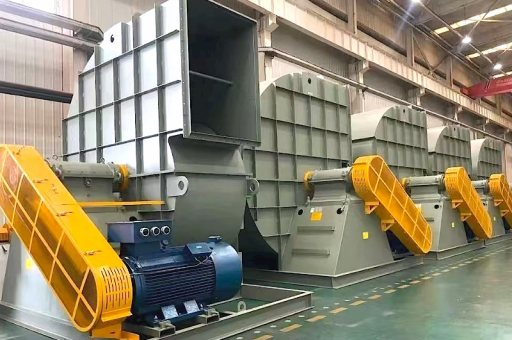
- Centrifugal Fan: The core machine. It uses a rotating impeller to increase the velocity of air/gas, creating pressure to move it through ductwork.
- High Temperature: This is the critical specification. The fan must handle flue gases typically ranging from 200°C to 400°C (392°F to 752°F), or even higher with special cooling systems.
- Backward (Curved/Inclined) Blades: This describes the impeller blade design.
- Why it's chosen: Backward-inclined blades are the most efficient design for heavy-duty industrial use. They are non-overloading (motor won't burn out if duct pressure drops) and handle particulate matter better than forward-curved blades.
- Steam Boiler: The application. The fan moves hot combustion air or flue/exhaust gas.
- Forced Draft (FD) Fan: Pushes air into the boiler burner.
- Induced Draft (ID) Fan: Pulls hot flue gas out of the boiler and through the stack/chimney.
- Alloy Steel: The construction material. Standard carbon steel (like Q235 or A36) fails under high heat. Alloy steel is used for the impeller, shaft, and sometimes the housing.
Key Specifications for an Alloy Steel High-Temp Fan
When sourcing or designing this fan, these parameters are mandatory:
| Specification | Typical Range for Boiler ID/FD Fans | Notes |
|---|---|---|
| Material (Impeller & Shaft) | Alloy Steel (e.g., 16Mo3, 15CrMo, 1.25Cr-0.5Mo) | Resists creep, oxidation, and thermal fatigue at high temp. |
| Material (Housing) | Carbon Steel (Q235) or Corten, lined with alloy or refractory | The housing can be made of cheaper steel if internal insulation is used. |
| Temperature Rating | 250°C - 350°C (Standard) Up to 450°C+ (With shaft cooling / alloy) |
The fan nameplate will state the maximum continuous operating temperature. |
| Impeller Type | Backward Curved / Backward Inclined (e.g., RAL/ARR, Sirocco type) | Highest efficiency and stability for boiler duty. |
| Bearing Cooling | Water cooling jacket or forced air cooling (fan on shaft) | Essential to prevent lubricant breakdown and shaft warping at the bearing housing. |
| Drive Type | Direct Drive (coupling) preferred over belt drive | Belts fail under high radiant heat. |
| Balance Grade | G6.3 or better (ISO 1940) | High-speed rotation at temp requires perfect dynamic balance to avoid vibration. |
Critical Design Features
- Shaft Cooling (The "Backward" Thermal Barrier): In high-temp fans, the shaft must be cooled where it exits the hot housing. This is often done with a cooling fan mounted on the shaft outside the housing, or a water-cooled bearing bracket.
- Thermal Expansion: The impeller is designed to grow slightly at operating temperature without rubbing the inlet cone (the "shroud ring"). A larger radial gap is used than in standard fans.
- Wear Resistance: Flue gas from solid fuel boilers (coal, biomass) contains fly ash. The leading edges of the blades are often hard-faced (Stellite or tungsten carbide overlay) to prevent erosion.
Common Applications in a Steam Boiler System
- Induced Draft (ID) Fan: Is by far the most common application for the alloy steel version. It handles the dirtiest and hottest gas directly from the boiler exit, before the economizer/air heater.
- Forced Draft (FD) Fan: Usually handles cold, clean ambient air, so alloy steel is rarely needed unless it is a very high-efficiency condensing boiler or the air is preheated.
- Recirculation Fan (FGR): Used in low-NOx boilers. These fans move hot flue gas (200-300°C) back to the burner. Alloy steel is mandatory.
Why Alloy Steel? (The Engineering Rationale)
You cannot use standard carbon steel for an ID fan in a high-pressure steam boiler. Here’s why:
- Creep Strength: At 350°C, carbon steel loses a significant percentage of its yield strength. It will literally deform (creep) over time under the centrifugal load of the spinning impeller.
- Oxidation (Scaling): Hot flue gas causes carbon steel to oxidize rapidly (like rusting, but faster). Alloying elements like Chromium and Molybdenum form a protective oxide layer that prevents the metal from thinning out.
- Thermal Fatigue: Boilers cycle on and off. The fan heats up and cools down. Alloy steel has better resistance to the cracking caused by repeated thermal expansion and contraction.
Operational & Maintenance Considerations
- Vibration Monitoring: High-temp fans are critical. A vibration sensor (accelerometer) on the bearing housing is mandatory to detect imbalance from ash buildup or blade wear.
- Start-Up Procedure: The fan must be run for a few minutes to purge the boiler before the burner ignites. Never start a cold fan with hot gas flowing through it.
- Cool Down: After the boiler shuts down, the fan should continue running for a while to cool the housing and shaft to prevent bearing damage and thermal lock-up.
Summary Table: Application vs. Specification
| Feature | Standard Fan | Your Requirement (Alloy Steel Backward Boiler Fan) |
|---|---|---|
| Material | Carbon Steel (MS/SS400) | Alloy Steel (16Mo3, 15CrMo, or equivalent) |
| Blade Type | Forward Curve / Radial | Backward Inclined / Curved |
| Max Temp | 80°C - 150°C | 250°C - 450°C+ |
| Duty | Clean air / AC | Hot flue gas / Ash laden |
| Lifespan | 5-10 years | 10-20 years (if maintained) |
| Cost | Low ($) | High ($$$$) |
Final Verdict: You are describing a heavy-duty, high-efficiency Induced Draft Fan for a steam boiler operating in the range of 250°C to 350°C. It requires a backward-inclined (ARR) impeller made of alloy steel to withstand the thermal stresses, erosion, and to provide the pressure needed to overcome boiler backpressure.
If you need a specific part number or datasheet, you should contact manufacturers like Howden, New York Blower, FläktGroup, Loren Cook, or Chinese OEMs like Yilida, Jianfeng, or Xinxiang Hongli, specifying the parameters above (Volume in m³/h, Pressure in Pa, Gas Temperature, Gas Composition).





