
This article's table of contents introduction:
- Article Directory / Table of Contents
- Introduction: The Role of FD Fans in Industrial Boilers
- What is a Large Capacity Industrial Boiler FD High Pressure Centrifugal Fan?
- Core Design Principles and Construction Materials
- Performance Parameters: Pressure, Flow Rate, and Efficiency
- Applications in Power Plants, Chemical Plants, and Heavy Industry
- How to Select the Right FD Fan for Your Boiler System
- Maintenance Best Practices and Common Failure Modes
- Frequently Asked Questions (FAQ)
- Conclusion: Optimizing Combustion with High-Pressure Centrifugal Fans
The Ultimate Guide to Large Capacity Industrial Boiler FD High Pressure Centrifugal Fans: Design, Performance, and Selection**
Article Directory / Table of Contents
- Introduction: The Role of FD Fans in Industrial Boilers
- What is a Large Capacity Industrial Boiler FD High Pressure Centrifugal Fan?
- Core Design Principles and Construction Materials
- Performance Parameters: Pressure, Flow Rate, and Efficiency
- Applications in Power Plants, Chemical Plants, and Heavy Industry
- How to Select the Right FD Fan for Your Boiler System
- Maintenance Best Practices and Common Failure Modes
- Frequently Asked Questions (FAQ)
- Conclusion: Optimizing Combustion with High-Pressure Centrifugal Fans
Introduction: The Role of FD Fans in Industrial Boilers
In any large-scale industrial boiler system, the Forced Draft (FD) fan is a critical component that supplies the necessary combustion air to the furnace. Without a reliable FD fan, the boiler cannot achieve proper fuel burning efficiency, leading to incomplete combustion, increased emissions, and reduced thermal output. When the application demands large capacity and high pressure—such as in power generation plants or heavy manufacturing—the Large Capacity Industrial Boiler FD High Pressure Centrifugal Fan becomes the standard solution.
This fan type is engineered to move massive volumes of air (often exceeding 100,000 m³/h) against significant system resistance from ductwork, air preheaters, and burners. Unlike axial fans, centrifugal fans generate higher pressure rises, making them ideal for overcoming static pressure losses in complex boiler systems.
What is a Large Capacity Industrial Boiler FD High Pressure Centrifugal Fan?
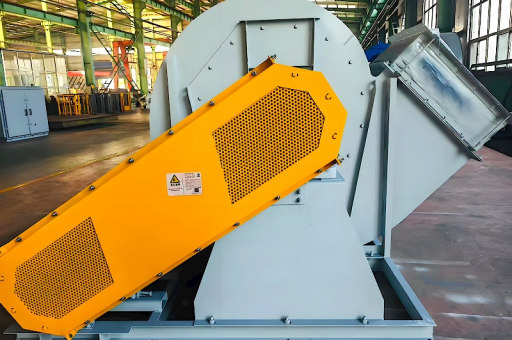
A Large Capacity Industrial Boiler FD High Pressure Centrifugal Fan is a mechanical device that uses a rotating impeller to accelerate air radially outward, converting kinetic energy into static pressure. It is specifically designed for:
- High flow rates (large capacity): Typically above 50,000 CFM (cubic feet per minute) or 85,000 m³/h.
- High static pressure: Often in the range of 3,000–12,000 Pa (12–48 in w.g.), depending on system requirements.
- Continuous operation: 24/7 duty cycles in harsh environments with high temperatures (up to 200°C or 400°F in standard designs, and higher with cooling systems).
These fans are typically backward-curved or airfoil-blade designs, which offer the highest efficiency and the lowest noise levels for heavy-duty industrial use.
Core Design Principles and Construction Materials
To ensure long-term reliability under demanding conditions, the construction of a large capacity FD fan follows strict engineering principles:
- Impeller: Built from high-strength steel or stainless steel for corrosion resistance. For high-temperature applications (above 300°C), alloy steel or heat-treated materials are used.
- Housing: Spiral volute casing designed for minimal leakage and maximum pressure recovery.
- Shaft and Bearings: Oversized to handle radial and axial loads. Many units use split-type bearings for easier maintenance.
- Drive System: Direct drive (for high speed) or V-belt drive (for adjustable speed). Modern fans often integrate variable frequency drives (VFDs) for precise air flow control.
- Inlet and Outlet Connections: Designed to match ductwork with minimal pressure drop. Dampers or inlet guide vanes are commonly fitted for flow regulation.
Performance Parameters: Pressure, Flow Rate, and Efficiency
Understanding the performance curve of an FD fan is essential for proper system design. The key parameters include:
- Airflow (Q): Measured in m³/h or CFM. Large capacity units handle 100,000–500,000 m³/h.
- Static Pressure (Ps): The resistance the fan must overcome, measured in Pa or inches of water gauge.
- Total Pressure (Pt): Static pressure plus velocity pressure.
- Fan Efficiency: Typically 80–90% for modern airfoil-blade centrifugal fans.
- Power Consumption (kW): Calculated using the formula: ( P = (Q × Pt) / (η × 3600) ), where η is efficiency.
These fans usually operate at the best efficiency point (BEP) to minimize energy costs and wear. A system curve analysis is recommended before selection.
Applications in Power Plants, Chemical Plants, and Heavy Industry
Large capacity FD fans are deployed in:
- Coal-Fired and Biomass Power Plants: Supplying combustion air to pulverized coal burners.
- Industrial Boilers: In chemical, petrochemical, and textile industries requiring consistent steam production.
- Waste-to-Energy Plants: Handling corrosive flue gas environments.
- Cement and Steel: For process heaters and kilns.
In each case, the fan must operate reliably at high temperatures and often with particulate-laden air, requiring robust filtration and blade coatings.
How to Select the Right FD Fan for Your Boiler System
Selection is a multi-step process:
- Determine required air flow: Based on boiler capacity and excess air ratio (typically 15–30% excess).
- Calculate system resistance: Sum of losses from air intake, ductwork, burners, preheaters, and dampers.
- Select fan type: Backward-curved (efficiency) or radial blade (for heavy dust).
- Check material compatibility: For high temperatures, use heat-resistant alloys.
- Consider speed control: VFDs allow better matching to load variations.
- Verify noise and vibration limits: Especially important in urban or enclosed installations.
Always request a fan performance curve from the manufacturer, and validate that the operating point is near the BEP.
Maintenance Best Practices and Common Failure Modes
To avoid unplanned downtime, follow these maintenance guidelines:
- Regular bearing lubrication: Grease or oil every 500 hours in normal condition.
- Vibration monitoring: Use accelerometers to detect imbalance or wear.
- Blade inspection: Check for erosion, corrosion, or buildup of deposits.
- Shaft alignment: Misalignment is a leading cause of bearing failure.
- Clean air intake filters: Prevent particulate wear.
Common failure modes include:
- Bearing overheating (due to poor lubrication or misalignment)
- Impeller fatigue cracks (from sustained high stress)
- Motor overload (from incorrect damper settings or duct blockages)
- Fan stall (operation beyond the stable curve region)
Frequently Asked Questions (FAQ)
Q1: What is the difference between an FD fan and an ID fan?
A: An FD fan (Forced Draft) supplies air into the boiler under positive pressure, while an ID fan (Induced Draft) extracts exhaust gases from the boiler under negative pressure. FD fans operate at higher pressure but generally lower temperature.
Q2: Can a centrifugal FD fan handle high-temperature air?
A: Yes, with proper materials. Standard units handle up to 200°C. For temperatures up to 500°C, use cooling wheels or special alloy impellers.
Q3: How do I reduce the noise of a large capacity FD fan?
A: Install silencers on intake and discharge, use vibration isolation mounts, and select backward-curved blade designs (quieter than radial blades). Enclosing the fan housing also helps.
Q4: What drives the energy cost of an FD fan?
A: The fan’s power consumption is proportional to the cube of the speed (if using VFD) and directly proportional to pressure and flow. Operating near the BEP reduces electricity bills significantly.
Q5: How long does a large capacity industrial FD fan last?
A: With proper maintenance, 15–25 years is typical. Key factors include operating temperature, dust load, and adherence to maintenance schedules.
Conclusion: Optimizing Combustion with High-Pressure Centrifugal Fans
The Large Capacity Industrial Boiler FD High Pressure Centrifugal Fan is a backbone component for any serious combustion process. By delivering high-pressure air reliably and efficiently, it directly impacts boiler efficiency, fuel consumption, and emission levels. Selecting the correct fan based on system resistance, temperature, and duty cycle is critical. Moreover, regular maintenance and intelligent speed control extend fan life and reduce operational costs.
Whether you are upgrading an existing boiler plant or designing a new power generation facility, investing in a properly engineered FD centrifugal fan from a reputable supplier like fan will ensure long-term, trouble-free operation.
Note: This article is based on industry best practices, engineering standards (such as AMCA and ISO 5801), and publicly available technical documentation from major industrial fan manufacturers. For specific engineering calculations and fan selection, consult a qualified mechanical engineer.





