
This article's table of contents introduction:
- Why Stainless Steel? (The "Why")
- Recommended Stainless Steel Grades (Material Selection)
- Delivery Specifications (What to Include in Your Order)
- Key Technical Considerations for Delivery
- Common Issues to Avoid During Delivery
- Summary for Your Supplier/Request
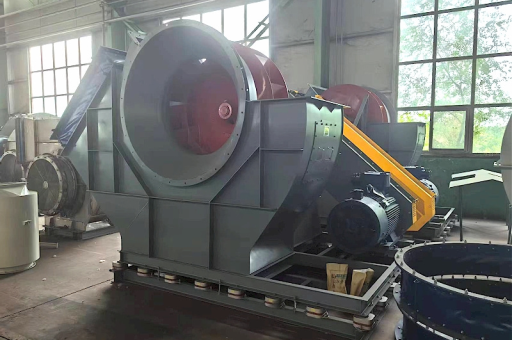
It sounds like you are looking for Stainless Steel material specifications for the delivery (manufacturing/supply) of a High-Pressure Centrifugal Fan used in Industrial Kilns.
Below is a detailed breakdown of the typical material requirements, standards, and key considerations for this specific application.
Why Stainless Steel? (The "Why")
Industrial kilns (cement, lime, ceramics, waste incineration) produce:
- High Temperatures: Even at the cold end, gas temperatures can be 150°C – 350°C.
- Corrosive Gases: SOx, NOx, HCl, and moisture form acids (sulfuric, hydrochloric) upon cooling.
- Abrasive Dust: Clinker dust, fly ash, or silica particles.
Stainless Steel is chosen for corrosion resistance and strength at elevated temperatures.
Recommended Stainless Steel Grades (Material Selection)
The choice depends on the gas temperature and chemical composition inside the kiln.
| Grade | Key Properties | Typical Use in Kiln Fan | Max Operating Temp (Continuous) |
|---|---|---|---|
| 304/304L (1.4301/1.4307) | Good corrosion resistance, excellent weldability, cost-effective. | General air, low-acid flue gas, moderate temperature. | ~800°C (for housing) / 550°C (for impeller) |
| 316/316L (1.4401/1.4404) | Better resistance to chlorides & acids (due to Molybdenum). | Most common for kiln fans handling wet or acidic off-gases. | ~800°C (housing) / 550°C (impeller) |
| 310S (1.4845) | High heat resistance, good oxidation resistance up to 1000°C. | Hot gas fans (Immediately after kiln discharge). Fits for extreme temperatures. | 1000°C |
| 904L (N08904) | Superior corrosion resistance (pitting/crevice). | Severe acidic environments (e.g., Wet Flue Gas Desulfurization). | ~400°C |
| 254 SMO (1.4547) | Ultimate chloride resistance. | Harsh chemical recovery boilers, waste incineration. | ~400°C |
🛠️ Standard Recommendation for "Industrial Kiln High Pressure Fan":
- Impeller (Wheel): 316L (for standard) or 310S (for high temp) – Impeller is the most critical part.
- Housing (Scroll/Volute): 316L or 304L (if temp is lower & cost is a factor).
- Shaft: Typically AISI 410 / 420 (Martensitic) or 17-4 PH for high strength and wear resistance. Sometimes 316L for lower stress.
- Bearing Housing / Bearings: Standard steel (Cast Iron or Steel) but with high-temperature grease.
Delivery Specifications (What to Include in Your Order)
You must specify test certificates and manufacturing standards.
A. Material Certification
- EN 10204 3.1 or 2 (European standard for material traceability).
- Mill Test Certificate (MTC) for each plate and shaft used.
- Required data: Chemical composition, mechanical properties (Yield strength, Tensile strength, Elongation).
B. Dimensional & Tolerances
- Plate Thickness: Must be verified by Ultrasonic Testing (UT) to ensure no laminations.
- Weld Consumables: Must match or exceed the base metal (e.g., ER316L wire for 316L base).
- Welding Standards: ISO 5817 (Quality Levels B or C) or ASME Section IX.
C. Surface Finish
- Mill finish (as rolled) – Standard.
- Pickling & Passivation – Required to remove heat tint from welding, restoring corrosion resistance.
- Bead Blasting – For a uniform appearance (often cosmetic but helps with cleaning).
D. Non-Destructive Testing (NDT) – Crucial for High Pressure
- Dye Penetrant Test (DPT/PT): Check welds for cracks (100% of critical welds).
- Radiography (RT) / Ultrasonic (UT): For very high pressure/safety-critical welds.
- Magnetic Particle Inspection (MPI): For shaft materials.
Key Technical Considerations for Delivery
| Component | Material Grade | Thickness (Example) | Critical Feature |
|---|---|---|---|
| Impeller Blades | 316L / 310S | 5 – 10 mm | Balance Grade (G6.3 or G2.5) ; Weld profile for aero efficiency |
| Backplate / Cone | 316L / 310S | 8 – 16 mm | Stress at center bore; connection to shaft |
| Housing | 316L / 304L | 6 – 12 mm | Stiffeners to prevent vibration at high pressure |
| Inlet Cone | 316L / 310S | 4 – 8 mm | Aerodynamic clearance (small gap to impeller) |
| Shaft | 17-4 PH / 420 | 80 – 150 mm dia | Keyway & fit tolerance (H7/h6 or interference) |
Common Issues to Avoid During Delivery
- Mixing Ferritic & Austenitic: Do not weld carbon steel to stainless steel without a proper transition piece (e.g., using Inconel 182). Galvanic corrosion will occur.
- Sensitization: Avoid holding 304/316 at 450°C – 850°C during welding (intergranular corrosion risk). Use Low Carbon versions (L-grade: 304L, 316L) .
- Stress Corrosion Cracking: In hot, chloride-rich environments, avoid 304; prefer 316 or 904L.
- Weld Under-matching: Ensure weld filler metal is equal or higher in strength and corrosion resistance than the base metal.
Summary for Your Supplier/Request
When placing the order, write:
"Supply of Stainless Steel High Pressure Centrifugal Fan for Industrial Kiln" Material: Impeller & Housing in SS 316L (Conforming to ASTM A240 / EN 10088-2). Temperature Rating: Continuous operation up to 350°C. Certification: Material test certificates per EN 10204 3.1. Welding: AWS A5.9 ER316L. Full penetration welds. 100% Dye Penetrant Test on welds. Balance quality G 6.3. Surface: Pickled and passivated.
Final Advice: If your kiln gas is dry and clean but very hot (>600°C), choose 310S. If it is wet, acidic, and moderately hot (<400°C), choose 316L. Never use 304 if exposure to chlorides (common in waste/cement kilns) is expected.
Would you like a specific dimension/size recommendation (e.g., flow rate in m³/h vs. pressure in mmWC) to complete the specification?





