
This article's table of contents introduction:
- What This System Is
- Why "Customized Speed" is Critical
- Key Design & Customization Factors
- Typical Customization Process (What to expect from a manufacturer)
- Critical Considerations for Custom Speed (VFD) Operation
- Example Custom Specifications (Template)
- Recommendation
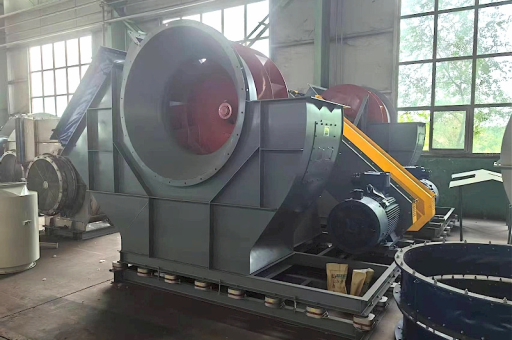
This is a highly specific piece of industrial equipment. A Motor Frequency Conversion High Pressure Centrifugal Blower with Customized Speed is a specialized solution for applications requiring precise airflow control at high static pressures (typically > 20 kPa or 80 inH₂O).
Here is a breakdown of what that means, the key design considerations, and how to specify one for a custom build.
What This System Is
- Core Component: A centrifugal blower (not a standard fan) designed to generate high pressure (e.g., for pneumatic conveying, aeration, or combustion air).
- Drive: A 3-phase AC induction motor controlled by a Variable Frequency Drive (VFD) .
- Customization: The impeller, housing, motor mounting, and controls are designed to match a specific operating point (Flow vs. Pressure) that is not served by standard off-the-shelf models.
Why "Customized Speed" is Critical
Standard blowers run at fixed speeds (e.g., 2900 RPM or 3500 RPM). Using a VFD for speed customization offers:
- Energy Savings: At 50% flow, fan power is ~12.5% of full load (Fan Affinity Laws: Power ∝ Speed³).
- Process Control: Fine-tuning airflow/pressure without dampers or throttle valves.
- Soft Start/Stop: Eliminates mechanical shock and high inrush current.
- Wide Operating Range: One machine can handle varying process demands (e.g., batch filtering vs. continuous drying).
Key Design & Customization Factors
When ordering a customized unit, you or your supplier must specify:
A. Performance Parameters (The Operating Point)
- Flow Rate (Q): m³/h or CFM
- Total Pressure (P): Pa, kPa, mmH₂O, or inH₂O (Note: High pressure typically > 20 kPa)
- Speed Range: e.g., 300 – 3600 RPM
- Gas/Medium: Air, corrosive gas, explosive gas, temperature, density.
B. Mechanical Customization
- Impeller Type:
- Backward Curved: High efficiency, non-overloading power curve.
- Radial (Paddle): Self-cleaning, handles particulates, but lower efficiency.
- Forward Curved: High flow at lower pressure, less common for high pressure.
- Material of Construction:
- Impeller: Carbon Steel (standard), Stainless Steel 304/316 (corrosive), Aluminum (spark-proof, important for explosive environments), Inconel (high temp).
- Housing: Cast iron, fabricated steel, or polymer-coated for corrosion.
- Bearing & Shaft Seal: High-pressure applications require robust bearings (usually anti-friction, grease or oil-lubricated) and shaft seals (labyrinth, carbon ring, or mechanical seals if handling toxic fluids).
- Motor Mounting: Direct drive (flexible coupling) or belt drive. Direct drive is more efficient for VFD use.
C. VFD & Control Customization
- VFD Enclosure: IP20 (indoor), IP54 (dust/water splash), IP66 (washdown).
- Control Interface:
- Local keypad (potentiometer for speed).
- Remote 4-20 mA analog input (from PLC).
- Modbus/Profibus/EtherCAT communication.
- PID loop for closed-loop pressure or flow control.
- Slow-down ramp to prevent surge/harmonic resonance.
- Braking: Dynamic braking resistor (for rapid deceleration).
D. Compliance & Safety
- ATEX / IECEx: If used in explosive atmospheres (gas or dust). Requires non-sparking impeller (Aluminum/copper) and temperature monitoring.
- High Temperature: Extended shaft cooling, insulated bearings.
- Surge Protection: For the VFD.
Typical Customization Process (What to expect from a manufacturer)
- Inquiry: You provide Flow (e.g., 5,000 m³/h) and Pressure (e.g., 50 kPa).
- Engineering Review: The manufacturer calculates aerodynamic design, speed, motor power, and impeller diameter.
- Motor Selection: Usually a 2-pole (high speed) or 4-pole motor, sized for the maximum power at 50/60 Hz plus a 10-15% safety margin.
- VFD Sizing: VFD must be rated for the motor's full load amps.
- Mechanical Design: Housing size, impeller diameter (often > 500mm for high pressure), inlet/outlet flanges (e.g., DIN, ANSI).
- Testing: Performance test (P-Q curve verification), vibration analysis, and sound level measurement.
Critical Considerations for Custom Speed (VFD) Operation
- Resonance: Variable speed machines can excite structural resonances. The controller may need to skip certain frequencies to avoid vibration.
- Low Speed Torque: Ensure the VFD can output full torque at low speed (some vector/V/F control may be needed).
- Variable Speed Limits: Do not exceed the impeller's maximum safe speed (typically 20-30% above rated, as per design).
- Motor Cooling: Standard motors have a shaft-mounted fan. At low speeds, cooling is poor. If running below 20 Hz for extended periods, use a separately powered (forced) cooling fan or a motor derated for variable speed.
Example Custom Specifications (Template)
| Parameter | Value | Notes |
|---|---|---|
| Flow (Q) | 12,000 m³/h | At maximum speed |
| Total Pressure (P) | 65 kPa (6.6 mH₂O) | At maximum speed |
| Speed Control Range | 500 – 2980 RPM | 7:1 turndown |
| Motor Power | 55 kW | 4-pole, 380V, 3-phase, 50 Hz |
| VFD | 75 kW, IP54 | ABB / Siemens / Danfoss |
| Impeller | Backward Curved, Cast Aluminum | Spark-proof (ATEX Cat 2) |
| Housing | Heavy-duty carbon steel, flanged DN300/DN250 | |
| Bearing Type | Sealed roller bearings, grease lubricated | L10 life > 50,000 hours |
| Shaft Seal | Labyrinth seal with vent | |
| Compliance | CE, ATEX II 2G c T3 |
Recommendation
If you are looking to purchase or design such a system, you should contact a manufacturer like:
- Siemens (Aerospace), **New York Blower (USA),**
- Howden (UK),
- Aerzen (Germany),
- Ventilatorenfabrik Oelde (Germany),
- Zhejiang Shangfeng (China),
- Turbocam (for custom impellers).
Provide them with a clear operating point (Flow vs. Pressure at max and min speed) and your environmental conditions (gas type, temperature, altitude, vibration level, enclosure rating).
Would you like a specific calculation example (e.g., how to determine the required motor power based on your flow and pressure)?





