
This article's table of contents introduction:
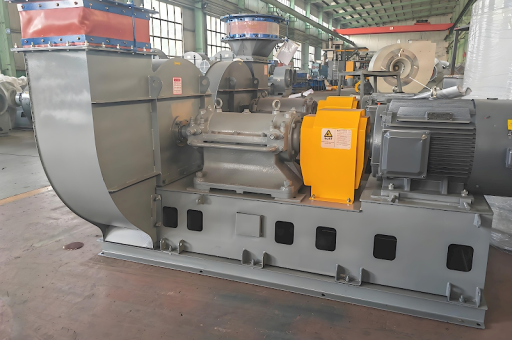
- Core Engineering Challenges
- Construction & Materials (The "Bill of Materials")
- Typical Applications (Where is this needed?)
- Operational & Maintenance Criticalities
- Sourcing & Cost Indicators
- Summary Table: Key Features
- Final Recommendation
This is a highly specialized piece of industrial equipment. A Radial Flow Fan (Centrifugal Fan) designed to handle continuous gas temperatures of 600°C (1112°F) is not standard off-the-shelf equipment. It requires specific engineering, metallurgy, and cooling techniques.
Here is a detailed breakdown of what such a fan entails, its construction, applications, and critical considerations.
Core Engineering Challenges
At 600°C, standard steel (like mild steel or even standard stainless steel like 304) will lose its structural integrity, creep, and oxidize rapidly. The key challenges are:
- Thermal Expansion: The impeller and shaft expand significantly at high temperatures. The fan casing must accommodate this without the impeller rubbing.
- Yield Strength Degradation: Metals lose up to 50-80% of their strength at 600°C.
- Oxidation & Scaling: Hot gases cause rapid surface oxidation (scaling) which erodes the impeller.
- Shaft Cooling: Heat travels down the shaft to the motor bearings, which are typically limited to 80-120°C. Motor failure is the primary risk.
Construction & Materials (The "Bill of Materials")
A. Impeller (The Rotating Wheel)
- Material: Inconel 625 or Hastelloy X (Nickel-based superalloys) are the industry standards. These retain high strength and resist oxidation at 600°C.
- Design: Heavy-duty, thick-section blades. Typically backward-curved or backward-inclined blades. These are more stable and efficient, and the heavy blades help dissipate heat.
- Manufacturing: Fully welded. The blades are often stress-relieved. A hub separate from the blades may be made of Inconel 718 for better fatigue resistance at the shaft connection.
B. Casing (The Scroll/Housing)
- Material: 316L Stainless Steel is a minimum. For extreme reliability or corrosive/dirty gas streams, Inconel or Hastelloy is used.
- Design: Heavy-gauge (6mm to 12mm thick) to handle thermal stress. The casing must have expansion joints or a split design to allow for thermal growth.
- Internal: Often ceramic fiber lining (e.g., Kaowool or Cerablanket) is applied to the inside of the casing to reduce the metal temperature of the casing itself.
C. Shaft & Bearings
- Shaft Material: Inconel or 4140 Steel with a high-temperature key. A thermal break (a section of shaft designed to restrict heat flow) is essential.
- Bearing System & Cooling: This is the most critical part.
- Cooling Fan: A separate, smaller fan (often air-cooled) is mounted on the shaft between the hot fan and the bearings to blow ambient air over the shaft.
- Water Jacket: The bearing housing is water-cooled (using a closed loop of water/glycol).
- Vented Bearing Housing: The bearing housing is typically pillow block type with a vent to allow hot air to escape, preventing pressure buildup.
- Bearing Type: Spherical roller bearings (for radial loads) and Deep groove ball bearings (for axial thrust). Lubrication is high-temp grease or oil mist.
D. Motor
- Cannot be direct-mounted. The fan shaft must pass through a thermal barrier.
- Mounting: V-belt drive is standard. This allows the motor to be placed physically away from the heat source.
- Motor Specification: Standard TEFC (Totally Enclosed Fan Cooled) motor mounted on an adjustable base. The belt drive also allows for speed changes.
- Electrical: the motor may need VFD (Variable Frequency Drive) control for precise airflow.
Typical Applications (Where is this needed?)
- Cement Industry: Kiln exhaust, preheater fans.
- Steel & Metallurgy: Exhaust from electric arc furnaces, ladle metallurgy stations, sintering plants.
- Glass Manufacturing: Furnace exhaust, annealing lehr exhaust.
- Chemical & Petrochemical: High-temperature reactor off-gassing, catalytic cracking regenerators.
- Waste-to-Energy / Incineration: Primary and secondary combustion air fans, flue gas recirculation.
- Power Generation: Biomass and coal-fired boilers (ID fans).
Operational & Maintenance Criticalities
- Thermal Soak & Cool-Down: You cannot start a cold fan with hot gas. The fan must be preheated (or run at low speed) to allow the impeller to expand evenly. Similarly, rapid cool-down can cause thermal shock and cracking. Ramp-up/Ramp-down time: 30-60 minutes minimum.
- Bearing Temperature Monitoring: RTD (Resistance Temperature Detectors) or Thermocouples must be embedded in the bearing housing. Alarms should trigger at ~90°C and shut down at ~110°C.
- Vibration Monitoring: Accelerometers are mandatory. High-temperature fans are prone to imbalance due to built-up dust or scale, which at 600°C can be dangerous.
- Spark Erosion: If the gas contains conductive particles at 600°C, you will need a grounding brush on the shaft to prevent static sparking (fire risk).
- Piping & Ductwork: The inlet and outlet ducts must have expansion joints (bellows) made of Inconel or ceramic fiber.
Sourcing & Cost Indicators
- Not a commodity product. You will not find this on a shelf at Grainger or McMaster-Carr.
- Manufacturers:
- New York Blower Company (USA)
- Greenheck (USA - though typically for lower temps)
- Robinson Fans (USA - specialized in severe duty)
- FläktGroup / Woods (Europe)
- TLT-Turbo (Germany)
- Powermax (India - budget-friendly, but verify material certs)
- Howden (Global)
- Cost: Expect 5x to 10x the price of a standard stainless steel fan of the same size. A 50 HP 600°C fan can easily cost $40,000 - $100,000+ depending on impeller material and drive complexity.
Summary Table: Key Features
| Feature | Standard Fan (<200°C) | High-Temp Fan (600°C) |
|---|---|---|
| Impeller Material | Carbon Steel / 304 SS | Inconel 625 / Hastelloy X |
| Casing Material | Carbon Steel | 316L SS / Inconel / Ceramic-lined |
| Drive Type | Direct Drive (often) | V-Belt Drive (mandatory) |
| Bearing Cooling | None | Water-jacketed + Forced Air |
| Lubrication | Standard grease | High-temp grease / Oil Mist |
| Motor | TEFC, close-coupled | Remote, V-belt driven |
| Expansion Joints | Not needed | Essential (metal or fabric) |
| Monitoring | Basic temp/vibration | RTD, Accelerometer, PLC interlock |
Final Recommendation
Do not attempt to modify a standard fan. Contact a specialized high-temperature fan manufacturer (like Robinson or New York Blower) with the following specs:
- Gas temperature (600°C continuous, peak?)
- Gas composition (dust? corrosive?)
- Airflow (CFM / m³/hr)
- Static pressure (in. wg / Pa)
- Required motor power (HP / kW)
- Ambient temperature at the fan location.
Safety note: A failure at 600°C can launch a massive, red-hot impeller through the casing. These must be engineered, built, and maintained to the highest standards (e.g., ISO 1940 G2.5 balancing).





