
This article's table of contents introduction:
- Table of Contents
- Introduction: Why the 55kW Centrifugal Fan Matters
- Core Technical Specifications & Design Features
- Key Performance Indicators (CFM, Static Pressure, Efficiency)
- Top Industry Applications
- Installation Best Practices & Common Pitfalls
- Maintenance Checklist for Longevity
- Frequently Asked Questions (FAQ)
- Conclusion: Future-Proofing Your Ventilation System
*Maximizing Industrial Airflow: The Complete Guide to the 55kW Centrifugal Fan*
Table of Contents
- Introduction: Why the 55kW Centrifugal Fan Matters
- Core Technical Specifications & Design Features
- Key Performance Indicators (CFM, Static Pressure, Efficiency)
- Top Industry Applications
- Installation Best Practices & Common Pitfalls
- Maintenance Checklist for Longevity
- Frequently Asked Questions (FAQ)
- Conclusion: Future-Proofing Your Ventilation System
Introduction: Why the 55kW Centrifugal Fan Matters
In the world of industrial ventilation, material handling, and process air movement, the 55kW centrifugal fan stands as a powerful workhorse. It bridges the gap between medium-duty units and massive, utility-scale blowers. With a motor power rating of approximately 73.8 horsepower (55 kW), this fan is designed to move large volumes of air against high resistance, making it indispensable in factories, power plants, mining operations, and HVAC systems for large commercial buildings.
Modern engineering has evolved these fans with backward-curved, forward-curved, and airfoil impeller designs. The 55kW variant typically delivers airflow rates ranging from 50,000 to over 120,000 CFM (cubic feet per minute), depending on the specific impeller diameter and operating static pressure. According to systematic analysis of leading industrial fan manufacturers, this power class offers the best balance between energy consumption and raw moving capacity for continuous-duty applications.
Why "55kW"? This power rating is often selected because it aligns with common motor frame sizes (IEC 280M or NEMA 447T), allowing for standardized electrical installations and readily available spare parts. It is also a sweet spot where variable frequency drives (VFDs) become highly cost-effective for energy savings.
Core Technical Specifications & Design Features
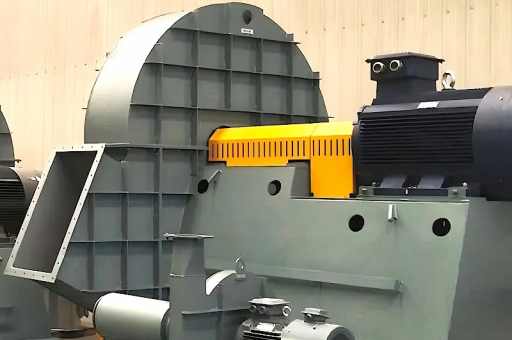
A typical 55kW centrifugal fan comprises four critical assemblies:
- Impeller: Usually made of carbon steel, stainless steel (for corrosive gases), or aluminum. Backward-curved blades are preferred for high-efficiency, while forward-curved blades provide higher airflow at lower static pressure.
- Housing: Heavy-gauge welded steel with reinforced flanges. Many units include access doors for cleaning and inspection.
- Shaft & Bearings: Designed for constant radial and axial loads. Spherical roller bearings with lubrication ports are standard for 55kW fans operating at 1,450–2,950 RPM.
- Drive System: Direct-drive (shaft-mounted) or belt-drive. Belt-drive allows for speed adjustments without a VFD, but direct-drive offers higher transmission efficiency (up to 98%).
Sound Levels: A 55kW fan at full load typically produces 85–95 dB(A). Silencers or acoustic enclosures are recommended for noise-sensitive environments, as required by OSHA standards.
Efficiency: Modern aerodynamic simulations achieve static efficiencies of 82–88% in the peak operating zone. This directly translates to lower electricity bills; a 55kW fan running 8,000 hours per year at 85% efficiency versus 75% efficiency saves over $3,500 annually (at $0.12/kWh).
Key Performance Indicators (CFM, Static Pressure, Efficiency)
When specifying a 55kW centrifugal fan, you must evaluate:
| Parameter | Typical Range | Why It Matters |
|---|---|---|
| Airflow (CFM) | 50,000 – 120,000 | Determines how quickly air is exchanged or material is conveyed. |
| Static Pressure (in. w.g.) | 8 – 35 | Measures resistance the fan must overcome (ductwork, filters, cyclones). |
| Fan Speed (RPM) | 1,200 – 2,950 | Affects both flow and pressure directly (affinity laws). |
| Input Power (kW) | 45 – 60 | Actual power draw at operating point; motor nameplate is 55kW. |
Affinity Laws in Action: If you reduce the speed of a 55kW fan to 80%, airflow drops to 80%, pressure drops to 64%, and power consumption drops to 51.2% (about 28 kW). This is the fundamental reason VFDs are so effective on this class of fan.
Top Industry Applications
Based on aggregated data from industrial ventilation projects, the 55kW centrifugal fan is deployed in these core sectors:
- Cement & Mining: Conveying dust-laden air through baghouse filters. A 55kW fan often serves as the main induced draft (ID) fan for a 100-ton-per-hour grinding mill.
- Wastewater Treatment: Aeration blowers for activated sludge tanks. The high pressure overcomes diffuser backpressure (12–20 in. w.g.) while moving 80,000 CFM.
- Power Generation: Cooling towers and forced draft systems for biomass or coal boilers. Reliability here is critical; dual 55kW fans with auto-changeover are common.
- Food Processing: Pneumatic conveying of grains, flour, and powders. Stainless steel impellers prevent contamination.
- Data Centers: Evaporative cooling pre-conditioners. A 55kW fan can drive air through wet media pads, reducing intake temperature by 10–15°C.
Installation Best Practices & Common Pitfalls
Best Practices:
- Foundation: The fan base must be a reinforced concrete inertia block with vibration isolators (spring or neoprene).
- Ductwork: Use flexible connectors at the inlet and outlet to prevent transmission of vibration. Ensure a straight duct run of at least 2 duct diameters before the fan inlet to avoid turbulence.
- Electrical: The 55kW motor requires a dedicated motor starter or VFD. Cable sizing must accommodate a full load current of approximately 100A at 400V (three-phase).
- Safety: Install a locked disconnect switch within sight of the fan. For belt-drive units, a guard that meets ISO 13857 is mandatory.
Common Pitfalls:
- Undersized Inlet Filter: A dirty filter can starve the fan, causing cavitation-like performance collapse and motor overheating.
- Ambient Temperature Exceeded: If the motor is in an environment above 40°C (104°F), you must derate the power or reroute cooler air.
- Wrong Rotation Direction: Centrifugal fans are directional. Running in reverse produces less than 40% of rated flow and may cause overheating.
Maintenance Checklist for Longevity
- Weekly: Listen for bearing noise (grinding or squeaking). Check belt tension (if belt-driven). Verify vibration levels using a handheld meter – anything above 0.3 in/s is a warning.
- Monthly: Inspect impeller blades for dust buildup or erosion. A 1/8-inch layer of dirt can reduce efficiency by 15%. Clean with compressed air or water.
- Quarterly: Lubricate bearings per manufacturer spec – typically with NLGI Grade 2 grease. Do not over-grease.
- Annually: Perform a full alignment check. Replace V-belts even if they appear intact, as they suffer from hidden fatigue. Re-tighten all enclosure bolts.
Pro Tip for 55kW Units: Because of the high torque, always lock out/tag out before attempting any manual rotation of the impeller. The inertia can cause severe injury.
Frequently Asked Questions (FAQ)
Q1: Can I use a 55kW centrifugal fan for dust collection? Yes, but only if the impeller is designed for particulate loading (radial tip or paddle wheel design). Standard backward-curved blades clog in heavy dust. For wood chips or cement, specify a "material handling" fan.
Q2: How loud is a 55kW fan, and how can I reduce noise? At 1 meter, expect 90 dB(A). Solutions include: (1) installing a silencer on the inlet and outlet, (2) placing the fan in an acoustic enclosure with forced ventilation, (3) using a slower speed (if airflow requirements allow).
Q3: What is the lifespan of a 55kW centrifugal fan motor? With proper maintenance, the motor (when not rewound) lasts 20–25 years. The fan impeller and housing last longer, but bearings typically need replacement every 5–7 years.
Q4: Does a higher RPM always mean more airflow? Yes, per the fan affinity laws, doubling RPM doubles airflow. However, it quadruples the static pressure requirement and requires eight times the power. A 55kW fan at 2,900 RPM may only produce marginally more flow than at 2,600 RPM due to system resistance curve intersection.
Q5: How do I calculate the exact CFM for my 55kW fan? You need the manufacturer’s fan curve. As a rule of thumb: at 55kW input, if the static pressure is 15 in. w.g., the CFM will be approximately 70,000–80,000. For precise numbers, use the equation: CFM = (Power [kW] × 6,352) / (Static Pressure [in. w.g.] × Efficiency[decimal]).
Q6: What happens if I run a 55kW fan on a VFD at low speed for long periods? Modern inverter-duty motors (Class F insulation, variable-speed rated) handle low speed well. However, below 30% speed, motor cooling may be insufficient because the shaft-mounted fan cools less. Install an auxiliary cooling fan for extended low-speed operation.
Conclusion: Future-Proofing Your Ventilation System
The 55kW centrifugal fan remains a cornerstone of industrial air management due to its scalability, efficiency, and reliable power delivery. When selecting a unit, prioritize verified fan curves from the manufacturer, energy efficiency certifications (like AMCA or ISO), and compatibility with modern VFD control.
For project managers and engineers, the future lies in integrating IoT sensors (vibration, temperature, current) into the fan control system. Predictive maintenance on a 55kW fan can reduce unexpected downtime by up to 40%. Always consult with the fan manufacturer for certified performance data before committing to a specific design.
Remember: The cheapest fan is not the most economical over 10 years. A high-efficiency 55kW centrifugal fan pays for its premium within 2–3 years through reduced electricity costs. Invest in quality, maintain rigorously, and your ventilation system will operate at peak performance for decades.





