
The Ultimate Guide to 5000Pa Centrifugal Fan: Applications, Performance, and Buying Tips
Table of Contents
- Introduction: What Is a 5000Pa Centrifugal Fan?
- How Does a 5000Pa Centrifugal Fan Work?
- Key Specifications and Performance Metrics
- Common Applications and Use Cases
- Advantages Over Other Fan Types
- How to Choose the Right 5000Pa Centrifugal Fan
- Installation and Maintenance Best Practices
- Frequently Asked Questions (FAQ)
- Conclusion
Introduction: What Is a 5000Pa Centrifugal Fan?
A 5000Pa centrifugal fan is a high-pressure industrial air-moving device capable of generating a static pressure of up to 5000 Pascals (Pa). This performance level places it in the medium-to-high pressure range, ideal for applications that require forced airflow through ducts, filters, or long piping systems.
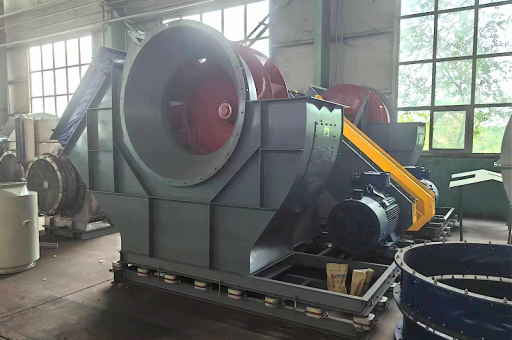
Unlike axial fans that move air parallel to the fan shaft, centrifugal fans use a rotating impeller to accelerate air radially outward. The 5000Pa rating means the fan can overcome significant resistance while maintaining consistent airflow. According to engineering standards, 1 Pa equals approximately 0.004 inches of water gauge (inWG), so 5000Pa corresponds to about 20 inWG — a pressure level suitable for industrial ventilation, dust collection, pneumatic conveying, and HVAC systems.
Key Insight: The “5000Pa” specification is not arbitrary. It represents the fan’s maximum static pressure capability at zero airflow, often tested under standardized conditions per ISO 5801 or AMCA 210 standards.
How Does a 5000Pa Centrifugal Fan Work?
A centrifugal fan operates on the principle of centrifugal force. The main components include:
- Impeller (wheel): Rotating blades that accelerate air.
- Volute (housing): A spiral-shaped casing that converts velocity into pressure.
- Motor: Drives the impeller via direct coupling or belt transmission.
- Inlet and outlet: Air enters axially and exits radially.
When the impeller spins, air is drawn into the center (eye) of the fan. The rotating blades fling the air outward toward the volute wall. The volute’s expanding cross-section slows the air down, converting kinetic energy into static pressure. The result is a high-pressure airstream leaving the discharge.
For a 5000Pa centrifugal fan, the impeller design often features backward-curved or airfoil blades. These profiles maximize efficiency and minimize turbulence, which is critical when operating at such elevated pressures. The motor power required typically ranges from 2.2 kW to 7.5 kW, depending on airflow volume (e.g., 2000 to 6000 m³/h).
Key Specifications and Performance Metrics
When evaluating a 5000Pa centrifugal fan, consider the following technical parameters:
| Parameter | Typical Range for 5000Pa Fan |
|---|---|
| Max Static Pressure | 5000 Pa (≈20 inWG) |
| Airflow (Q) | 500 – 8000 m³/h |
| Motor Power | 5 – 7.5 kW (2–10 HP) |
| Rotational Speed | 1450 – 2900 RPM (4-pole or 2-pole motors) |
| Inlet Diameter | 100 – 315 mm |
| Noise Level | 65 – 85 dB(A) at 1m |
| Efficiency | 65% – 82% (backward-curved blades) |
Important Note: The fan’s actual performance depends on the system resistance curve. A 5000Pa fan will not deliver its maximum pressure at peak airflow. Always refer to the manufacturer’s fan curve.
Pro Tip: Matching the fan’s operating point to your system’s resistance is crucial. An oversized fan wastes energy; an undersized one fails to deliver required performance.
Common Applications and Use Cases
The 5000Pa centrifugal fan is a workhorse in many industrial and commercial settings:
- Dust Collection Systems: Used in woodworking, metal fabrication, and chemical plants to extract dust through long ducts and cyclone separators.
- Pneumatic Conveying: Moves lightweight materials like grains, powders, or plastic pellets through pipelines.
- HVAC Forced Air Systems: Overcomes resistance from filters, heat exchangers, and diffusers in large buildings or cleanrooms.
- Ventilation of Tunnels and Parking Garages: Delivers fresh air while extracting fumes against duct friction.
- Industrial Drying: Supplies consistent high-pressure airflow for drying processes in textiles, paper, and food industries.
- Fume Extraction Laboratories: Ensures toxic vapors are captured and expelled safely.
For example, a woodworking shop with 50 meters of ducting and two baghouse filters would require a 5000Pa fan to maintain adequate air velocity (20 m/s) at the collection hoods. Without sufficient static pressure, the system would lose suction, leading to dangerous dust accumulation.
Advantages Over Other Fan Types
Why choose a 5000Pa centrifugal fan over axial fans or lower-pressure centrifugal models?
- High Pressure Capability: Axial fans typically max out at 500–1000 Pa. For high-resistance systems, only centrifugal designs suffice.
- Stable Performance: Centrifugal fans exhibit a flat pressure curve near the best efficiency point, reducing surging risks.
- Durability: Heavy-duty bearings and robust impellers handle particulate-laden air without rapid wear.
- Quieter Operation: Compared to axial fans operating at the same pressure, centrifugal models produce lower tonal noise due to smoother flow.
- Flexibility in Installation: Can be mounted horizontally or vertically, and duct connections are available in various configurations (e.g., forward or backward discharge).
The main trade-off is size and cost — a 5000Pa centrifugal fan is generally larger and more expensive than an axial fan of similar airflow. However, for applications demanding pressure, it is irreplaceable.
How to Choose the Right 5000Pa Centrifugal Fan
Selecting the best 5000Pa centrifugal fan involves these steps:
-
Define System Requirements: Calculate total static pressure (duct friction, filter loss, fittings) using the Darcy-Weisbach equation or simplified duct calculators. Add a 10–15% safety margin.
-
Determine Required Airflow (m³/h or CFM): Based on application standards. For dust collection, ASHRAE recommends capture velocity at hoods (e.g., 0.5–1.0 m/s for fine dust).
-
Review Fan Curves: Ensure the fan delivers the required airflow at the calculated pressure. Avoid operating near the stall region.
-
Consider Blade Design: Backward-curved blades are most efficient for 5000Pa applications. Forward-curved blades offer higher airflow at lower pressures, while radial blades handle abrasive materials better.
-
Evaluate Motor and Drive: Direct-driven fans eliminate belt maintenance but limit speed flexibility. Belt-driven fans allow speed changes via pulley adjustments.
-
Check Noise and Compliance: Local regulations may limit noise exposure. Look for fans with low sound power ratings. CE, UL, or ATEX certification may be required in hazardous environments.
Example Scenario: A pharmaceutical cleanroom needs 4000 m³/h airflow against a system resistance of 4800 Pa. A 5000Pa fan with a 5.5 kW motor and backward-curved impeller would meet the spec. Selecting a fan with a slightly higher pressure margin (e.g., 5200Pa) ensures long-term performance as filters load.
Installation and Maintenance Best Practices
Proper installation extends fan life and maintains the 5000Pa performance:
- Foundation and Mounting: Use vibration isolators (spring or rubber) to reduce transmitted noise. Ensure the base is level and rigid.
- Duct Connections: Smooth transitions at inlet and outlet minimize turbulence. Use flexible connectors to prevent vibration transfer.
- Electrical Wiring: Follow motor nameplate data (voltage, phase, current). Use proper wire gauge and thermal overload protection.
- Startup Sequence: Check impeller rotation direction (marked on housing). Run at no load first to verify current draw.
- Maintenance Schedule:
- Monthly: Inspect belts, bearings, and vibration levels.
- Quarterly: Clean impeller blades to prevent imbalance.
- Annually: Lubricate bearings, replace filters, and verify fan curve with pressure readings.
Common Failure Modes: Bearing wear (noise, vibration), belt slippage (reduced pressure), and impeller corrosion (in chemical environments). Address these promptly to avoid total system shutdown.
Frequently Asked Questions (FAQ)
Q1: Can a 5000Pa centrifugal fan be used for residential HVAC? Generally no. Residential systems require only 250–500 Pa. A 5000Pa fan would be oversized, causing excessive energy use and noise. It suits commercial or industrial applications.
Q2: How do I reduce the noise from a 5000Pa fan? Install acoustic silencers on inlet and outlet ducts. Use vibration dampers. Select a fan with airfoil blades and slower rotational speed (e.g., 1450 RPM instead of 2900 RPM) if airflow allows.
Q3: What is the difference between static pressure and total pressure? Static pressure measures resistance in the duct system, while total pressure includes velocity pressure. A 5000Pa fan rating refers to static pressure. Total pressure = static pressure + velocity pressure, and is usually higher by 100–300 Pa depending on discharge velocity.
Q4: Can I install a 5000Pa fan outdoors? Yes, but ensure the motor and electrical enclosure are weatherproof (IP55 rating or higher). Use a rain hood on the inlet if needed. High-speed outdoor fans may require winterization for bearing lubrication.
Q5: How long does a 5000Pa centrifugal fan last? With proper maintenance, 10–15 years is typical. Bearing life (L10) is often 40,000–80,000 hours. Impeller life depends on wear from particulates — abrasive materials may require stainless steel or coated impellers.
Conclusion
A 5000Pa centrifugal fan is an essential component for any system that demands reliable high-static-pressure airflow. From industrial dust control to HVAC in large commercial spaces, understanding the fan’s working principle, specifications, and selection criteria ensures optimal system performance and energy efficiency.
When choosing a 5000Pa centrifugal fan, always match the fan curve to your system’s resistance. Invest in quality components (backward-curved impeller, premium bearings, and efficient motor) and follow a strict maintenance schedule. Doing so will maximize equipment lifespan and minimize downtime.
Whether you are designing a new ventilation system or upgrading an existing one, a properly selected 5000Pa centrifugal fan from a reputable manufacturer — such as fan — can deliver the pressure and airflow you need for years of trouble-free operation.
This guide consolidates technical data from ISO standards, AMCA publications, and industry best practices to provide a comprehensive resource for engineers, facility managers, and HVAC professionals.





