
This article's table of contents introduction:
- Breakdown of Specifications
- Likely Application
- Critical Engineering Factors for This Fan
- Summary of Performance (Example Curve)
- Immediate Recommendation
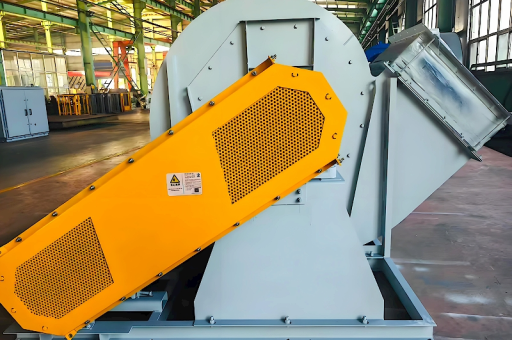
It appears you are listing specifications for a heavy-duty industrial centrifugal fan (blower). Here is a breakdown of what those terms mean, the likely application, and key engineering considerations.
Breakdown of Specifications
- HG785 Alloyed Steel:
- This refers to the material of construction (impeller, housing, shaft).
- HG785 is a high-strength, low-alloy (HSLA) structural steel (yield strength ~685 MPa / 100 ksi).
- Why it is used here: It is chosen for its high tensile strength and resistance to fatigue. In a high-temperature fan, standard carbon steel loses strength rapidly. HG785 maintains integrity better than Q235 or standard 45# steel at elevated temperatures, resisting creep and deformation.
- 8117 m³/h (8,117 cubic meters per hour):
- This is the volumetric flow rate.
- Conversion: ~4,777 CFM (Cubic Feet per Minute).
- Implication: This is a medium-to-large industrial flow rate, suitable for a single process line or a medium-sized boiler.
- High Temperature Exhaust Fan:
- This indicates the fan is designed to handle hot gases, not ambient air.
- Typical temperature ranges: 150°C to 400°C (with HG785 steel, the upper limit is often capped at ~450°C / 842°F before requiring specialized alloys like Inconel or 310S stainless).
- Centrifugal Blower:
- The mechanism: Air enters axially and is discharged radially (90-degree turn).
- Impeller type (assumed): Likely radial bladed (paddle wheel) or backward inclined. For exhaust containing particulates (dust, fume), a radial blade is common as it is rugged and self-cleaning.
Likely Application
Given the high-temperature rating and specific flow rate, this unit is typically found in:
- Industrial Ovens / Dryers: Fume extraction.
- Boiler Induced Draft (ID): Pulling hot flue gas through a boiler, economizer, or scrubber.
- Fume Exhaust Systems: For welding, chemical, or thermal treatment processes.
- Kilns / Furnaces: Air supply or off-gas handling.
Critical Engineering Factors for This Fan
If you are selecting, installing, or troubleshooting this fan, consider the following:
| Factor | Consideration for HG785 / 8117 m³/h Application |
|---|---|
| Pressure (SP) | Flow is useless without pressure. For 8117 m³/h, you need a specified Static Pressure (e.g., 2000 Pa, 4000 Pa). The motor HP/KW depends entirely on this. |
| Thermal Expansion | HG785 expands with heat. The shaft seal and housing must allow for expansion without seizing. A water-cooled bearing housing is highly recommended for inlet temps > 250°C. |
| Motor Power | A fan moving 8117 m³/h against moderate pressure (e.g., 2500 Pa) would require roughly 11-15 kW (15-20 HP) . High temp gas is less dense, so motor load may be lower at start (cold) than at running (hot). |
| Balance & Vibration | Fans made of HG785 are heavy. Dynamic balancing to ISO 1940 G6.3 or G2.5 is critical. High temp operation can warp an unbalanced wheel. |
| Cooling | The fan shaft is often exposed between the housing and the bearing. A shaft cooling fan or heat slinger is necessary to prevent heat soak into the bearings (which fail if > 80°C). |
Summary of Performance (Example Curve)
You did not provide a specific Static Pressure (SP) value. Here is a hypothetical performance table for this fan size:
| Static Pressure (Pa) | Air Volume (m³/h) | Motor Power (approx) | Impeller Speed (RPM) |
|---|---|---|---|
| 1500 Pa (6" w.g.) | 8,117 | 5 kW (10 HP) | 1450 |
| 2500 Pa (10" w.g.) | 8,117 | 11 kW (15 HP) | 1750 |
| 4000 Pa (16" w.g.) | 8,117 | 5 kW (25 HP) | 2200+ |
Immediate Recommendation
- Verify the Static Pressure required for your ductwork.
- Confirm the gas temperature (Continuous max vs. Peak surge). If > 400°C, ask for alternative material (e.g., 310S SS).
- Check the Particulate Load. If the exhaust contains sticky or abrasive dust, request a radial tipped (not backward curved) impeller.
- Inspect the Bearings. Request Shaft-mounted or Pillow block with a grease relief line and thermocouple port for monitoring.
Are you designing a system around this fan, or are you trying to repair/replace an existing unit that is vibrating or failing? Knowing that will help narrow down the specific problem.





