
This article's table of contents introduction:
- Definition & Core Function
- The Critical Design Challenge
- Key Customization Parameters (What you need to specify)
- Material Selection Strategy
- Advanced Wear & Corrosion Protection Techniques
- High-Temperature Design Features (The "Hot" Part)
- Typical Applications
- Key Advantages of Customization
- How to Proceed (Where to get one)
- Summary Table (Quick Reference)
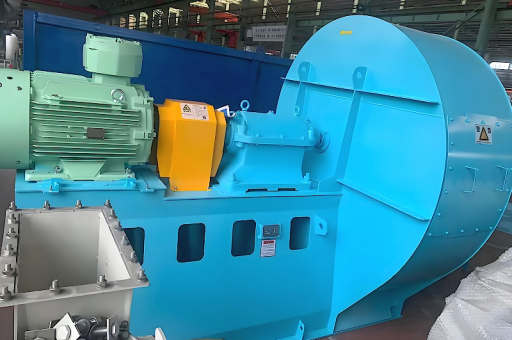
This is a highly specialized piece of industrial equipment. A "customized wear-resistant and anti-corrosion high-temperature centrifugal fan" is not a standard, off-the-shelf product. It is engineered for specific, harsh process environments (e.g., cement plants, steel mills, chemical incinerators, power plants, and waste-to-energy facilities).
Here is a comprehensive breakdown of what this product entails, its key design features, material selection, and applications.
Definition & Core Function
This fan is a centrifugal (radial) fan designed to:
- Move high-temperature gases (typically 200°C to 700°C or higher).
- Resist erosion from particulate matter (dust, fly ash, metal shavings).
- Resist chemical attack from corrosive gases (SOx, NOx, HCl, Cl₂, acidic vapors).
The Critical Design Challenge
The key challenge is that the conditions are mutually exclusive for standard materials:
- Wear resistance usually requires hardness (e.g., high-chrome cast iron, ceramic coatings).
- Anti-corrosion usually requires chemical inertness (e.g., stainless steel 316L, high-nickel alloys, rubber/plastic linings).
- High temperature eliminates most organic linings (rubber, epoxy) and reduces the strength of many metals.
A successful design must find the optimal balance for the specific gas chemistry, temperature, and particle load.
Key Customization Parameters (What you need to specify)
To design this fan, a manufacturer needs precise data:
| Parameter | Why It Matters |
|---|---|
| Gas Temperature (Max, Normal, Min) | Determines thermal expansion, material strength limits, and cooling method. |
| Gas Composition | Identifies corrosive agents (e.g., H₂S, SO₃, HF, Cl₂). Water vapor? Dew point? |
| Particulate Load (g/Nm³) | Higher load requires thicker impellers, hardened runners, or wear liners. |
| Particle Size & Composition | Fine dust erodes differently than coarse, abrasive material (e.g., silica vs. metal oxides). |
| pH of Condensate | Critical for predicting corrosion below the acid dew point. |
| Desired Static/Dynamic Pressure | Determines blade profile (backward, forward, radial) and motor power. |
| Flow Rate (m³/hr or CFM) | Standard fan sizing. |
Material Selection Strategy
This is the most crucial part of the customization. Here is a typical hierarchy:
| Zone | Temperature Range | Recommended Material / Treatment | Pros & Cons |
|---|---|---|---|
| Impeller (Rotating, High Stress) | < 250°C | Stainless Steel (SS316L / 904L) + Hardfacing (Stellite, Tungsten Carbide plasma spray on leading edges). | Good corrosion resistance; wear protection applied only where needed. |
| 250°C - 450°C | Hastelloy C-276 / Inconel 625 | Excellent for high temp + acid gases (e.g., waste incineration). Very expensive. | |
| 450°C - 700°C+ | High-Nickel Alloys (Inconel 718, Haynes 230) or Cast Alloy (e.g., 25/20 Cr-Ni, or proprietary heat-resistant steel). | For extreme heat; may need shroud cooling (air- or water-cooled shaft). | |
| < 120°C (Wet Gas) | PVDF / FRP (Fiber-Reinforced Plastic) or Rubber-Lined Steel (for extremely corrosive wet scrubbing). | Excellent corrosion; poor wear resistance. Cannot handle high temps. | |
| Casing (Housing, Stationary) | All temps | Carbon Steel with Ceramic Tile Epoxy Lining or Hard Chrome Carbide Spray. | Least expensive. Lining provides both wear and corrosion protection. |
| High Temp | Same as impeller material (e.g., SS316L, Hastelloy). | Full alloy construction is expensive but eliminates lining failure risk. | |
| Shaft | High Temp | Heat-Treated Alloy Steel (e.g., 4140) with Flinger Discs to prevent heat migration to bearings. | Bearings must be kept cool (often water-cooled or with remote mount). |
Advanced Wear & Corrosion Protection Techniques
Beyond material selection, manufacturers apply specialized coatings and designs:
- Wear Liners: Replaceable steel or ceramic plates bolted onto the casing volute (wear-prone zones). This is the #1 method for handling high dust loads.
- Hardfacing / Cladding: Welding or plasma-transferred arc (PTA) applying Stellite, Colmonoy, or tungsten carbide to the leading edges and tip surfaces of the impeller blades.
- Ceramic Coatings: Advanced thermal spray (e.g., Cr₂O₃, Al₂O₃-TiO₂) creates a very hard, chemically inert surface. Excellent for both wear and corrosion, but brittle if applied thickly. Must be matched to the expansion of the base metal.
- Anti-Wear Hardsurfacing: For extreme erosion (e.g., conveying crushed slag), the impeller can be cast from high-chrome white iron (e.g., 27% Cr iron) -- but this is brittle and only for extremely specific, shock-free applications.
- Acid Dew Point Prevention: The fan must be designed so its internal surfaces never fall below the acid dew point of the gases (e.g., keep insulation thick, use heating traces, or keep casing surface temp > 150°C).
High-Temperature Design Features (The "Hot" Part)
- Cooling System:
- Shaft Cooling: Overhung shaft with a fan wheel on the shaft (between bearing housing and impeller) to draw ambient air across the shaft.
- Water-Cooled Bearing Housing: For temps > 400°C.
- Expansion Joints: Flexible connectors (metal bellows or high-temp fabric) between fan and ductwork to handle thermal growth.
- Thermal Slot Casing: The casing is often split horizontally or vertically with a thermal slot to prevent warping during rapid heat-up/cool-down.
- Material Annealing: Impeller may be stress-relieved after welding to prevent fatigue cracking from thermal cycling.
Typical Applications
Where you would find these fans:
- Cement Plants: Kiln exhaust, raw mill fans, cooler fans (high dust, moderate temp).
- Steel Mills: Sinter plant exhaust, blast furnace gas, converter gas.
- Waste-to-Energy / Incineration: Flue gas handling after scrubbers (high temp + corrosive acids + fly ash).
- Chemical / Petrochemical: Sulfuric acid plants, nitric acid plants, chlorine gas.
- Power Plants: Boiler flue gas, FGD (Flue Gas Desulfurization) reheat fans.
- Mining & Smelting: Flash furnace off-gas, roaster off-gas.
Key Advantages of Customization
- Longer Service Life: A properly specified fan can last 3-5x longer than a generic carbon steel or SS316 fan in the same harsh application.
- Reduced "Bridging" / Fouling: Smooth, non-stick coatings (e.g., PTFE-infused ceramic) prevent dust buildup.
- Lower Maintenance: Replaceable wear liners mean you don't scrap the entire casing.
- Energy Efficiency: Despite being heavy-duty, custom impeller aerodynamics (backward curved blades) can still achieve high efficiency.
How to Proceed (Where to get one)
You cannot buy this on Amazon. You need an industrial fan manufacturer with a strong engineering department. Look for companies like:
- New York Blower (USA)
- Howden (Global)
- TLT-Turbo (Germany)
- Robinson Fans (USA)
- Zhejiang Shangfeng (China, high-end industrial)
- AirPro Fan & Blower Co. (USA, custom heavy-duty)
The next step: Provide the manufacturer with a detailed process datasheet (gas composition, temperature profile, flow rate, pressure, particulate analysis, and duty cycle). They will then propose an engineered solution.
Summary Table (Quick Reference)
| Requirement | Typical Solution |
|---|---|
| Extreme Wear (High Dust) | Ceramic tile lining, hardfaced impeller, replaceable wear liners. |
| Acid Corrosion (Wet Gas, < Dew Point) | High-nickel alloy (Hastelloy), FRP, or rubber/ceramic dual lining. |
| High Heat ( > 450°C) | Nickel superalloy impeller, water-cooled shaft, insulated casing. |
| Combined Wear + Corrosion + Heat | Inconel 625 with hardfacing, or carbon steel with high-temp ceramic coating. Most expensive. |





