
This article's table of contents introduction:
- The Core Challenge: The Operating Environment
- Critical Design Features
- Performance Parameters (Key Selection Data)
- Operational Strategy & Controls
- Comparison: Air-Cooled vs. Water-Cooled
- Summary: "Must-Have" Checklist for Procurement
- Recommendation
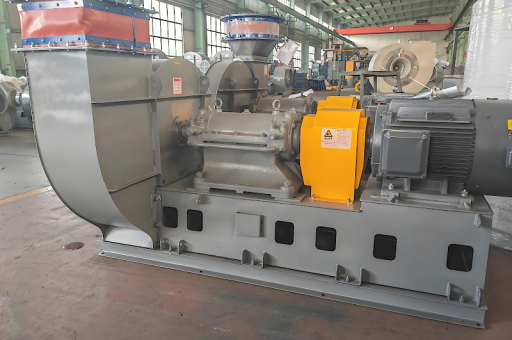
This is a highly specialized industrial application. A High Pressure Centrifugal Fan for metallurgical flue gas denitrification (DeNOx) is a critical component in the Selective Catalytic Reduction (SCR) or Selective Non-Catalytic Reduction (SNCR) systems used in steel mills, non-ferrous smelters, and coke plants.
Here is a technical breakdown of the requirements, design considerations, and selection criteria for this specific use case.
The Core Challenge: The Operating Environment
Unlike standard HVAC fans, a fan in this service must handle a hostile and variable gas stream.
- High Temperature: Flue gas temperatures can range from 180°C to 400°C (356°F to 752°F) depending on the location (before or after the economizer/heat exchanger).
- Corrosive Gases: The gas contains sulfur oxides (SO₂/SO₃), which combine with water vapor to form sulfuric acid (H₂SO₄). This leads to acid dew point corrosion.
- Abrasive Dust: Metallurgical flue gas is laden with fine, hard particulates (iron oxide, fly ash, catalyst dust from SCR).
- Variable Flow: Load changes in the furnace require the fan to operate across a wide range of flows and pressures.
Critical Design Features
A standard fan will fail rapidly. A fan designed for DeNOx service requires the following:
A. Impeller & Shaft Design
- Blade Profile: Backward-curved or Backward-inclined blades are mandatory.
- Why: They are non-overloading (motor won't burn out if duct pressure drops), self-cleaning (less dust accumulation), and offer higher efficiency for high-pressure applications.
- Material: Typically 16Mo3 (1.5415) or P265GH with high-temperature coating. For extreme corrosion, Duplex Stainless Steel (e.g., 1.4462) or Corten steel is used.
- Structural Integrity: The impeller must be stress-relieved and dynamically balanced (ISO 1940 G2.5 or G1.0) to handle thermal expansion and high rotational speeds (e.g., 1500–3000 rpm).
B. Shaft Seal & Bearing Housing
- Shaft Seal: A labyrinth seal or carbon ring seal with a purge air system is critical. This prevents hot, corrosive gas from leaking into the bearing housing, which would destroy the grease/lubricant and bearings.
- Bearing Cooling: An external cooling fan or water-cooled bearing housing is required to dissipate heat conducted down the shaft from the hot impeller.
- Vibration Monitoring: Accelerometers (vibration sensors) must be mounted on both bearing housings and wired to the control room for predictive maintenance.
C. Casing & Inlet Box
- Material: Heavy-gauge steel with abrasion-resistant liners (e.g., ceramic tiles or hard-facing plates) in the cut-off (scroll tongue) and volute areas where dust erosion is highest.
- Drainage: The casing must have condensate drain ports at the lowest point. During startup or low load, water vapor and acid can condense. If not drained, the fan will "wet bottom" and suffer rapid wall thinning.
- Access Doors: Manholes for inspection and cleaning of dust build-up.
Performance Parameters (Key Selection Data)
When specifying this fan, the following data are non-negotiable:
| Parameter | Typical Metallurgical DeNOx Range | Reason |
|---|---|---|
| Gas Volume (m³/h) | 100,000 – 1,000,000+ | Based on smelter/steel furnace capacity. |
| Static Pressure (Pa) | 6,000 – 15,000 Pa | High pressure to overcome SCR catalyst layers, heat exchangers, and ductwork. |
| Gas Temperature (°C) | 180°C – 350°C (design margin to 400°C) | SRV (Safety Release Valve) settings & final temperature. |
| Density (kg/m³) | 6 – 1.0 kg/m³ | Low density due to high temperature. |
| Dust Load (mg/Nm³) | < 50 mg/Nm³ (after ESP) but can spike to 200+ | Determines if an erosion-resistant coating is a "must-have." |
Operational Strategy & Controls
- Variable Frequency Drive (VFD): Absolutely required. Allows the fan to ramp up/down with furnace load, saving significant energy and reducing wear. A fixed-speed damper control is less efficient and causes more dust deposition.
- Anti-Surge Control: The control system must prevent the fan from operating in its "surge zone" (unstable low-flow/high-pressure region), which can cause catastrophic mechanical damage.
- Cold Start Up: The fan must not be started until the flue gas temperature is above the acid dew point (typically 120–140°C for SO₃) to prevent acid condensation on the cold metal.
Comparison: Air-Cooled vs. Water-Cooled
| Feature | Air-Cooled (External Radiator) | Water-Cooled (Jacket) |
|---|---|---|
| Typical Temp Limit | Up to 250°C | Up to 400°C+ |
| Maintenance | Lower (no water leaks) | Higher (risk of scaling, leaks, freezing) |
| Footprint | Larger (needs radiator space) | Smaller |
| Best For | Lower temp applications (e.g., coke oven gas) | High temp steel furnace flue gas |
Summary: "Must-Have" Checklist for Procurement
- Material: 16Mo3 or better for impeller; acid-resistant coating (e.g., epoxy Novolac for low-temp, or Viton/rubber lining for wet conditions).
- Bearings: SKF/FAG high-temp bearings with cooling fan and lube purge system.
- Seals: Labyrinth with compressed air purge.
- Drive: VFD-ready motor (F-class insulation minimum).
- Casing: With inspection doors, drain ports, and abrasion liners.
- Testing: Factory performance test per AMCA 210 / ISO 5801 hot air.
Recommendation
If you are selecting a fan for a metallurgical DeNOx project, prioritize manufacturers with proven experience in steel, cement, or non-ferrous industries. Do not use "standard" HVAC fans.
Next Step: To get a specific recommendation, you need to provide:
- Gas composition (SOx, NOx, dust type, moisture %).
- Operating temperature profile (min, normal, max).
- Required static pressure (Pa) and volume (m³/h) at the operating temperature.





