
This article's table of contents introduction:
- Decoding the Model Number: "5-06"
- The Impeller: Backward Blade Design
- Common Applications
- Efficiency & Performance (What to Expect)
- Typical Construction Materials
- Comparison to Other Common Series
- Actionable Next Steps / How to Use This Information
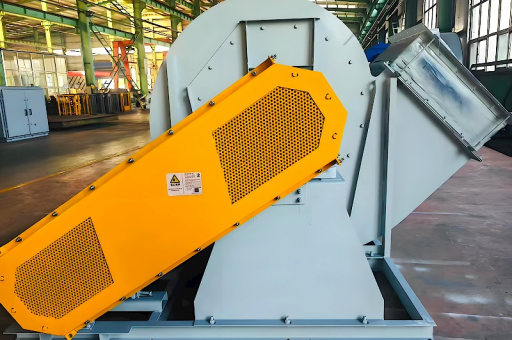
It looks like you're referencing a "5-06 Series Backward Blade High-Efficiency Centrifugal Fan Blower."
This is a specific model designation commonly found in industrial ventilation, HVAC systems, and dust extraction equipment, particularly from Chinese manufacturers or global OEMs (Original Equipment Manufacturers).
Here is a detailed breakdown of what this model designation typically means, its features, and common applications.
Decoding the Model Number: "5-06"
- The First Digit (5): This usually indicates the type of impeller and the blade angle.
- In many Chinese fan standards (like the "4-72," "9-19," or "5-06" series), "5" often refers to a Backward Inclined (BI) or Backward Curved (BC) blade design. The specific angle and shape of the blade give it different pressure and efficiency characteristics.
- The Second Digit (06): This typically indicates the pressure coefficient or the specific speed of the fan.
- A lower number (like 06) often suggests a medium-to-high pressure fan, though not as extreme as pure high-pressure series (like "9-19").
- Important Note: These designations are not universal. Some manufacturers use "5-06" for a specific blade count or a proprietary housing shape. You should always compare the exact performance curve (CFM vs. Static Pressure) from the manufacturer's datasheet.
The Impeller: Backward Blade Design
The "Backward Blade" is the most critical feature. There are two main types within this category:
- Backward Inclined (BI): Blades are flat and lean backward relative to the direction of rotation.
- Backward Curved (BC or Airfoil): Blades are curved backward, and often hollow (airfoil shape) for higher efficiency.
Key Characteristics of Backward Blade Fans:
- ✅ High Efficiency: They are generally the most aerodynamically efficient centrifugal fans (typically 75-85% static efficiency).
- ✅ Non-Overloading Power Curve: This is a major safety feature. The motor's power draw peaks at the fan's "duty point" and drops off if the system resistance decreases (e.g., a filter gets removed). This prevents the motor from burning out.
- ✅ Lower Noise: For the same airflow and pressure, they are quieter than forward-curved fans.
- ❌ Lower Airflow (at low pressure): They cannot move as much air as a forward-curved fan at very low static pressure.
- ✅ Self-Limiting: They will not "run away" (over-speed) if the system is open.
Common Applications
The 5-06 series with a backward blade is a workhorse for clean-to-moderately dusty air. It's not designed for heavy particulate, but it handles light dust better than a forward-curved fan.
- HVAC Systems: Air handling units, commercial ventilation.
- Industrial Ventilation: General factory ventilation, fume exhaust (non-corrosive, non-sticky).
- Dust Collection: As a secondary or induced draft fan in smaller systems.
- Clean Rooms: When paired with HEPA filters due to its pressure capability.
- Agricultural Ventilation: Drying systems, grain aeration.
Efficiency & Performance (What to Expect)
This series is specifically labeled "High-Efficiency." This usually implies:
- Impeller Design: The blades are likely an airfoil or optimized curved design to minimize air turbulence.
- Housing Design: The scroll (volute) is matched precisely to the impeller exit angle to recover kinetic energy as static pressure.
- Performance Range:
- Pressure: Medium to medium-high (e.g., 1500 Pa to 3500 Pa / 6" to 14" w.g.).
- Flow: Varies greatly depending on impeller diameter and RPM (e.g., 1,000 CFM to 50,000+ CFM).
Typical Construction Materials
- Impeller: Steel (often painted or galvanized), Stainless Steel (for corrosion resistance), or Aluminum (for spark resistance).
- Housing: Heavy-gauge steel with a robust baseplate for low vibration.
- Drive: Usually Belt-Driven (BD) . This allows for RPM changes to adjust airflow.
- Direct Drive (DD) is less common in this specific series.
- Bearings: Heavy-duty pillow block bearings (regreasable).
Comparison to Other Common Series
| Series | Blade Type | Pressure | Efficiency | Typical Use |
|---|---|---|---|---|
| 4-72 | Forward Curved | Low-Med | Lower (60-70%) | General ventilation, low cost |
| 5-06 | Backward Inclined | Medium-High | High (75-85%) | HVAC, Industrial, Dust (light) |
| 9-19 | Forward / Radial | Very High | Medium | Pneumatic conveying, high pressure |
| Y5-48 | Backward (Abrasion) | Medium | High | Dust exhaust (heavy/abrasive) |
Actionable Next Steps / How to Use This Information
If you are trying to specify, purchase, or maintain this fan, you need the following details that the model number alone does not specify:
- Diameter (Size): These fans come in many sizes (e.g., No. 3.55C, No. 4.5C, No. 10D). The number increases with the impeller diameter.
- RPM (Speed): The fan's RPM is critical. A 5-06 fan running at 2900 RPM will produce very different airflow than one at 1450 RPM.
- Air Density / Temperature: The fan's performance is heavily dependent on the air density (temperature and altitude). A fan moving hot air will move less mass of air at the same static pressure.
- Performance Curve: You must get the manufacturer's data sheet. Look for a graph showing CFM (or m³/h) on the X-axis and Static Pressure (Pa or in.w.g.) on the Y-axis, with RPM and Power curves.
In short: You have identified a high-quality, energy-efficient industrial fan. Your next step is to find the specific impeller diameter and the manufacturer's performance chart to ensure it matches your required airflow and static pressure.





