
This article's table of contents introduction:
- Table of Contents
- Introduction: The Need for High-Flow, Energy-Efficient Air Movement
- What is a 132kW Low-Pressure High-Flow Centrifugal Fan?
- Technical Specifications and Core Design Principles
- Key Advantages: Efficiency, Reliability, and Cost Savings
- Primary Industrial Applications
- How to Select the Right Fan for Your System
- Frequently Asked Questions (FAQ)
- Conclusion: The Future of Large-Scale Ventilation
** Maximizing Industrial Ventilation: The Complete Guide to the 132kW Low-Pressure High-Flow High-Efficiency Centrifugal Fan
Table of Contents
- Introduction: The Need for High-Flow, Energy-Efficient Air Movement
- What is a 132kW Low-Pressure High-Flow Centrifugal Fan?
- Technical Specifications and Core Design Principles
- Key Advantages: Efficiency, Reliability, and Cost Savings
- Primary Industrial Applications
- How to Select the Right Fan for Your System
- Frequently Asked Questions (FAQ)
- Conclusion: The Future of Large-Scale Ventilation
Introduction: The Need for High-Flow, Energy-Efficient Air Movement
In heavy industries such as power generation, cement production, mining, and large-scale HVAC systems, moving massive volumes of air against minimal resistance is a constant challenge. Traditional high-pressure fans often waste energy when static pressure is low but flow is high. Enter the 132kW Low-Pressure High-Flow High-Efficiency Centrifugal Fan—a specialized piece of rotating equipment engineered to deliver exceptional air volume with significantly lower energy consumption. This article provides a comprehensive technical deep dive into this fan class, examining its design, benefits, applications, and selection criteria, drawing on industry best practices and operational data.
What is a 132kW Low-Pressure High-Flow Centrifugal Fan?
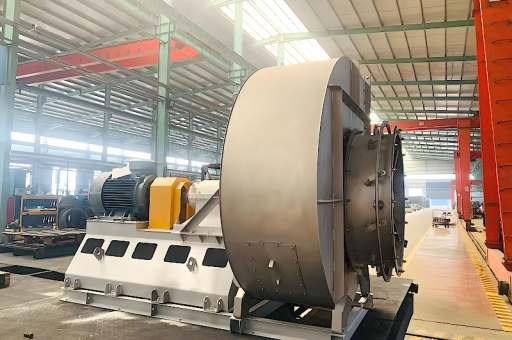
A 132kW centrifugal fan operating in a low-pressure (typically < 2,500 Pa to 5,000 Pa static pressure) yet high-flow configuration is designed for applications where resistance is low but air volume must be enormous. Unlike standard radial fans that focus on high static pressure, this fan uses a specific impeller geometry (often backward-curved or airfoil blades) to maximize volumetric flow (CMM or CFM) at a lower pressure head. The 132kW power rating provides a robust motor capable of driving large impellers often exceeding 1.5 meters in diameter. The "high-efficiency" designation typically means a peak static efficiency of 83% to 88% or higher, compliant with standards such as ISO 12759 or AMCA 205.
Technical Specifications and Core Design Principles
Understanding the engineering behind this fan type is crucial for selection and maintenance:
- Power Rating: 132 kW (approx. 177 HP).
- Flow Range: Typically 150,000 m³/h to 300,000 m³/h (depending on ductwork and density).
- Static Pressure Range: 1,500 Pa to 4,500 Pa (low-pressure differential).
- Impeller Type: Backward-curved (BC) or airfoil (AF) blades. These reduce turbulence and minimize energy loss.
- Efficiency: Over 85% in the duty point, often using Computational Fluid Dynamics (CFD) optimized designs.
- Drive Mechanism: Direct drive or V-belt drive. Direct drive offers higher efficiency and lower maintenance.
- Construction: Typically carbon steel with a heavy-duty welded enclosure; options for stainless steel or FRP for corrosive environments.
- Inlet Design: High-efficiency conical or venturi inlets to reduce inlet turbulence and improve flow uniformity.
The Core Principle: By prioritizing low pressure, the fan can spin at a moderate speed and use a larger, aerodynamically refined impeller. This reduces the tip speed relative to the flow, cutting down on frictional losses and noise while maintaining high air volume.
Key Advantages: Efficiency, Reliability, and Cost Savings
- High Efficiency (85%+): A 132kW fan operating for 8,000 hours per year at 85% efficiency vs. a standard 68% efficient fan can save over 150,000 kWh of electricity annually. This translates to thousands of dollars in operational savings.
- Lower Noise Levels: Due to lower tip speeds and optimized impeller design, low-pressure centrifugal fans produce significantly less aerodynamic noise (typically 10-15 dBA less than a comparable high-pressure fan).
- Reliability and Low Maintenance: Backward-curved impellers are less prone to dust buildup and vibration. Direct-drive models reduce belt replacement costs and downtime.
- Prolonged Motor Life: Operating within a stable, low-pressure zone reduces motor load fluctuations, preventing overheating and mechanical stress.
- Compact Footprint: Despite high flow, these fans are often more compact than axial fan arrays or multiple smaller units.
Primary Industrial Applications
The 132kW Low-Pressure High-Flow High-Efficiency Centrifugal Fan is the workhorse of many industries:
- Power Plants: Primary and secondary air supply to coal mills; forced draft (FD) fans for boilers.
- Cement Industry: Raw mill exhaust, baghouse ventilation, and cooler exhaust systems.
- Mining: Large-scale tunnel ventilation, dust collection systems, and mine dewatering exhaust.
- HVAC (Commercial & Industrial): Dedicated outdoor air systems (DOAS) for large buildings, data center hot aisle containment, and factory exhaust.
- Wastewater Treatment: Aeration blowers (though rotary lobe blowers are common, high-flow centrifugal fans are used for low-pressure diffusers).
- Flue Gas Desulfurization (FGD): Handling large volumes of corrosive gas at low pressure.
How to Select the Right Fan for Your System
Selecting a 132kW low-pressure high-flow centrifugal fan requires a systematic approach:
- Define System Resistance: Measure the total static pressure drop of your ductwork, filters, and dampers. Do not overestimate.
- Calculate Volume Required: Determine the required CMM or CFM based on process needs or ventilation standards.
- Plot the Fan Curve: Use the manufacturer's performance curves. Ensure the operating point falls within the high-efficiency zone (typically 80-90% of peak efficiency).
- Assess Air Density: Temperature and altitude affect performance. Correct for density.
- Check Drive Types: Direct drive is preferred for reliability; V-belt offers flexibility in speed adjustment.
- Material Selection: For corrosive or abrasive air, consider stainless steel, liners, or wear-resistant coatings.
- Space & Noise Constraints: Verify the fan’s physical dimensions and sound power levels meet site requirements.
Frequently Asked Questions (FAQ)
Q1: What is the difference between a low-pressure and a high-pressure centrifugal fan? A: A low-pressure fan (like this 132kW model) is designed for high volume against low system resistance (e.g., ductwork, filters). A high-pressure fan uses smaller impellers at higher speeds to overcome high resistance (e.g., pneumatic conveying). The impeller geometry differs significantly—low-pressure fans have larger, backward-curved blades.
Q2: Can a 132kW low-pressure fan be used for a high-pressure application? A: No. Using a low-pressure fan on a high-resistance system will cause it to operate at a very low flow (stall condition), leading to vibration, motor overload, and instability. Always match the fan type to the system curve.
Q3: How do I calculate the actual energy savings of a high-efficiency fan? A: The formula is: Savings (kWh) = (Air Volume x Pressure x Operating Hours) x (1/E_old - 1/E_new) / (36,000 x Motor Efficiency) . A 132kW fan at 85% efficiency can save 15% to 25% energy than a standard 68% efficient fan.
Q4: Is a 132kW fan suitable for variable air volume (VAV) systems? A: Absolutely. Modern VFD (Variable Frequency Drive) controllers allow the fan to modulate speed, maintaining efficiency at partial loads. This is highly recommended for power savings.
Q5: What maintenance does a low-pressure high-flow fan require? A: Regular inspections for blade wear, bearing lubrication, and vibration analysis. Clean impellers quarterly in dusty environments. Check belt tension (if V-belt) monthly.
Q6: Where can I buy a genuine 132kW low-pressure centrifugal fan? A: You can find reliable OEM suppliers and reputable distributors through specialized industrial directories, trade shows (like AHR Expo, Hannover Messe), or direct inquiries to manufacturers of industrial ventilation equipment. Visit fan to explore reliable manufacturers.
Q7: What is the average lifespan of this fan? A: With proper operation and maintenance (including vibration monitoring), a well-built 132kW centrifugal fan can last 15-25 years in continuous service.
Q8: How does air density at high altitudes affect performance? A: Lower air density at altitude reduces both the volumetric capacity and the static pressure capability. You often need a fan with a larger impeller or higher speed to compensate. Always consult the manufacturer’s altitude correction factors.
Conclusion: The Future of Large-Scale Ventilation
The 132kW Low-Pressure High-Flow High-Efficiency Centrifugal Fan represents a crucial evolution in industrial air movement technology. It directly addresses the global imperative for energy conservation, offering substantial operational cost savings and enhanced reliability compared to older, inefficient fan designs. For plant engineers, facility managers, and system designers, this fan provides a proven solution for demanding applications requiring enormous volumes with minimal energy penalty. Investing in a high-efficiency, low-pressure centrifugal fan is not merely a cost decision—it is a strategic asset for sustainability, noise reduction, and long-term process stability. As energy prices rise and environmental regulations tighten, this fan class will become even more central to industrial ventilation strategy. To discuss a solution tailored to your specific air volume and static pressure requirements, contact leading manufacturers via fan.





