
This article's table of contents introduction:
- What is it?
- Core Design Principles & Key Components
- Applications (Where you find them)
- Key Advantages over Standard Fans
- Selection & Specification Considerations
- Example of a Common Configuration
- Summary
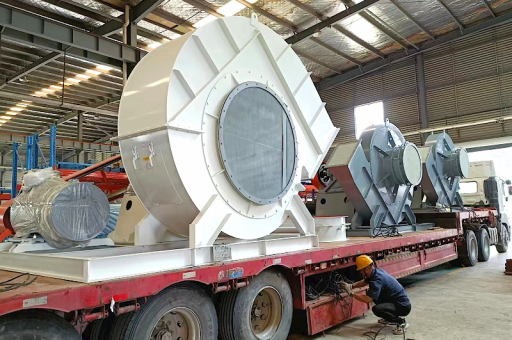
This is a specialized industrial fan designed for demanding environments. Here is a comprehensive breakdown of what a High Temperature and High Flow Wear-Resistant Centrifugal Fan is, its key components, applications, and why it differs from a standard fan.
What is it?
It is a centrifugal fan (also known as a blower) engineered to handle three critical challenges simultaneously:
- High Temperature: Moving gases that are significantly hotter than ambient (e.g., 200°C to 700°C+).
- High Flow Rate: Moving a very large volume of gas against a moderate to high system resistance (pressure).
- Wear Resistance: Withstanding erosion and particle impact from abrasive dust, ash, or granular materials carried in the gas stream.
Core Design Principles & Key Components
Standard fans would fail quickly under these conditions. This specialized fan uses specific materials and design features:
Casing (Housing)
- Material: Heavy-gauge steel or alloy steel (e.g., Corten, 16Mn). For extreme temperatures, stainless steel or Inconel may be used.
- Design: Typically a scroll or volute shape to efficiently convert kinetic energy into pressure. The casing is often thicker than standard to resist wear and vibration.
- Cooling: May include a cooling air jacket or insulation layer to protect the bearing housing and structural supports from radiant heat.
Impeller (The Rotating Wheel)
- Material: High-strength alloys (e.g., 16Mn, 304/316 Stainless Steel, or Hastelloy for extreme corrosion and heat). For wear resistance, blades are often made from abrasion-resistant steel (e.g., NM400, NM500).
- Blade Type:
- Backward-Curved (Backward-Inclined): Most common. More efficient, self-cleaning, and quieter than forward-curved. Better for handling particulate-laden air.
- Radial Blades (Straight or Paddle): Best for very heavy dust loads and high temperatures, but less efficient. They are self-cleaning and robust.
- Airfoil Blades: High efficiency but prone to dust build-up and wear if not specifically treated.
- Reinforcement: Blades and backing plate are heavily reinforced with gussets and thicker sections to withstand centrifugal stress at high temperatures and speeds.
Wear Protection (Crucial Feature)
- Wear Liners: Replaceable ceramic tiles (alumina or zirconia) or hard-faced steel plates are bolted or welded to the inside of the casing and on the inlet cone (spiral housing) where impact is highest.
- Hardfacing (Weld overlay): Applying a layer of tungsten carbide or chromium carbide weld overlay to the leading edges of impeller blades and the cut-off (volute tongue) to resist erosion.
- Surface Treatments: Thermal spray coatings (e.g., HVOF - High-Velocity Oxy-Fuel) of ceramic or carbide materials.
Shaft and Bearings
- Material: High-strength alloy steel (e.g., 40Cr, 42CrMo). The shaft is often larger diameter to handle higher loads and reduce deflection.
- Bearing Housing: Water-cooled bearing housings are essential for high-temperature fans. A circulating water jacket keeps the bearings at a safe operating temperature.
- Bearing Type: Heavy-duty spherical roller bearings designed for high radial and axial loads.
Drive System
- Typically motor-driven via V-belts or a direct drive with a flexible coupling.
- V-belt drives allow for speed adjustment (changing flow/pressure) and isolate the motor from heat.
Applications (Where you find them)
This fan is a workhorse in heavy industries:
- Cement Industry: Kiln exhaust, raw mill exhaust, clinker cooler fans. Carrying hot, abrasive dust.
- Steel & Iron: Sinter plant fans, blast furnace gas fans, converter exhaust.
- Power Generation: Induced Draft (ID) fans for coal-fired boilers. These move hot flue gas loaded with fly ash.
- Mining & Minerals: Dryers, roasters, and calciners.
- Chemical Industry: Fluidized bed reactors, dryers, and incinerators.
- Waste Incineration: Forced draft and induced draft fans handling hot, acidic, and abrasive combustion gases.
- Glass Manufacturing: Tank furnace exhaust.
Key Advantages over Standard Fans
| Feature | Standard Fan | High-Temp/High-Flow/Wear-Resistant Fan |
|---|---|---|
| Temperature | Max ~80-100°C | 200°C to 700°C+ (with special alloys/cooling) |
| Flow Capacity | Moderate | Very High (100,000 m³/h or more) |
| Wear Life | Short (weeks/months) | Long (years with proper liners) |
| Maintenance | Frequent blade replacement | Periodic liner replacement; longer intervals |
| Cost | Low | High (materials, engineering, cooling) |
| Safety | Lower thermal fatigue risk | Higher risk of heat-related failure (bearing seizure, shaft creep) |
Selection & Specification Considerations
When specifying this fan:
- Operating Temperature: Max temperature and temperature fluctuations (thermal shock).
- Gas Composition: Abrasiveness (particle size, hardness, concentration), corrosiveness (acids, sulfides).
- Flow Rate (m³/h or CFM): At actual inlet conditions (not standard).
- Static Pressure (Pa or inwg): The resistance the fan must overcome.
- Dust Load (g/m³ or grains/ft³): Critical for impeller design and liner thickness.
- Motor Power (kW/HP): Based on the fan's brake horsepower plus a safety margin (usually 10-15%).
- Cooling Method: Water-cooled bearings, air-cooled shaft, or insulated housing.
Example of a Common Configuration
A typical Induced Draft (ID) Fan for a coal-fired power plant boiler:
- Type: Single or double inlet, backward-curved impeller.
- Material: Corten steel casing, 16Mn impeller with welded or bolted wear-resistant liners on the inlet cone and cut-off.
- Wear Protection: Chrome carbide hardfacing on blade leading edges.
- Bearing Cooling: Water-cooled bearing pedestal.
- Temperature: 140°C to 180°C continuous, with excursions to 250°C.
- Flow: 500,000 m³/h.
Summary
A High Temperature and High Flow Wear-Resistant Centrifugal Fan is not a simple "off-the-shelf" product. It is a bespoke, heavy-duty engineered solution for the most punishing industrial gas handling applications. Its value lies in its longevity and reliability in environments where standard fans fail quickly, preventing costly unplanned downtime. The primary costs are upfront, but the return on investment comes from reduced maintenance and extended operational life.





