
This article's table of contents introduction:
- What Makes it "High-Temperature" & "Centrifugal"?
- Core Energy-Saving Technologies
- Critical Material & Construction Differences
- Common "Energy-Saving" Configurations
- Key Selection Criteria (For Engineers)
- Example Product & Specification (Representative)
- Summary for a Quick Quote
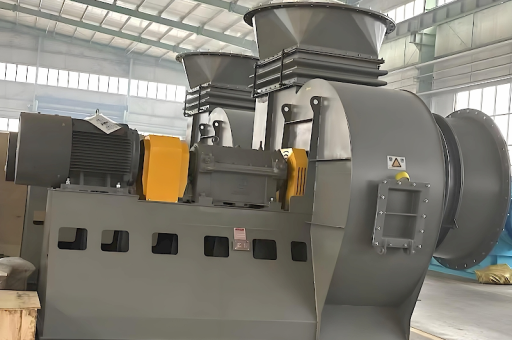
Your request for an "Energy-Saving High-Temperature Industrial Centrifugal Fan" targets a specific niche in industrial HVAC and process equipment. These fans are critical in industries like cement, steel, glass, power generation, and chemical processing, where moving flue gas, hot air, or combustion gases is necessary but represents a major energy cost.
Here is a comprehensive breakdown of what defines this type of fan, the key technologies that make it "energy-saving," and how to select one.
What Makes it "High-Temperature" & "Centrifugal"?
- Temperature Range: "High-temperature" typically means operating continuously at 200°C (392°F) to 600°C (1112°F) , with some specialized models handling up to 1000°C for short periods.
- Centrifugal Design: Unlike axial fans (like a desk fan), centrifugal fans use a rotating impeller to accelerate air outward. They are ideal for high-pressure, high-volume applications against duct resistance.
- Why Centrifugal for High-Temp? The design naturally isolates the motor from the hot gas stream (via a shaft and bearing housing), allowing the motor to run at ambient temperature.
Core Energy-Saving Technologies
Energy savings in these fans come from aerodynamic design, motor efficiency, and system control.
| Technology | How it Saves Energy | Typical Improvement |
|---|---|---|
| Backward-Curved (BC) Impeller | Most efficient fan type. Air leaves the impeller at a lower velocity than forward-curved, reducing turbulence and friction losses. | 10-20% more efficient than forward-curved or radial paddle wheels. |
| High-Efficiency Motor (IE4/IE5) | Using a Permanent Magnet Synchronous Motor (PMSM) or Synchronous Reluctance Motor. These have near-zero slip and lower heat losses. | 2-5% more efficient than standard IE3 induction motors. |
| Variable Frequency Drive (VFD) | The single biggest energy saver. Instead of throttling dampers (wasting energy), a VFD reduces fan speed. Fan power is proportional to the cube of the speed. | 50-70% energy savings at 50% flow. (Fan Affinity Laws) |
| Aerodynamic Inlet Design | Smooth, streamlined inlets (often with a bell-mouth) reduce turbulence and inlet losses before air hits the impeller. | 3-7% improvement in static efficiency. |
| Lightweight, High-Strength Materials | Using aluminum alloys or advanced composites for the impeller reduces moment of inertia, requiring less energy to accelerate. | 2-5% improvement during variable speed operation. |
Critical Material & Construction Differences
Standard fans fail quickly at high temperatures. This fan's construction is non-negotiable:
- Impeller:
- < 250°C: High-strength aluminum alloy or carbon steel.
- 250-500°C: Stainless steel (e.g., SS 310/316) or Corten steel for corrosion resistance.
- > 500°C: High-nickel alloys (Inconel, Hastelloy) or ceramic coatings.
- Shaft: Usually alloy steel (e.g., 4140) to maintain strength at elevated temperatures. An oversized shaft reduces flexing that leads to fatigue.
- Bearings: Remounted in a water-cooled bearing housing or heat-dissipating flange. Must be specified for higher temperature operation (e.g., with higher clearance and special high-temp grease).
- Cooling Systems:
- Shaft Cooling Fan: A small fan on the motor side to blow ambient air over the shaft.
- Water Jacket: Circulating water around the bearing housing.
- Inlet Box Cooling: Ambient air is mixed with the hot gas stream to reduce inlet temperature (slightly less efficient but protects the fan).
- Expansion Joints: The housing must include bellows or sliding joints to accommodate thermal expansion without binding the impeller.
Common "Energy-Saving" Configurations
- Plug Fan (Plenum Fan): A backward-curved impeller mounted in a simply box. Very compact, low leakage, and ideal for high-efficiency filtration systems (e.g., in waste-to-energy plants).
- Industrial Exhauster: A heavy-duty, radial-blade (paddle wheel) design. Less efficient (70-75%) but incredibly robust for dirty, sticky, or abrasive gases (e.g., in cement kilns).
- High-Efficiency Backward Inclined (BI): The most common energy-saving type for clean to slightly dirty air. Efficiency up to 85-90%. Used in boiler ID fans and regenerative thermal oxidizers.
Key Selection Criteria (For Engineers)
When specifying this fan, you must provide:
- Operating Temperature (°F/°C): Peak temperature, not average.
- Gas Composition: Is it clean, dirty, corrosive, or abrasive? (This dictates impeller type and material).
- Volume Flow (CFM or m³/h): Required at actual operating conditions (not standard conditions).
- Static Pressure (ins w.g. or Pa): Total system resistance.
- Density Correction: Fan performance charts are based on standard air. Hot air is less dense, requiring more volume (ACFM) to move the same mass of gas. A 400°C gas has roughly half the density of ambient air.
- Altitude: Further affects air density.
Example Product & Specification (Representative)
Model: eTurbofan or Soler & Palau HT-BC Series
- Type: Backward Curved Centrifugal with Airfoil Blades
- Max Temperature: 450°C continuous (with water-cooled shaft cooling)
- Efficiency: Up to 87% static efficiency
- Drive: Direct drive with IE4 PMSM motor and integrated VFD
- Material: SS304 housing, SS316 impeller with ceramic coating.
- Accessories: Inlet box silencer, expansion joint, high-temp isolation damper.
Summary for a Quick Quote
If you are looking to purchase this fan, you would typically send a request like this:
"I need a Backward Inclined (BI), direct-drive centrifugal fan for a regenerative thermal oxidizer (RTO) . It must handle 250°C continuously, with a volume of 50,000 CFM at 25 in w.g. static pressure. It should be equipped with a IE5 PMSM motor and integrated VFD for energy savings. The impeller should be SS316, the housing Corten steel, and the bearings must have a water-cooling jacket."
Recommendation: For specific energy-saving targets, you should ask manufacturers for "Performance Curves with VFD" and "Lifecycle Cost Analysis (LCCA)" for your specific flow profile. The initial price may be 20% higher, but the payback is often under 18 months due to the cube law savings of VFD control.





