
This article's table of contents introduction:
- Core Concept & Application
- Key Components & Design Features (Carbon Steel)
- Why Carbon Steel for High Temperature?
- Performance & Specifications
- Common Industrial Applications
- Advantages & Disadvantages
- Maintenance & Safety Considerations
- How to Choose / Specification Example
- Suppliers & Manufacturers (Examples)
- Summary Table: Material vs. Temperature for Centrifugal Fan Impellers
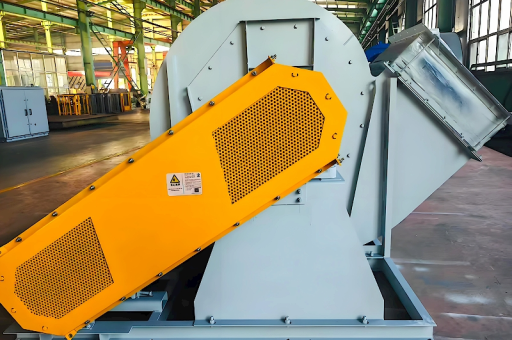
Here is a comprehensive overview of Industrial High Temperature Centrifugal Fans constructed from Carbon Steel for Air Supply.
These fans are critical pieces of equipment in various industries, designed to move large volumes of air or gas at elevated temperatures while withstanding thermal and mechanical stress.
Core Concept & Application
An Industrial High Temperature Centrifugal Fan uses a rotating impeller to increase the velocity of air, creating pressure to move it through ductwork. The "high temperature" designation means it's engineered to handle process air or gases significantly hotter than ambient (typically 200°C to 700°C or more). The "Carbon Steel" construction refers to the primary material used for the fan housing and impeller.
Key Components & Design Features (Carbon Steel)
To handle high temperatures, these fans incorporate specific design features that differentiate them from standard fans:
- Housing (Volute/Casing): Made from thick-gauge Carbon Steel (e.g., ASTM A36, Q235, or similar). The thickness is crucial to maintain structural integrity as the steel loses strength at elevated temperatures. Often includes internal bracing.
- Impeller (Wheel): The heart of the fan.
- Material: High-temperature-grade carbon steel (e.g., Q345R, A516 Gr70) or wear-resistant alloys.
- Blade Design:
- Backward-Inclined (BI) or Airfoil: Most common for high-efficiency air supply. They are non-overloading and handle clean to slightly dusty air.
- Radial (R) or Radial-Tip (RT): Used for highly abrasive or sticky materials (e.g., in cement plants or boiler exhaust). Less efficient but more robust.
- Construction: Often welded with stress-relieved joints. The blade-to-backplate weld is critical.
- Shaft: Typically high-strength carbon steel (e.g., 1045 or 4140). Must be oversized (larger diameter) to withstand thermal expansion and prevent sagging at high operating temperatures.
- Bearings:
- External (Outboard): Bearings are located outside the fan housing, often on a separate bearing pedestal or pillow block. This keeps them cool and away from hot gases.
- Cooling: May use a spacer between the housing and bearing or a cooling disc (a metal disc on the shaft that radiates heat).
- Housings: Cast iron or ductile iron, with grease fittings for high-temperature grease.
- Shaft Seal: Prevents hot air leakage where the shaft passes through the housing. Materials like graphite packing or Teflon are used.
- Drive System:
- Belt Drive (most common): Allows for speed adjustment (variable air flow). Belts are standard, and bearings are isolated from heat.
- Direct Drive (less common): Motor is coupled directly. Requires a high-temperature motor or a cooling shaft.
Why Carbon Steel for High Temperature?
While stainless steel (e.g., 304, 310) is often used for corrosive or very high-temperature (>500°C) applications, carbon steel is chosen because:
- Cost-Effectiveness: Significantly cheaper than stainless steel.
- Strength at Moderate Temperatures: Carbon steel maintains adequate tensile strength up to ~350-400°C. Above this, it loses strength rapidly (creep).
- Weldability: Easier to fabricate and repair.
- Availability: Widely available.
Limitation: Carbon steel will oxidize (scale/rust) more quickly at elevated temperatures, especially if moisture or corrosive gases are present. For clean, dry hot air, it's perfectly adequate.
Performance & Specifications
When specifying or selecting this fan, you need to know:
- Airflow (CFM / m³/hr): Volume of air to be moved.
- Static Pressure (in. wg / Pa): Resistance the fan must overcome in the system.
- Temperature (Max & Continuous): This determines material selection and cooling requirements.
- Gas Composition: Is it clean air, or does it contain dust, moisture, or corrosive fumes?
- Altitude: Affects air density and motor power.
Common Industrial Applications
- Furnace & Oven Ventilation: Supplying combustion air to industrial furnaces, heat treatment ovens, or kilns.
- Boiler Draft Systems: Forced Draft (FD) Fans supply air for combustion in boilers (power plants, refineries). Induced Draft (ID) Fans exhaust hot flue gases.
- Dryers & Ovens: Conveyor dryers, spray dryers, and baking ovens in food, textile, and chemical industries.
- Cement & Lime Kilns: Supplying air for combustion and cooling.
- Waste Incineration: Supplying air to incinerators.
- Glass Manufacturing: Annealing lehrs and furnace venting.
Advantages & Disadvantages
| Advantage | Disadvantage |
|---|---|
| Cost-Effective (vs. stainless steel) | Limited Temperature Max (~400-450°C for continuous use) |
| High Strength & Durability | Susceptible to Scaling/Oxidation at high temp |
| Easy to Weld & Fabricate | Requires Proper Cooling for bearings/drive |
| Widely Available | Heavier than some alternative materials (e.g., aluminum) |
| Good for Clean, Dry Hot Air | Not suitable for corrosive or wet environments |
Maintenance & Safety Considerations
- Thermal Expansion: The fan housing and ductwork must have expansion joints or bellows to accommodate expansion/contraction. The shaft must be designed with axial and radial float.
- Bearing Cooling: Ensure cooling discs or shaft spacers are in place. Monitor bearing temperatures. High-temperature grease will break down over time.
- Vibration Monitoring: Critical. High temperature can warp the impeller. Vibration sensors can detect imbalance early.
- Material Degradation: Inspect for scale, pitting, or cracking on the impeller and casing walls, especially near the shaft seal.
- Lockout/Tagout (LOTO): Crucial. Never work on a hot fan. The casing and impeller can cause severe burns.
- Drive Belt Tension: High temperature can cause belts to stretch or degrade faster.
How to Choose / Specification Example
| Parameter | Specification |
|---|---|
| Fan Type | Centrifugal, Backward-Inclined, Single Inlet |
| Application | Forced Draft for Industrial Boiler |
| Airflow | 50,000 CFM |
| Static Pressure | 20 in. wg (5000 Pa) |
| Temperature | 350°C (662°F) Continuous |
| Material | Housing: Carbon Steel (A36), Impeller: Carbon Steel (Q345R) |
| Drive | Belt Drive, V-Belt |
| Bearing | Double Row, Spherical Roller, External (Outboard) |
| Shaft Seal | Graphite Packing with Lantern Ring |
| Motor | 200 HP, 1800 RPM, TEFC |
| Cooling | Shaft Cooling Disc |
Suppliers & Manufacturers (Examples)
- Greenheck (USA)
- New York Blower (USA)
- Cincinnati Fan (USA)
- Twin City Fan (USA)
- Howden (Global)
- Robinson Fans (USA)
- Many Chinese Manufacturers (e.g., Zibo, Shandong - often very cost-effective for standard carbon steel models)
Summary Table: Material vs. Temperature for Centrifugal Fan Impellers
| Material | Max Continuous Temp (Approx.) | Cost | Corrosion Resistance | Primary Application |
|---|---|---|---|---|
| Carbon Steel (e.g., A36) | 350°C (660°F) | Low | Poor | Clean hot air, moderate temp |
| High-Temp Carbon Steel (e.g., Q345R) | 450°C (840°F) | Medium | Fair | Boilers, ovens, dryers |
| Stainless Steel (304) | 650°C (1200°F) | Medium-High | Good | Food, chemical, corrosive gases |
| Stainless Steel (310) | 1000°C (1830°F) | High | Excellent | Extreme heat, incinerators |
Final Recommendation for "Carbon Steel Air Supply": If your application involves clean, dry air under 400°C, a carbon steel fan is the most economical and robust choice. Ensure the fan is properly specified with external bearings, cooling provisions, and a stress-relieved impeller to handle the thermal load. Always consult the manufacturer's data for maximum allowable temperature for the specific carbon steel grade used.





