
This article's table of contents introduction:
- The Role of Q235 Steel (Material Properties)
- "Energy Saving" (Efficiency Features)
- Heat Dissipation Application (Operating Conditions)
- Common Model Types (Search Terms)
- Selection Checklist (Critical Parameters)
- Summary for Your Application
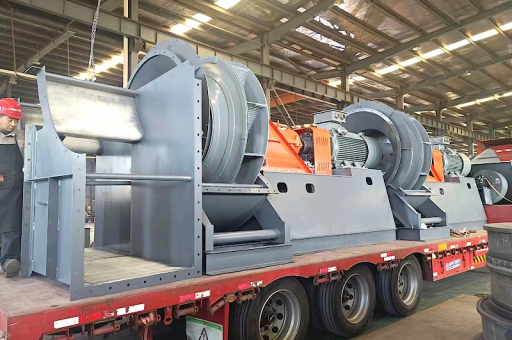
Based on your query, it appears you are looking for information regarding Q235 steel used in the construction of energy-saving industrial centrifugal fans specifically for heat dissipation applications.
Here is a detailed breakdown of how these components work together, along with considerations for selection and performance.
The Role of Q235 Steel (Material Properties)
Q235 is a standard carbon structural steel (equivalent to ASTM A36 or S235JR). In this context, it is the most common material for the fan housing, impeller (wheel), and base.
- Why Q235 is used: It offers high weldability, good strength-to-weight ratio, and low cost. For heat dissipation applications (which typically involve moving hot air or exhaust gases), it is suitable for temperatures up to 350°C - 400°C (662°F - 752°F).
- Limitation: For temperatures exceeding 400°C (e.g., boiler exhaust, furnace venting), Q235 will begin to lose structural integrity (blue brittleness). In those cases, you must upgrade to Q345R (boiler plate) or Stainless Steel (304/316) .
"Energy Saving" (Efficiency Features)
In modern industrial fans, energy saving is achieved through aerodynamic design and motor efficiency, not just the material.
- Backward Curved Blades: Most energy-saving centrifugal fans use Backward Inclined (BI) or Backward Curved (BC) blades. These are more efficient than forward-curved blades (which are quieter but less efficient).
- High-Efficiency Motors: The fan is typically paired with an IE3 (Premium Efficiency) or IE4 (Super Premium Efficiency) motor. In some cases, a permanent magnet synchronous motor (PMSM) is used for direct drive, eliminating belt losses.
- Variable Speed Control (VFD): To truly save energy, the fan should be controlled by a Variable Frequency Drive. This allows the fan speed to match the exact cooling demand, rather than running at full speed and using dampers (which waste energy).
Heat Dissipation Application (Operating Conditions)
"Heat dissipation" usually means:
- Exhausting hot air from ovens, furnaces, kilns, or industrial processes.
- Cooling electronics or machinery (forced draft).
- Ventilation in high-temperature environments (foundries, heat treatment plants).
Key Design Considerations for Heat:
- Shaft Seal: A cooling fan or a heat slinger is often mounted on the drive shaft between the fan housing and the bearing to prevent heat from traveling down the shaft and melting bearing grease.
- Bearing Cooling: For air temperatures >120°C, the bearing housing may require a water-cooling jacket or a remote mounting with a long shaft.
- Expansion: Q235 expands when hot. The fan housing design must allow for thermal expansion (e.g., sliding feet on the base) to prevent warping or bearing misalignment.
Common Model Types (Search Terms)
When sourcing a Q235 Energy Saving Industrial Centrifugal Fan for Heat Dissipation, you often look for these models:
- 9-19 Series: High pressure, low volume. Used for pneumatic conveying or high-resistance heat systems.
- 9-26 Series: High pressure, medium volume. Good for long duct runs with hot air.
- 4-72 / 4-79 Series: Medium pressure, high volume. Most common for general ventilation and heat exhaust.
- Y5-47 / Y5-48 Series: Specifically designed for induced draft in boilers (handling flue gas up to 250°C).
Selection Checklist (Critical Parameters)
To ensure the fan works correctly for heat dissipation, do not just specify "Q235 heat dissipation fan." Specify these:
- Airflow (m³/h or CFM): How much hot air needs to be moved?
- Static Pressure (Pa or inches WG): What is the resistance of the ducts, filters, and heat exchangers?
- Temperature (°C): This is critical. If >200°C, you need a thermal expansion joint and possibly a cooling wheel on the shaft.
- Medium: Is it just hot air, or does it contain dust, corrosive gases, or humidity?
- Drive Type:
- Direct Drive (Coupling): Best for efficiency and high RPM.
- Belt Drive: Best for adjusting speed easily (turning pulleys) or isolating the motor from extreme heat.
Summary for Your Application
If you are buying a Q235 Energy Saving Centrifugal Fan for Heat Dissipation:
- It is a good choice for moving hot air up to 350°C.
- Ensure it has backward curved blades and a VFD-ready IE3 motor for energy savings.
- Insist on thermal protection for the bearings (heat slinger or water cooling if temp > 150°C).
- Do not use Q235 if the gas temperature is consistently above 400°C or if the air is corrosive.
Would you like help calculating the required fan power (kW) based on a specific temperature and airflow, or do you need a recommendation for a specific motor brand for high-temperature duty?





